• HOME
  • NEWS
  • EXPLORE
    • CAREER
      • Companies
      • Jobs
    • EVENTS
    • iGEM
      • News
      • Team
    • PHOTOS
    • VIDEO
    • WIKI
  • BLOG
  • COMMUNITY
    • FACEBOOK
    • INSTAGRAM
    • TWITTER
Friday, April 3, 2026
BIOENGINEER.ORG
No Result
View All Result
  • Login
  • HOME
  • NEWS
  • EXPLORE
    • CAREER
      • Companies
      • Jobs
        • Lecturer
        • PhD Studentship
        • Postdoc
        • Research Assistant
    • EVENTS
    • iGEM
      • News
      • Team
    • PHOTOS
    • VIDEO
    • WIKI
  • BLOG
  • COMMUNITY
    • FACEBOOK
    • INSTAGRAM
    • TWITTER
  • HOME
  • NEWS
  • EXPLORE
    • CAREER
      • Companies
      • Jobs
        • Lecturer
        • PhD Studentship
        • Postdoc
        • Research Assistant
    • EVENTS
    • iGEM
      • News
      • Team
    • PHOTOS
    • VIDEO
    • WIKI
  • BLOG
  • COMMUNITY
    • FACEBOOK
    • INSTAGRAM
    • TWITTER
No Result
View All Result
Bioengineer.org
No Result
View All Result
Home NEWS Science News Biology

Scientists find missing factor in gene activation

Bioengineer by Bioengineer
May 14, 2018
in Biology
Reading Time: 2 mins read
0
Share on FacebookShare on TwitterShare on LinkedinShare on RedditShare on Telegram
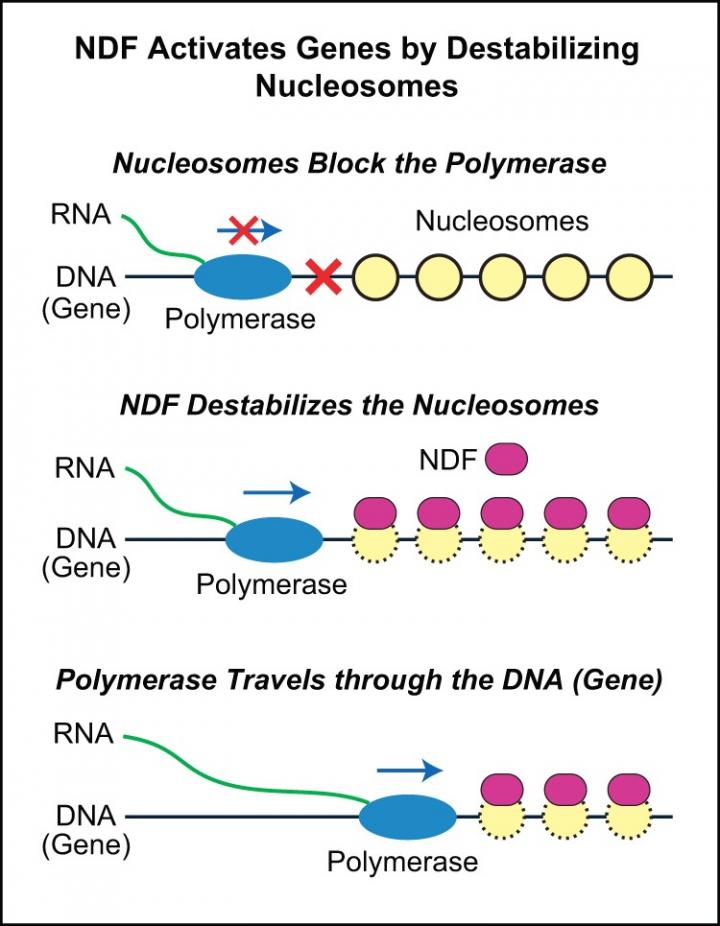
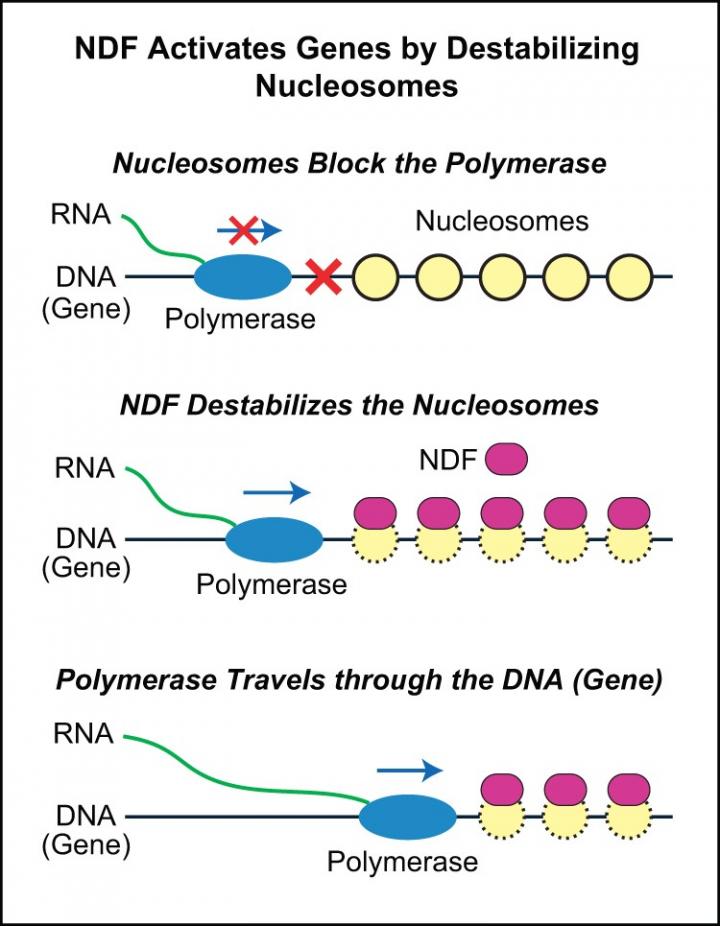
IMAGE

Credit: Kadonaga Lab, UC San Diego

Until human genes are activated, they are blocked by structures known as nucleosomes, components that serve to package DNA inside cells.

For the past several decades, scientists have been trying to determine how these nucleosome roadblocks clear out to allow genes to be turned on. Now, a team of scientists led by postdoctoral researcher Jia Fei in James Kadonaga's lab at the University of California San Diego has identified a key factor that partially unravels nucleosomes and clears the way for genes to activate.

The identification of "NDF," or nucleosome destabilizing factor, is described May 14 in the journal Genes & Development. The researchers say the finding provides a new perspective on how genes are turned on and off–knowledge useful in the study of human diseases such as cancer, which can be caused by improper gene activity.

"It's a special privilege to discover a new activity in the regulation of our genes," said Kadonaga, adding that the breakthrough came as a result of Fei's interest in factors that might disassemble or destabilize nucleosomes. "This novel approach led to the identification of NDF as a nucleosome destabilizing factor."

Genes are special functional segments in our DNA, which is a long molecular chain of genetic instructions. When genes are turned on, an enzyme named RNA polymerase travels along the DNA and makes a working copy (RNA) of the DNA. Here, nucleosomes, which look like beads on the DNA chain, pose a problem as they block the passage of the polymerase. This led to the question: How is the polymerase able to travel through nucleosomes?

The answer emerged with the identification of NDF, which destabilizes nucleosomes and enables the progression of the polymerase. The researchers say NDF's makeup suggests that it is broadly used in perhaps all human cells and may play a role in disease.

"NDF is present at abnormally high levels in breast cancer cells, and the overproduction of NDF might be partly responsible for the uncontrolled growth of these cells," said Kadonaga, Distinguished Professor of Molecular Biology and the Amylin Endowed Chair in Lifesciences Education and Research. "Thus, the identification of NDF resolves an old mystery and reveals a new factor that may have an important role in many aspects of human biology."

Kadonaga said the research was a collaborative effort with UC San Diego colleagues Bing Ren and Christopher Glass, "and exemplifies the friendly, collegial and interactive nature of our campus."

###

Other coauthors include Haruhiko Ishii and Franz Meitinger of the Ludwig Institute for Cancer Research; and Marten Hoeksema and George Kassavetis of UC San Diego.

The Ludwig Institute for Cancer Research, the National Institutes of Health's (NIH) National Institute of Diabetes and Digestive and Kidney Diseases (DK091183), the Foundation Le Ducq and the NIH's National Institute of General Medical Sciences (R35 GM118060) supported the research.

Media Contact

Mario Aguilera
[email protected]
858-822-5148
@UCSanDiego

http://www.ucsd.edu
Share12Tweet8Share2ShareShareShare2

Related Posts

Brain Power May Hold the Key to Predicting Cognitive Decline

Brain Power May Hold the Key to Predicting Cognitive Decline

April 2, 2026
Insights into CD4+ T-Cell Depletion and Pulmonary Infections in Critically Ill Immunocompromised Patients

Insights into CD4+ T-Cell Depletion and Pulmonary Infections in Critically Ill Immunocompromised Patients

April 2, 2026

Advanced Sensors Reduce Costs in Genetic Disorder Research

April 2, 2026

Advancing Blood Purification: Innovations Beyond Traditional Dialysis

April 2, 2026
Please login to join discussion

POPULAR NEWS

  • blank

    Revolutionary AI Model Enhances Precision in Detecting Food Contamination

    96 shares
    Share 38 Tweet 24
  • Imagine a Social Media Feed That Challenges Your Views Instead of Reinforcing Them

    1007 shares
    Share 398 Tweet 249
  • Promising Outcomes from First Clinical Trials of Gene Regulation in Epilepsy

    51 shares
    Share 20 Tweet 13
  • Popular Anti-Aging Compound Linked to Damage in Corpus Callosum, Study Finds

    44 shares
    Share 18 Tweet 11

About

BIOENGINEER.ORG

We bring you the latest biotechnology news from best research centers and universities around the world. Check our website.

Follow us

Recent News

Biomarker Analysis Tracks AZD2811 in SCLC Trial

Health Promotion Boosts Leisure in 80+ Elderly

Nutrient and Heavy Metal Analysis of Nigerian Infant Formula

Subscribe to Blog via Email

Enter your email address to subscribe to this blog and receive notifications of new posts by email.

Join 78 other subscribers
  • Contact Us

Bioengineer.org © Copyright 2023 All Rights Reserved.

Welcome Back!

Login to your account below

Forgotten Password?

Retrieve your password

Please enter your username or email address to reset your password.

Log In
No Result
View All Result
  • Homepages
    • Home Page 1
    • Home Page 2
  • News
  • National
  • Business
  • Health
  • Lifestyle
  • Science

Bioengineer.org © Copyright 2023 All Rights Reserved.