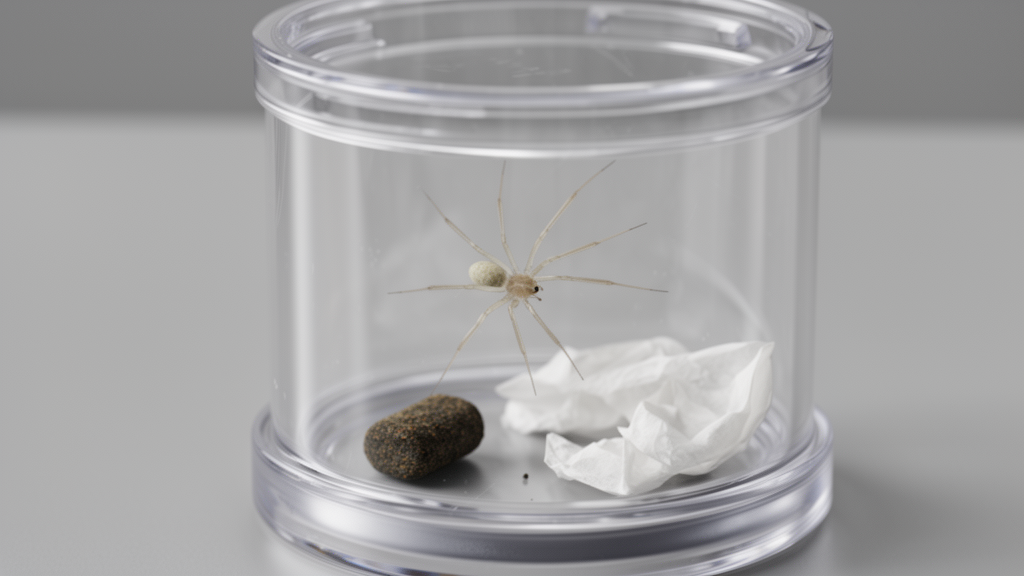
Researchers Johan Ariff Mohtar and Mohd Faidz Mohamad Shahimin at Universiti Malaysia Perlis have established the first documented controlled captive breeding and rearing system for the cellar spider Crossopriza lyoni, overcoming propagation hurdles that long restricted research to wild-caught specimens. Working at the Tissue Culture and Biomolecular Laboratory within the Faculty of Chemical Engineering Technology, the authors successfully sustained laboratory cultures across seven generations spanning one thousand two hundred and one days. While arachnids increasingly serve as model organisms across evolutionary developmental biology, venomology, ecology, and silk biomaterials, research progress has been constrained by severe cannibalism, extended life cycles, and an absence of reproducible captive rearing techniques. Prior to this study, multi-generational laboratory stocks were confined to few spider species, including Parasteatoda tepidariorum, Cupiennius salei, Pholcus phalangioides, and Trichonephila edulis. By resolving husbandry barriers for Crossopriza lyoni, the team demonstrated a reliable, low-cost approach for closed-colony propagation under controlled conditions.
Belonging to the basal clade Haplogynae and the family Pholcidae, Crossopriza lyoni is a cosmopolitan spider distributed broadly across tropical and subtropical regions while adapting effectively to temperate climates across Europe and America, leading to its cataloguing as an invasive species. In regions like Malaysia, the spider exhibits synanthropic habits, living in close association with humans within dwellings and abandoned buildings where extensive web construction renders it a domestic nuisance. Despite this reputation, the spider represents an efficient natural predator of mosquitoes, prompting scientific interest in its potential use within integrated mosquito population control to suppress dengue transmission. The venom of Crossopriza lyoni, although used to paralyze insect prey, poses no threat to humans, as the species has never been reported to inflict harmful bites. However, despite decades of studies examining its cytology, silk properties, predatory behavior, and genetics, experimental progress was hampered by the absence of documented rearing methods and dependence on wild specimens.
Morphologically, Crossopriza lyoni features a distinctive box-shaped opisthosoma with a cone-like protrusion on its upper back, tapering to a triangular point along its caudal end, often accented by lateral white stripes. The carapace of its subcircular cephalothorax displays a brown dorsal median indentation, while its body—spanning three to seven millimeters in females and two and a half to six millimeters in males—bears long, slender legs marked with tiny brown spots and white bands girdling the ends of the femur and tibia. To verify the species beyond morphological keys, genomic DNA was extracted from leg tissue for polymerase chain reaction amplification of the mitochondrial cytochrome oxidase subunit I gene. Using forward primer LCO1490A and chelicerate reverse primer CR2, the authors amplified a six hundred and fifty base pair sequence displaying ninety-nine point sixty-nine percent homology to Crossopriza lyoni in database searches, depositing the verified sequence in GenBank under accession number ON552547.
The captive culture was initiated from two pairs of spiders gathered from irregular webs in an abandoned staircase storehouse in Malaysia. The researchers housed each adult pair in a cylindrical transparent container measuring seven point eight by fourteen centimeters, drilled with holes along the top and walls for airflow and feeding access. This specific geometry provided appropriate spatial dimensions for spiders to make mating contact quickly and build dense webs. Spiders were maintained at room temperatures between twenty-eight and thirty degrees Celsius, relative humidity ranging from fifty-eight to eighty-two percent, and a twelve-hour photoperiod. Because solitary adult males rarely produced dragline silk or attached exploration threads when placed alone on bare container walls, introducing a female was critical to initiate web construction. When inverted upside down, the female immediately deposited exploration threads across the surface, and by turning the container with its lid at the bottom overnight, the female expanded the silk into a characteristic hanging dome-sheet.
The web built by female Crossopriza lyoni forms an irregular dome-shaped sheet web with white flecks, where the spider rests inverted at the dome apex. Web formation proceeds through laying thick skeleton threads containing bundles of fibrils with diameters between five and six micrometers, each individual fibril measuring approximately one point two micrometers. These smooth scaffolding threads, equivalent to major ampullate silk, are interlaced with thinner filling silk consisting of fibril pairs with diameters of zero point eight to zero point nine micrometers, serving as web reinforcement comparable to minor ampullate silk. Captive females continued spinning new exploration threads even after web completion, producing a dense meshwork. Additionally, cottony flecks were constructed on the web as early as the first instar and during pre-moulting and oviposition.
To prevent cannibalism during mating introduction, the female was pre-fed a medium mealworm, Tenebrio molitor, prior to transferring the male into the container. Courtship rituals began as early as five minutes after contact, with the male drumming his opisthosoma back and forth in front of the female, an action that may transmit vibrational cues across the web or respond to synthesized contact pheromones. While vibrating, the male reached out with his front walking legs to draw the female closer. Once accepted, the male positioned himself on the female’s underside and inserted his enlarged palpal bulbs into her epigynum. Copulation lasted forty to sixty minutes and recurred repeatedly across an average of ten consecutive days prior to egg deposition. Throughout this mating phase, mealworms were continually provided to supply nutrients for gamete development, promote web construction, and suppress aggression. The male and female frequently displayed communal feeding on the same mealworm, demonstrating cooperative feeding during cohabitation.
During oviposition, the female deposited eggs within a glutinous liquid equivalent to spumaline, which prevents desiccation while binding the clutch into a spherical ball. Once the mass hardened, the female loosely wrapped it with silk and grasped it with her chelicerae, occasionally hanging it on the web during feeding. The two founding pairs yielded one hundred and thirty-three spherical eggs, measuring zero point ninety millimeters in diameter, which shifted in color from greenish to brownish within hours. To recover individual eggs without injury, the team established a water droplet separation technique taking advantage of the low supercontraction properties of pholcid silk, which lacks differentiated spidroins. Dipping the female’s cephalothorax into a water droplet released her cheliceral grip, after which the egg mass was soaked for one minute.
Artificial embryo incubation was optimized in sterile plastic containers inside a humidity chamber maintained at twenty-nine degrees Celsius and seventy-three percent relative humidity. Under these controlled conditions, embryos developed over an average period of nineteen days, achieving a high hatching rate of eighty-nine point five percent. Upon hatching, newly emerged spiderlings, known as prenymphs, shed their chorion and stayed dormant near their eggshells for several minutes before active movement. Guided by innate negative geotropism, prenymphs moved toward the top of the container while attaching individual dragline threads to the substrate in discrete patterns. Within hours, these intersecting threads formed a communal gossamer mesh where prenymphs aggregated in mass, displaying a transient gregarious phase characteristic of solitary pholcids prior to dispersal.
Three days after hatching, prenymphs completed their first moult and were individually transferred into single Drosophila vials using a fine brush to eliminate cannibalism. The first instar averaged twenty-two point twenty-three days, with spiderlings fed live sugar ants, Paratrechina longicornis, because Drosophila melanogaster fruit flies proved too large and entangled flies damaged the juvenile webs. All spiderlings were reared to maturity at thirty degrees Celsius and seventy-seven percent humidity in continuous darkness, as photoperiod does not influence pholcid development. Subsequent juvenile stages advanced across successive moults: the second instar averaged thirty-nine point seventy-five days, during which spiderlings received cold-anesthetized fruit flies or phorid flies, Megaselia species. The third, fourth, and fifth instars averaged fifty-nine point fifty-three, eighty-three point eighty-two, and one hundred and fourteen point twenty-three days, respectively. From the fourth instar onward, juveniles were fed medium to large mealworms, facilitating rapid growth and much denser web expansion in individual housing.
Sexual differentiation was clearly observable in the subadult instar, where females exhibited a ventral abdominal protrusion developing into a functional epigynum, while males possessed enlarged pedipalpal segments forming genital bulbs. Following adult ecdysis, spiders were transferred into standard cylindrical breeding enclosures, where copulation was induced forty-eight hours later. Monogamous females produced between two and nine egg batches with the same partner. Mature females demonstrated notable longevity, frequently surviving up to four hundred and twenty-five days, with one individual living for seven hundred and sixty-nine days. By establishing reproducible protocols across mating, incubation, feeding, and colony husbandry, the study confirms that Crossopriza lyoni can serve as a dependable, low-cost laboratory model organism for morphological, developmental, and genetic research.
Subject of Research: Laboratory breeding and husbandry protocol for the cellar spider Crossopriza lyoni
Article Title: Laboratory breeding and rearing of cellar spider, Crossopriza lyoni Blackwall
Article References: Mohtar, J. A., & Shahimin, M. F. M. (2022). Laboratory breeding and rearing of cellar spider, Crossopriza lyoni Blackwall. Development Genes and Evolution, 232(5-6), 125-136. https://doi.org/10.1007/s00427-022-00697-0
Image Credits: AI Generated
DOI: 10.1007/s00427-022-00697-0
Keywords: Crossopriza lyoni, cellar spider, arachnid rearing, captive breeding, developmental biology, husbandry, Pholcidae, model organism, Laboratory, breeding, rearing, cellar
News Source: Drew Townsend. (November 10, 2026). Scientists Establish First Laboratory Breeding System for Synanthropic Cellar Spiders. Scienmag.