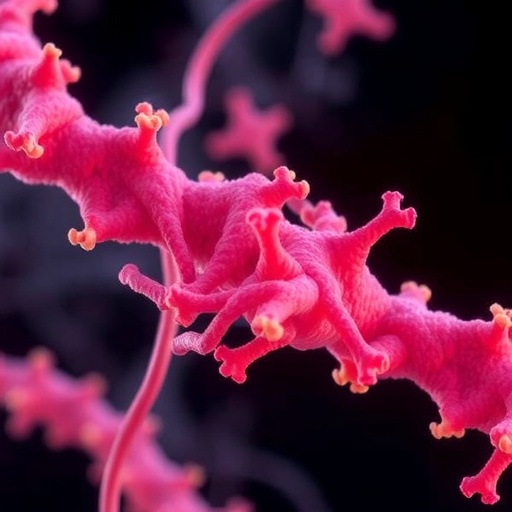
In the intricate architecture of biological tissues, collagen stands as a fundamental pillar, providing strength and structural integrity. This triple-helical protein, assembled from three intertwined polypeptide strands, forms resilient fibers that largely resist enzymatic degradation. Its unique molecular design renders collagen resistant to conventional proteinases, effectively safeguarding tissues from premature breakdown. However, certain pathogenic bacteria have evolved specialized enzymes, known as bacterial collagenases, capable of dismantling this robust scaffold. This enzymatic capability allows harmful bacteria to invade and degrade host tissues with alarming efficiency, facilitating infection proliferation.
Recently, an international team of researchers, including experts from the University of Arkansas and notable Japanese institutions such as Osaka University and Waseda University, has illuminated the precise molecular mechanism by which bacterial collagenase operates. Published in Nature Communications, their study elucidates how the enzyme ColH engages with collagen at the atomic scale to catalyze its continuous and processive cleavage. This breakthrough deepens our atomic-level understanding of bacterial collagenase’s extraordinary efficiency, offering promising avenues for the enhancement of therapeutic enzymes used in transplantation and regenerative medicine.
Collagenase serves dual roles—both as a virulence factor in bacterial infections and as a clinical tool. In medical applications, collagenase facilitates the isolation of insulin-producing pancreatic islets for transplantation in diabetes treatment, enabling more effective cell separation from donor tissue. Furthermore, collagenase is employed therapeutically in fibrotic disorders like Dupuytren’s contracture, where abnormal collagen accumulation restricts finger mobility. By enzymatically degrading excessive collagen deposits, collagenase treatments can restore functional range of motion. Harnessing bacterial collagenase’s mechanisms has thus captured widespread biomedical interest.
This collaborative study was spearheaded by Professor Josh Sakon of the University of Arkansas, who has partnered with Osamu Matsushita of Okayama University for over three decades. The foundational work in the 1990s identified and characterized two key bacterial collagenase genes, colG and colH, whose recombinant expressions enabled large-scale enzyme production. Despite successful commercialization, the detailed catalytic process remained enigmatic until now. The current investigation clarifies the enzyme’s dynamic conformational shifts that underpin its remarkable collagen-degrading prowess.
At the core of the bacterial collagenase function lies its distinctive quaternary structure reminiscent of a doughnut-shaped ring with an openable segment. This configuration allows the enzyme to transiently encircle the helical collagen molecule. The study identifies two primary conformational states: the “dynamic form,” where the collagen strand threads into the enzyme’s central cavity, and the “ratchet form,” during which the enzyme extricates one collagen strand to an active catalytic site for cleavage. This ratchet-like mechanism ensures directional progression along the triple helix without backward slippage.
Intriguingly, the enzyme exploits the intrinsic geometry of collagen itself to fuel its processivity. By employing the two remaining collagen strands as guiding rails, it effectively pulls one strand into its catalytic pocket for sequential cleavage. The enzyme’s active site then hydrolyzes peptide bonds stepwise, detaching collagen segments systematically. Following each cut, the enzyme reverts to an open conformation and shifts forward to engage the next cleavage site. This mechanism resembles a molecular ratchet or a judo move, using the substrate’s structure to advance rather than forcefully dragging it.
This enzymatic behavior markedly contrasts with how endogenous collagenases in humans and animals degrade collagen, reflecting a divergent evolutionary pathway. Triple-helical collagen appeared around a billion years ago, underpinning multicellular life by facilitating cellular adhesion and tissue formation. Bacteria, through hundreds of millions of years of evolution, developed these specialized collagenases that can circumvent the protective structural constraints of collagen, enabling invasive infection strategies and ecological niches exploitations.
The implications of this discovery stretch beyond microbiology. Understanding the mechanistic nuances of bacterial collagenase function opens new horizons for bioengineering improved enzymes with heightened specificity and efficiency. Such tailored enzymes could revolutionize transplantation techniques, fibrosis treatments, and even cancer therapy. Indeed, Professor Sakon highlights the potential to strip away collagen “shields” enveloping certain tumors, thereby enhancing the efficacy of chemotherapeutic agents by rendering cancer cells more exposed and vulnerable.
Bacterial collagenase’s potent tissue-degrading activity is strikingly demonstrated in clinical settings such as gas gangrene, where the enzyme can destroy tissue at rates approaching an inch per hour. The elucidation of its catalytic mechanism affords insights crucial to controlling and mitigating such aggressive bacterial infections while inspiring biomimetic strategies for medical innovation. Additionally, the research reinforces the interplay between evolutionary biology and therapeutic development, illustrating how ancient molecular adaptations can inform modern medicine.
This comprehensive analysis leveraged advanced imaging techniques and atomic-level structural characterization, enabling visualization of the enzyme in various functional states. By dissecting these transient conformations, researchers delineated how conformational dynamics and substrate geometry interplay to facilitate continuous cleavage. These findings lay the groundwork for rational enzyme design, potentially yielding collagenases with customized properties suitable for diverse biomedical applications, ranging from tissue engineering to targeted drug delivery.
Collateral research contributions came from a diverse international team, including graduate students and postdoctoral scholars whose multidisciplinary expertise enriched the study. Their combined efforts culminate in a pivotal advancement in understanding bacterial-collagen interactions and enzymology. Ultimately, these insights forge a path toward harnessing bacterial collagenases not just as agents of pathological destruction but as powerful tools for regenerative and therapeutic innovation.
In sum, revealing the processive, ratchet-like mechanism by which bacterial collagenase degrades collagen underscores the elegant solutions nature has evolved to overcome biochemical challenges. This paradigm-shifting discovery sets the stage for translational research aimed at exploiting bacterial enzymatic strategies for human health benefits. As scientific frontiers advance, such breakthroughs spotlight the intricate molecular choreography that sustains life and offers new hope against disease.
Subject of Research: Cells
Article Title: Bacterial collagenase harnesses collagen geometry for processive cleavage
News Publication Date: April 2, 2026
Web References: https://www.nature.com/articles/s41467-026-71099-3
References: DOI: 10.1038/s41467-026-71099-3
Image Credits: Whit Pruitt
Keywords: Bacterial collagenase, collagen degradation, ColH enzyme, protein structure, triple helix, enzymatic processivity, tissue engineering, regenerative medicine, pathogenic bacteria, enzyme mechanism, transplantation, molecular ratchet
Tags: atomic-scale enzyme catalysisbacterial collagenase mechanismbacterial virulence factorsColH enzyme molecular interactioncollagen triple helix structurecollagenase in regenerative medicinecollagenase in transplantationcollagenase proteinase resistanceenzymatic degradation of collagenpancreatic islet isolationpathogenic bacteria tissue invasiontherapeutic enzyme enhancement