• HOME
  • NEWS
  • EXPLORE
    • CAREER
      • Companies
      • Jobs
    • EVENTS
    • iGEM
      • News
      • Team
    • PHOTOS
    • VIDEO
    • WIKI
  • BLOG
  • COMMUNITY
    • FACEBOOK
    • INSTAGRAM
    • TWITTER
Saturday, January 3, 2026
BIOENGINEER.ORG
No Result
View All Result
  • Login
  • HOME
  • NEWS
  • EXPLORE
    • CAREER
      • Companies
      • Jobs
        • Lecturer
        • PhD Studentship
        • Postdoc
        • Research Assistant
    • EVENTS
    • iGEM
      • News
      • Team
    • PHOTOS
    • VIDEO
    • WIKI
  • BLOG
  • COMMUNITY
    • FACEBOOK
    • INSTAGRAM
    • TWITTER
  • HOME
  • NEWS
  • EXPLORE
    • CAREER
      • Companies
      • Jobs
        • Lecturer
        • PhD Studentship
        • Postdoc
        • Research Assistant
    • EVENTS
    • iGEM
      • News
      • Team
    • PHOTOS
    • VIDEO
    • WIKI
  • BLOG
  • COMMUNITY
    • FACEBOOK
    • INSTAGRAM
    • TWITTER
No Result
View All Result
Bioengineer.org
No Result
View All Result
Home NEWS Science News Biology

Scientists developed ‘smart fertilizer’

Bioengineer by Bioengineer
September 5, 2017
in Biology
Reading Time: 2 mins read
0
Share on FacebookShare on TwitterShare on LinkedinShare on RedditShare on Telegram
IMAGE

Credit: Press-office SibFU

According to the head of the works Tatiana Volova, Professor of SibFU and the Head of Laboratory in the Institute of Biophysics KSC of SB RAS, development of a new generation of drugs with the use of bio-decomposable materials which decompose under the influence of the microflora to innocuous products and provide a gradual release of the active principle into the soil, is the newest area of research in the field of agriculture. For example, nitrogen is one of the elements, which is often lacking for the growth and development of plants. Plant-available nitrogen in the soil is usually small. Moreover, its compounds are chemically very mobile and easily leached from the soil. In this connection there is the task of developing such forms of nitrogen fertilizers that provide slow release nitrogen and the constancy of its concentration in the soil.

""The key point for the development of such drugs is the presence of environmentally safe and bio-decomposable material. We have developed and implemented the technology for the synthesis of bio-decomposable polyesters of microbiological origin, is effective as a material for products for biomedical applications, and also explored patterns of their decomposition in soil and other environments"" — says Tatiana Volova.

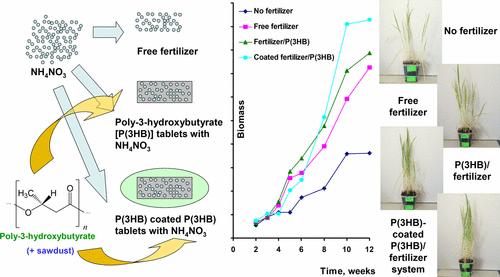
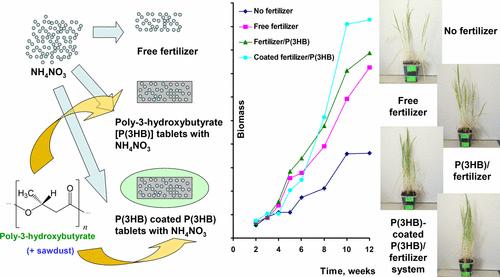
To create a slowly decaying structures, the researchers used a biodegradable polymer called poly-3-hydroxybutyrate (?3??). Scientists mixed powder of the biopolymer with wood flour and ammonium nitrate. The resulting mass was pressed into tablets and used in the experiments with wheat. Disintegration of biodegradable tablets with the addition of ammonium nitrate.

It was tested several options for fertilizing plants. Wheat was grown without fertilizers, with the addition of pure ammonium nitrate, with the application of pressed pellets or tablets, optionally coated with a film layer of biopolymer. The best results were achieved when fertilizing Packed in double protection, when the core of the tablet, including fertilizer and ?3?? (and in some cases wood flour) covered with a polymer film. In this case, due to slow decomposition of the film and the tablet fertilizer was supplied to the soil with the relatively stable rate within two months.

Biomass of wheat in an experiment with a hard Packed fertilizer was the highest and nearly a quarter exceeded the biomass of wheat grown with the addition of normal fertilizer.

###

Media Contact

Yaroslava Zhigalova
[email protected]
7-391-291-2733
@SibFUniversity

http://www.sfu-kras.ru/en

Original Source

http://www.sfu-kras.ru/en/news/19197

Share12Tweet7Share2ShareShareShare1

Related Posts

Novel Cis-Element Enables Bacterial Uptake in Plants

Novel Cis-Element Enables Bacterial Uptake in Plants

January 3, 2026
Carotenoids Boost Rice Root Adaptation and Iron Uptake

Carotenoids Boost Rice Root Adaptation and Iron Uptake

January 2, 2026

Addendum: Cryo-EM Reveals RNA-Rich Plant Mito Ribosome

January 2, 2026

Phage Cas12p Nucleases Need Thioredoxin to Cut DNA

January 2, 2026
Please login to join discussion

POPULAR NEWS

  • blank

    PTSD, Depression, Anxiety in Childhood Cancer Survivors, Parents

    120 shares
    Share 48 Tweet 30
  • NSF funds machine-learning research at UNO and UNL to study energy requirements of walking in older adults

    71 shares
    Share 28 Tweet 18
  • Exploring Audiology Accessibility in Johannesburg, South Africa

    52 shares
    Share 21 Tweet 13
  • SARS-CoV-2 Subvariants Affect Outcomes in Elderly Hip Fractures

    44 shares
    Share 18 Tweet 11

About

We bring you the latest biotechnology news from best research centers and universities around the world. Check our website.

Follow us

Recent News

Decoupling Point Spread Functions in Fluorescence Microscopy

Supporting LGBTQIA+ Communities in Viral Disease Prevention

Mapping Arginine Reactivity Across the Human Proteome

Subscribe to Blog via Email

Enter your email address to subscribe to this blog and receive notifications of new posts by email.

Join 71 other subscribers
  • Contact Us

Bioengineer.org © Copyright 2023 All Rights Reserved.

Welcome Back!

Login to your account below

Forgotten Password?

Retrieve your password

Please enter your username or email address to reset your password.

Log In
No Result
View All Result
  • Homepages
    • Home Page 1
    • Home Page 2
  • News
  • National
  • Business
  • Health
  • Lifestyle
  • Science

Bioengineer.org © Copyright 2023 All Rights Reserved.