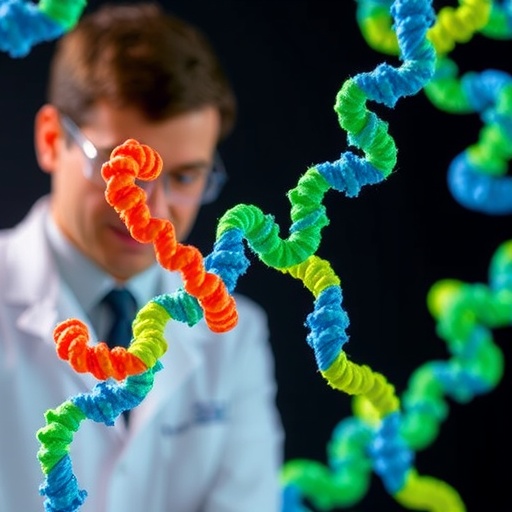
A groundbreaking advancement in the manipulation of cellular structures has been unveiled by researchers led by Dr. Travis Craddock, a professor of biology at the University of Waterloo and Canada Research Chair in Quantum Neurobiology. This pioneering work explores how weak magnetic fields combined with isotopic variations can profoundly alter the polymerization dynamics of tubulin, a fundamental protein in cellular architecture. By bridging the realms of structural biology, biophysics, and quantum biology, this discovery challenges long-held assumptions about the biological insignificance of atomic-scale phenomena within warm, noisy biological environments.
For decades, the consensus in biological sciences held that quantum effects—interactions tied to atomic and subatomic particles—were too fragile to influence complex biological systems due to constant molecular vibrations and thermal noise. However, Dr. Craddock’s team has delivered compelling experimental evidence demonstrating statistically significant changes in tubulin polymerization rates influenced by magnetic isotope effects. The subtleties of these phenomena align with the radical pair mechanism, a quantum theoretical model previously invoked to explain magnetic field effects in avian navigation but rarely applied to cellular biochemistry until now.
Tubulin proteins make up microtubules, which are cytoskeletal polymers critical for maintaining cell shape, intracellular transport, and cell division. In neurodegenerative diseases such as Alzheimer’s and Parkinson’s, microtubule destabilization is a prominent pathological hallmark, leading to neuronal dysfunction and death. The team’s novel approach uses specific weak magnetic fields and isotopes to stabilize tubulin polymerization, suggesting a quantum biological pathway by which brain protein structures could be therapeutically modulated.
The implications of this research extend well beyond the molecular scale. Current pharmaceutical interventions for neurodegenerative diseases primarily address symptoms or slow progression, but are often accompanied by adverse side effects ranging from gastrointestinal distress to severe neurological complications such as brain swelling. This new strategy opens the door to non-invasive, quantum-inspired treatment options that could directly stabilize neuronal microtubules and potentially halt or reverse disease progression.
What makes this study particularly revolutionary is its interdisciplinary approach, exploiting principles from quantum physics to elucidate biophysical mechanisms that classical biochemistry could not fully explain. The team’s experiments confirm that the presence of isotopes, differing only in nuclear spin properties, can affect the kinetics of tubulin polymerization in the presence of weak magnetic fields. This nuanced interaction highlights an elegant quantum-classical interface within living systems previously obscured by assumptions grounded in macroscopic biology.
These findings are not merely academic; they offer a tantalizing glimpse of future therapeutic modalities. The prospect of harnessing magnetic isotope effects to manipulate protein assembly dynamics may enable fine-tuned interventions for protein misfolding disorders—conditions notoriously difficult to treat due to their complexity and the inability of large molecules to cross the blood-brain barrier effectively. Furthermore, elucidation of such quantum effects enriches our fundamental understanding of cellular physiology.
The research currently focuses on biochemical protein assays under controlled laboratory conditions. The next stage involves translating these insights to living human brain cells cultured in vitro, to validate the observed effects in physiological contexts. Success in these endeavors could revolutionize how we understand and ultimately treat a wide spectrum of neurodegenerative illnesses, potentially decreasing the projected burden of dementia expected to affect over a million Canadians by 2030.
Collaborations played a vital role in this endeavor, with expertise pooled from Dr. Robert P. Smith at Nova Southeastern University and Dr. Christoph Simon of the University of Calgary. Their combined efforts have cemented a comprehensive experimental framework, enabling detection of the subtle yet biologically significant magnetic-isotope interactions that have so far eluded classical interpretation.
This landmark study has been published in the prestigious journal Science Advances under the title “Tubulin Polymerization Dynamics are Influenced by Magnetic Isotope Effects Consistent with the Radical Pair Mechanism.” The publication on February 13, 2026, marks a transformative moment in quantum neurobiology, signaling a paradigm shift in how we perceive molecular processes in living cells.
Travis Craddock reflects on this milestone with enthusiasm: “Our discovery fundamentally alters the paradigm of biology by demonstrating that weak magnetic fields and isotopes can influence essential protein structures via quantum mechanisms.” This realization paves the way for intense exploration of quantum phenomena in cellular biology, potentially redefining therapeutic strategies for devastating neurological disorders.
As research continues to unfold, this integrative approach promises to unravel new layers of complexity in neuron function and protein chemistry. Future investigations must focus on elucidating the precise quantum states and interactions governing these effects, optimally translating them into clinical innovations for neurodegenerative disease intervention.
In sum, the advent of exploiting magnetic isotope effects to control tubulin polymerization dynamics delivers a powerful testament to the untapped quantum mechanisms underpinning life itself. This study embodies the frontier where physics converges with biology to forge innovative solutions for humanity’s most daunting medical challenges.
Subject of Research: Cells
Article Title: Tubulin polymerization dynamics are influenced by magnetic isotope effects consistent with the radical pair mechanism
News Publication Date: 13-Feb-2026
Web References: https://www.science.org/doi/10.1126/sciadv.ady8317
Image Credits: University of Waterloo
Keywords: Neuroscience, Cell biology, Diseases and disorders, Alzheimer disease, Parkinsons disease, Neurodegenerative diseases, Biophysics, Cellular neuroscience, Isotopes, Magnetic fields, Research methods
Tags: biophysics of cytoskeletal proteinsexperimental evidence of quantum effects in biologyimpact of quantum effects on neurodegenerative diseasesisotopic variation in cellular biologymagnetic isotope effects on tubulinmicrotubule regulation and cellular architectureprotein structure modification techniquesquantum biology in structural proteinsquantum neurobiology researchradical pair mechanism in biophysicstubulin polymerization dynamicsweak magnetic field effects on proteins