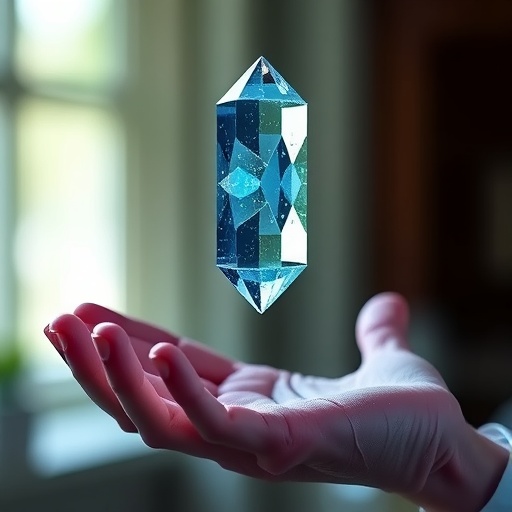
Time crystals have long captivated physicists and material scientists due to their unusual characteristic of exhibiting periodic motion in time—essentially “ticking” through cycles without expending energy, defying conventional thermodynamics. Initially proposed as a theoretical curiosity over a decade ago and later realized in various quantum systems, these phases of matter have perplexed and fascinated researchers eager to harness their potential in cutting-edge technological applications such as quantum computing, precision timing, and advanced data storage. The recent breakthroughs by a team of researchers at New York University (NYU) have brought new dimensions to these enigmatic structures, uncovering a novel class of time crystals that levitate and interact through sound waves in an unprecedentedly simple, classical system.
Unlike traditional time crystals, which typically operate within quantum realms and require highly specialized environments, this new variant discovered by the NYU physicists exists at a macroscopic scale, visible to the naked eye. The system consists of millimeter-sized styrofoam beads suspended mid-air by an acoustic levitator—a device that uses standing sound waves to counteract gravity. These beads not only hover gracefully but also interact through scattered sound waves, exchanging forces in a manner that shatters classical physical expectations. What makes this discovery revolutionary is that the interactions between the beads defy Newton’s Third Law of Motion, which stipulates that forces always come in equal and opposite pairs. Instead, these levitated particles move nonreciprocally, meaning the forces they exert on each other are unbalanced, with larger beads influencing smaller ones more than vice versa.
The researchers highlight that the simplicity of their experimental setup belies the profound implications it holds for fundamental physics and potential technological advances. The acoustic levitator chamber stands just under a foot tall, presenting a tangible, accessible system to study the dynamics of time crystals outside the opaque quantum domain. Professor David Grier, director of NYU’s Center for Soft Matter Research and the senior author of the study, emphasizes that this accessible model system paves the way for experimentalists and theoreticians alike to explore phenomena at the intersection of classical mechanics, wave physics, and emergent nonreciprocal behaviors.
Central to this discovery is the mechanism by which the particles interact: the scattering of sound waves. Unlike electromagnetic or mechanical forces, whose action and reaction pairs are symmetrical and balanced, sound waves scattered by particles of different sizes create forces of varying magnitude and direction. Larger beads scatter sound waves more effectively, exerting a stronger influence on smaller beads, which respond with lesser reciprocal force. This asymmetry creates a nonreciprocal interaction matrix where the classic rules of balanced force pairs are transcended, allowing for spontaneous oscillations where the beads collectively “tick” in a coordinated rhythm, forging a classical time crystal.
This acoustic nonreciprocity grants the bead ensemble the capacity to maintain persistent, rhythmic motion without energy dissipation—the hallmark of time crystals. Unlike prior examples that rely heavily on quantum entanglement or complex spin interactions, this classical system reveals that nonreciprocal wave-mediated forces alone are sufficient to originate and sustain time crystal behavior. Such findings hold immense promise, suggesting simpler pathways to harness these effects in practical devices and potentially inspiring new architectures for quantum-inspired computing and sensing technologies.
Moreover, this research offers enlightening parallels to biological systems, particularly our intrinsic circadian rhythms governing daily physiological cycles. Many biochemical networks in living organisms are known to operate via nonreciprocal interactions, coordinating complex processes such as metabolism and cellular repair. The NYU team’s findings underscore how physics principles observed in this acoustically levitated crystal resonate with the foundational rhythms of life itself, opening new interdisciplinary dialogues between physics, biology, and materials science.
The experimental protocol utilized standing sound waves to levitate styrofoam particles, carefully tuning wave frequencies and amplitudes to achieve stable suspension. Once levitated, beads began to interact through continuous scattering of sound, dynamically adjusting their mutual positions within the trapped sound field. A series of high-speed imaging frames captured these evolving oscillations, enabling detailed analysis of the collective modes of the crystal. The results definitively demonstrated the spontaneous breaking of time-translation symmetry—a definitive signature of time crystalline order—under entirely classical and macroscopic conditions.
The theoretical underpinnings draw from non-Hermitian physics and active matter frameworks where dissipative processes and nonreciprocal interactions enable new steady-states far from equilibrium. By exploiting acoustic wave scattering, the NYU team has shown that time crystal order does not necessitate quantum ground states or isolation at ultracold conditions, but can arise naturally from classical wave-mediated forces that break reciprocal symmetry. This insight renders the discovery a paradigmatic shift, broadening the landscape of time crystals beyond the confines of exotic quantum materials.
Taken together, these findings mark a new chapter in our understanding of nonequilibrium phases of matter. The implications extend beyond fundamental science, foreshadowing applications that range from advanced metamaterials with programmable mechanical responses to robust time-keeping devices inspired by classical oscillators. The ability to visualize, manipulate, and control time crystal behavior at macroscopic scales could accelerate innovation in precision timing technologies and potentially new paradigms of information processing that leverage wave-mediated interactions.
The study was made possible through support from the U.S. National Science Foundation and represents a collaborative effort involving graduate student Mia Morrell and undergraduate Leela Elliott under the leadership of Professor Grier. Their combined experimental expertise and theoretical insight achieved a milestone, demonstrating that time crystals are not strictly artifacts of quantum mechanics but can be accessible in real-world classical systems through creative harnessing of sound-mediated interactions.
The research was published in the prestigious journal Physical Review Letters, presenting both experimental data and theoretical context that support the formation of nonreciprocal wave-mediated classical time crystals. This work inspires renewed investigation into acoustic metamaterials, topological wave physics, and active matter, as well as potential translation into technology sectors focused on quantum simulation, nonreciprocal devices, and biomimetic systems.
With fundamental physics entering an era where classical and quantum domains interlace through the language of waves and symmetry-breaking, this discovery of an acoustically levitated time crystal heralds exciting new possibilities. As research accelerates, the interplay of sound, motion, and nonreciprocal forces is poised to reveal deeper insights into the fabric of time-dependent order and to inspire technologies that keep pace with the rhythmic precision of nature itself.
Subject of Research: Physics – Classical and Quantum Time Crystals, Nonreciprocal Wave-Mediated Interactions, Acoustic Levitation
Article Title: Nonreciprocal Wave-Mediated Interactions Power a Classical Time Crystal
News Publication Date: 6 February 2026
Web References: DOI: 10.1103/zjzk-t81n
References: Physical Review Letters (Journal)
Image Credits: NYU’s Center for Soft Matter Research
Keywords
Crystals, Particle physics, Condensed matter physics, Time crystals, Acoustic levitation, Nonreciprocal interactions, Wave-mediated forces, Classical time crystal, Symmetry-breaking, Active matter, Physics experiments
Tags: acoustic levitation technologyadvances in material sciencecutting-edge technological applicationsenergy-efficient systems in physicshand-held time crystalslevitating time crystalsmacroscopic time crystalsNew York University research breakthroughsnovel phases of matterperiodic motion in timeQuantum Computing Applicationssound wave interactions in physics