In a groundbreaking leap towards sustainable carbon management, scientists from the Dalian Institute of Chemical Physics (DICP) of the Chinese Academy of Sciences, in collaboration with Fudan University, have unveiled an innovative approach to integrating carbon dioxide capture and conversion. This advancement, led by Profs. BAO Xinhe, GAO Dunfeng, and ZHANG Guohui together with Prof. WANG Guoxiong, offers a promising route to enhance the efficiency of CO₂ capture directly linked to its electrochemical conversion, thus significantly mitigating the energy penalties associated with carbon capture protocols.
Conventional industry-scale CO₂ capture processes hinge on a sequential “capture-release-compression-electrolysis” methodology, wherein carbon dioxide is first trapped from flue gases, then released and compressed before finally undergoing electrochemical conversion. This multi-step chain is energy-intensive, predominantly because it demands purified CO₂ feedstocks for effective conversion. The innovative bicarbonate-mediated integrated approach integrated by this team circumvents these steps, coupling CO₂ capture with immediate electrolysis, thereby potentially halving the energy expenditure historically required.
Central to this technology is the electrolysis of bicarbonate-rich capture solutions, a pivotal reaction stage that transforms captured carbon into valuable carbon monoxide (CO). However, prior efforts have been hampered by low reaction rates and high operational voltages — factors that collectively degrade the energy efficiency and scalability of the process. Addressing these challenges, the researchers engineered a fine-tuned reaction microenvironment through the strategic incorporation of ionomers within cobalt phthalocyanine (CoPc)-based electrodes, thus mimicking an intricate molecular dance to optimize catalytic activity.
The deployment of Nafion, a perfluorinated sulfonic acid polymer known for its proton conductivity, within the CoPc electrode matrix proved transformative. In the context of a cation exchange membrane-based zero-gap electrolyzer setup, this adjustment led to an extraordinary enhancement in performance metrics. The Nafion-modified CoPc electrode achieved a Faradaic efficiency for CO production of 93% at an applied current density of 300 mA cm⁻², with a partial CO current density soaring to 410 mA cm⁻² under an impressively low cell voltage of 3.09 V. These figures mark a notable advancement in the electrochemical conversion performance of bicarbonate solutions.
Probing deeper into the electrode structure via advanced characterization techniques alongside finite element simulation illuminated the underlying mechanism. The Nafion ionomer’s proton conductivity was found to significantly bolster the local concentration of in situ generated CO₂ (i-CO₂) near the active catalytic centers of CoPc. This enrichment of reactive carbon species at the electrode interface facilitates a more efficient electron transfer and conversion process, optimizing CO formation while curbing parasitic reactions. The microenvironment manipulation essentially tailors the chemical interface, enhancing selectivity and reaction kinetics.
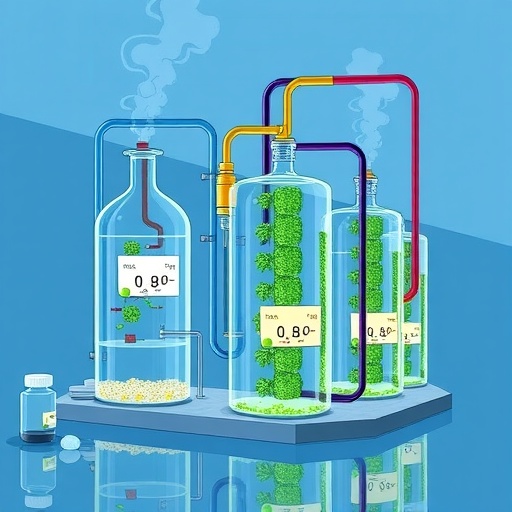
Additionally, the study demonstrated a closed-loop system embodying both CO₂ capture from simulated flue gas and its subsequent electrochemical conversion within a single device framework utilizing the Nafion-incorporated CoPc electrode. This integrated cycle showcases the potential of this approach as a viable pathway towards sustainable carbon management, reducing the gap between lab-scale innovation and industrial applicability.
The implications of this research extend beyond mere performance improvements; it underscores a paradigm shift in how carbon capture and conversion technologies might evolve. By controlling reaction microenvironments at a molecular level, the researchers highlight a scalable strategy to circumvent traditional energy-intensive separation steps and directly convert captured carbon species with heightened efficiency. This synergy between materials engineering and electrochemical insight propels the field closer to practical, energy-efficient carbon recycling systems.
Prof. GAO emphasizes that such reaction microenvironment control strategies not only open new avenues for advancing bicarbonate-mediated electrolysis but also pave the way for the broader adoption of reactive carbon capture technologies. These technologies could play a crucial role in global efforts to curtail greenhouse gas emissions and align with carbon-neutrality targets across industries reliant on fossil fuel combustion.
This study elucidates the nuanced interplay of ionomer conductivity, catalyst structure, and reaction dynamics that collectively define the frontier of integrated carbon capture and conversion. Future research inspired by these findings may delve into optimizing ionomer compositions, exploring alternative catalyst materials, and scaling up device configurations to meet industrial throughput demands.
In summary, the confluence of innovative catalyst design, electrochemical engineering, and materials science embodied in this work presents a formidable stride towards sustainable carbon management. The breakthrough injects fresh momentum into the pursuit of economically viable, high-efficiency CO₂ conversion processes—an essential pillar in the global response to climate change.
Subject of Research: Not applicable
Article Title: Ionomer-Driven Reaction Microenvironment Control in Bicarbonate-Mediated Integrated CO2 Capture and Electrolysis
News Publication Date: 10-Jan-2026
Web References: DOI:10.1002/anie.202523118
Keywords
Catalysis, Carbon Dioxide Capture, Electrolysis, Bicarbonate, Reaction Microenvironment, Ionomer, Nafion, Cobalt Phthalocyanine, Electrochemical Conversion, Carbon Monoxide, Proton Conductivity, Sustainable Energy
Tags: bicarbonate electrolysis for CO productionbicarbonate-based carbon dioxide capturecarbon capture from flue gases technologychemical physics in carbon capture innovationDalian Institute of Chemical Physics carbon researchdirect CO2 capture and electrolysis processelectrochemical CO2 conversion methodsenergy-efficient carbon capture solutionsintegrated CO2 capture and electrolysislow-voltage CO2 electrolysis advancementsreducing energy penalties in carbon capturesustainable carbon management technology