• HOME
  • NEWS
  • EXPLORE
    • CAREER
      • Companies
      • Jobs
    • EVENTS
    • iGEM
      • News
      • Team
    • PHOTOS
    • VIDEO
    • WIKI
  • BLOG
  • COMMUNITY
    • FACEBOOK
    • INSTAGRAM
    • TWITTER
Monday, January 12, 2026
BIOENGINEER.ORG
No Result
View All Result
  • Login
  • HOME
  • NEWS
  • EXPLORE
    • CAREER
      • Companies
      • Jobs
        • Lecturer
        • PhD Studentship
        • Postdoc
        • Research Assistant
    • EVENTS
    • iGEM
      • News
      • Team
    • PHOTOS
    • VIDEO
    • WIKI
  • BLOG
  • COMMUNITY
    • FACEBOOK
    • INSTAGRAM
    • TWITTER
  • HOME
  • NEWS
  • EXPLORE
    • CAREER
      • Companies
      • Jobs
        • Lecturer
        • PhD Studentship
        • Postdoc
        • Research Assistant
    • EVENTS
    • iGEM
      • News
      • Team
    • PHOTOS
    • VIDEO
    • WIKI
  • BLOG
  • COMMUNITY
    • FACEBOOK
    • INSTAGRAM
    • TWITTER
No Result
View All Result
Bioengineer.org
No Result
View All Result
Home NEWS Science News Chemistry

Scientists develop a chemocatalytic approach for one-pot reaction of cellulosic ethanol

Bioengineer by Bioengineer
June 12, 2019
in Chemistry
Reading Time: 2 mins read
0
IMAGE
Share on FacebookShare on TwitterShare on LinkedinShare on RedditShare on Telegram

IMAGE

Credit: WANG Aiqin

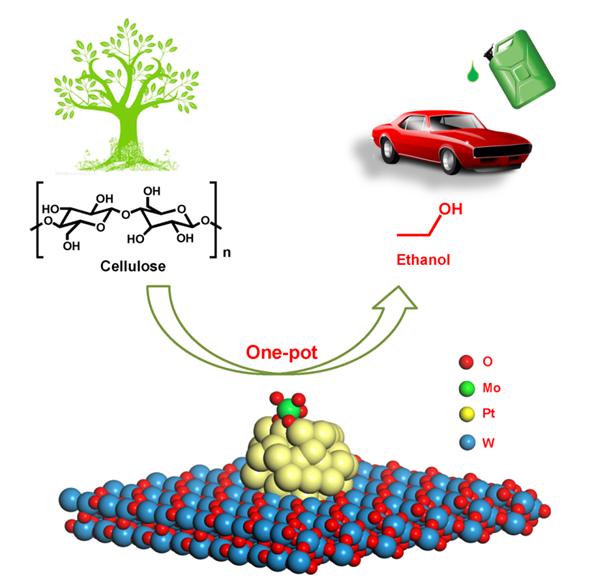
Scientists at the Dalian Institute of Chemical Physics (DICP) of the Chinese Academy of Sciences have developed a chemocatalytic approach to convert cellulose into ethanol in a one-pot process by using a multifunctional Mo/Pt/WOx catalyst. This approach opens up an alternative avenue for biofuel production. The findings were published in Joule.

Cellulosic ethanol is one of the most important biofuels, yet commercial production is hindered by the low efficiency and high cost of the bioconversion process.

Prof. WANG Aiqin, leader of the research group, and her colleagues developed a chemocatalytic process in which two separate reactions, cellulose conversion to ethylene glycol and ethylene glycol conversion to ethanol, were coupled in a one-pot reaction by using a multifunctional Mo/Pt/WOx catalyst, thus achieving an ethanol yield of higher than 40 %.

While noting that the new process can still be made more efficient, WANG said that “in principle” the new process can “overcome the intrinsic limitations on ethanol concentration imposed by the bioconversion process.”

“With further improvement in catalyst efficiency and robustness, this one-pot chemocatalytic approach shows great potential in the practical production of cellulosic ethanol in the future,” WANG said.

###

The research was supported by China’s National Key Projects for Fundamental Research and Development program, the National Natural Science Foundation of China, and the Strategic Priority Research Program of the Chinese Academy of Sciences.

Media Contact
WANG Yongjin
[email protected]

Related Journal Article

http://dx.doi.org/10.1016/j.joule.2019.05.020

Tags: Chemistry/Physics/Materials SciencesEnergy/Fuel (non-petroleum)
Share12Tweet8Share2ShareShareShare2

Related Posts

blank

Advancing Alkene Chemistry: Homologative Difunctionalization Breakthrough

January 8, 2026
Biocompatible Ligand Enables Safe In-Cell Protein Arylation

Biocompatible Ligand Enables Safe In-Cell Protein Arylation

January 8, 2026

Monovalent Pseudo-Natural Products Boost IDO1 Degradation

January 7, 2026

Catalytic Enantioselective [1,2]-Wittig Rearrangement Breakthrough

January 7, 2026
Please login to join discussion

POPULAR NEWS

  • Enhancing Spiritual Care Education in Nursing Programs

    154 shares
    Share 62 Tweet 39
  • PTSD, Depression, Anxiety in Childhood Cancer Survivors, Parents

    146 shares
    Share 58 Tweet 37
  • Robotic Ureteral Reconstruction: A Novel Approach

    70 shares
    Share 28 Tweet 18
  • Study Reveals Lipid Accumulation in ME/CFS Cells

    50 shares
    Share 20 Tweet 13

About

We bring you the latest biotechnology news from best research centers and universities around the world. Check our website.

Follow us

Recent News

Targeting SPAK Halts Liver Cancer Progression, Boosts Immunity

Gradient Graphene Powers Precise Directional Laser Printing

Machine Learning Unveils Unified Cell-State Landscape

Subscribe to Blog via Email

Enter your email address to subscribe to this blog and receive notifications of new posts by email.

Join 71 other subscribers
  • Contact Us

Bioengineer.org © Copyright 2023 All Rights Reserved.

Welcome Back!

Login to your account below

Forgotten Password?

Retrieve your password

Please enter your username or email address to reset your password.

Log In
No Result
View All Result
  • Homepages
    • Home Page 1
    • Home Page 2
  • News
  • National
  • Business
  • Health
  • Lifestyle
  • Science

Bioengineer.org © Copyright 2023 All Rights Reserved.