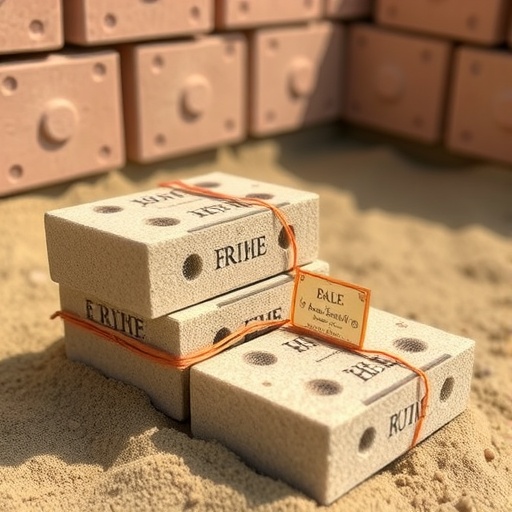
Scientists at the University of Sharjah have made groundbreaking advancements in the quest for sustainable construction materials by transforming the seemingly inhospitable desert sand of the United Arab Emirates into eco-friendly building bricks. This innovation marks a pivotal step towards reducing the construction industry’s reliance on traditional materials like Portland cement, which is responsible for a staggering 10% of the global carbon dioxide emissions. Conventional bricks, made primarily from Portland cement and fired clay, while functional, carry a heavy environmental cost, prompting the University of Sharjah’s researchers to explore alternative materials that tap into the abundant resources at their disposal.
The allure of desert sand as a primary ingredient for construction materials has long been overshadowed by misconceptions regarding its utility. Historically, the fine particles found in the UAE’s deserts were deemed unsuitable for construction due to their grain characteristics and the comprehensive processing required to render them usable. However, the researchers employed alkali-activated binders in combination with local desert sand to create a sustainable alternative that holds great promise for the building sector. Their findings, published in the Journal of Materials in Civil Engineering, present a compelling case for the reimagined use of desert resources in construction.
The process, as outlined by the research team, initiates with collecting natural desert sand from the Sharjah region—a source abundant yet underutilized. The scientists incorporated alkali-activated binders, which can include environmentally beneficial by-products like blast-furnace slag and fly ash, transforming this bountiful resource into durable bricks that not only pass rigorous environmental standards but outperform many existing construction materials. This technique utilizes alkaline solutions to stimulate chemical reactions that yield strong binding phases—a critical factor given the harsh environmental conditions prevalent in desert regions.
Critical to the success of this innovation is the curing process used, which occurs at ambient temperature. Unlike traditional methods that require heat treatment, which significantly increases energy costs and consumption, the ambient curing technique adopted by the researchers minimizes the environmental footprint of the manufacturing process. The ability to cure bricks at room temperature without sacrificing performance aligns perfectly with global sustainability goals, marking a decisive advantage over heat-based curing systems employed elsewhere.
The implications of this research extend beyond mere construction efficiencies. As highlighted in the study, the construction industry is increasingly viewed as a prominent contributor to climate change and global energy consumption, accounting for approximately 40% of energy use. By developing construction materials that integrate local, widely available resources like desert sand, the researchers aim to break the cycle of dependence on carbon-intensive materials, potentially reducing the construction sector’s carbon footprint and ushering in an era of sustainability.
Additionally, extensive testing revealed that the alkali-activated desert sand bricks boast superior performance metrics under aggressive conditions, such as exposure to sulfate, which often compromises the integrity of conventional bricks. It’s noteworthy that these bricks exhibited a distinct resilience, retaining structural integrity even when subjected to the harsh challenges presented by sulfate-laden environments—a critical consideration for construction projects situated in coastal regions.
In further emphasizing the bricks’ advantages, the research demonstrated that the new material not only meets but exceeds key ASTM standards, confirming its viability as a long-lasting, reliable building option. Incorporating local desert sand into the mix presents a dual benefit: it conserves resources by leveraging what is typically seen as waste while simultaneously championing innovations that can redefine how materials are sourced and utilized in building projects.
Plans are already underway to scale this technological advancement beyond laboratory settings to real-world applications. The University of Sharjah investigators are actively pursuing the creation of pilot-scale testing protocols that will validate performance consistency and establish quality assurance mechanisms as they transition towards industrial-scale production. This next phase will involve a thorough commercial and cost analysis aimed at optimizing manufacturing workflows and logistics—all crucial components for the practical implementation of this eco-friendly brick technology.
The anticipated outcomes of this research endeavor could catalyze a profound transformation within the construction industry. By illustrating the potential of desolately perceived resources like desert sand and by-product materials, the researchers are not only forging a path toward sustainable building practices but are also prompting a reevaluation of how materials are traditionally regarded in construction contexts. The momentum around this innovative technology has already begun to attract attention from industry stakeholders eager to implement greener practices within their operational mandates.
In conclusion, the advancements made by the University of Sharjah in developing eco-friendly desert sand bricks represent an exciting convergence of sustainability and innovation. As the construction sector grapples with its environmental responsibilities, the integration of locally sourced materials into building products offers a glimpse into a more sustainable future, where durability, cost-effectiveness, and ecological mindfulness coexist. By reframing desert sand from an underutilized resource into a valuable building material, these researchers are poised to lead a shift that could redefine industry standards for decades to come.
Subject of Research: Environmental Engineering and Sustainable Construction Materials
Article Title: Production of Eco-Friendly Desert Sand Bricks Using Alkali-Activated Binders
News Publication Date: 17-Nov-2025
Web References: Doi example – http://dx.doi.org/10.1061/JMCEE7.MTENG-205
References: Journal of Materials in Civil Engineering
Image Credits: Abdul Wahid Muhammad Ikram
Keywords
Applied sciences, Engineering, Environmental engineering
Tags: alkali-activated bindersalternative to Portland cementdesert sand in constructioneco-friendly building bricksenvironmental impact of traditional bricksgreen construction technologiesinnovative building materialsJournal of Materials in Civil Engineeringreducing carbon emissions in constructionsustainable construction materialsUAE desert resourcesUniversity of Sharjah research