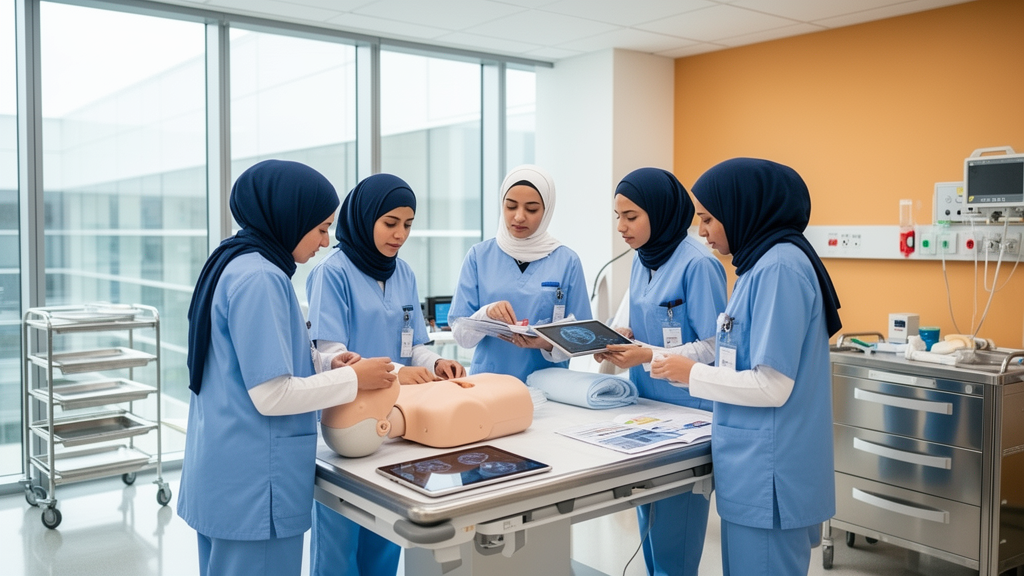
Undergraduate nursing students in Saudi Arabia report substantial knowledge gaps, misunderstandings, social stigma, and a lack of personal confidence when communicating about human papillomavirus prevention, according to a descriptive qualitative study conducted at the University of Bisha. The newly published research, which utilized the Health Belief Model as an overarching theoretical framework, examined how future nursing professionals understand the infection, evaluate personal vulnerability, and perceive their preparation for clinical preventive dialogue.
The authors noted that despite the established status of human papillomavirus as a critical public health priority and a primary driver of cervical and other malignancies, there has been limited qualitative evidence examining nursing students’ perceptions of the virus and its prevention within Saudi Arabia. To address this empirical gap, the study sought to investigate undergraduate nursing students’ perceptions of human papillomavirus and preventive strategies, employing the Health Belief Model to interpret their health beliefs and educational readiness within their regional academic setting.
To capture these student perspectives in detail, the investigators implemented a descriptive qualitative study design that utilized purposive sampling to recruit thirty-six eligible undergraduate nursing students from the University of Bisha in Saudi Arabia. Data collection was carried out through six separate focus group discussions, which enabled the researchers to gather comprehensive interactive dialogues regarding the participants’ knowledge, attitudes, and perceived preparedness. The study team subsequently conducted thematic analysis guided by the Health Belief Model, employing the framework’s six predefined constructs as overarching deductive analytic domains. In parallel with this deductive structure, specific subthemes were developed inductively from the participants’ firsthand accounts, ensuring that emergent issues not explicitly defined by the initial model were fully integrated into the analysis.
The investigation’s deductive findings corresponded directly to the six core constructs of the Health Belief Model: perceived susceptibility, perceived severity, perceived benefits, perceived barriers, cues to action, and self-efficacy. In particular, students identified a lack of confidence when discussing human papillomavirus prevention, along with challenges in discussing sensitive sexual health issues.
Beyond the overarching deductive categories, the inductive thematic analysis uncovered several critical subthemes regarding student knowledge deficits and social dynamics. Foremost among these findings was an inadequate overall understanding of human papillomavirus, accompanied by specific misconceptions concerning vaccination safety and the exact routes of viral transmission. The participants also demonstrated low perceived personal susceptibility to the infection, often viewing the pathogen as an improbable personal threat. Furthermore, the discussions revealed that stigma and societal challenges surrounding sensitive sexual health issues created substantial friction, while participants noted that institutional and educational factors significantly influenced their subject knowledge, professional relevance, and overall communication preparedness.
Based on these findings, the authors emphasized the necessity of providing evidence-based and culturally sensitive education focused on human papillomavirus transmission, screening procedures, vaccination, reproductive health issues, stigma reduction, and communication skills. The researchers suggested that these educational needs could potentially be addressed through interactive pedagogical approaches, including case-based learning, role-playing scenarios, clinical simulation, and focused communication training. However, the study authors explicitly noted that their findings do not demonstrate the efficacy of any specific teaching methods, but instead highlight the precise educational needs identified within this sample of thirty-six students. Because the present investigation did not evaluate the effectiveness of simulation, case-based learning, or related techniques, the authors concluded that further research is needed.
Subject of Research: Nursing students' perceptions and educational needs regarding human papillomavirus prevention
Article Title: Undergraduate nursing students’ perceptions of human papillomavirus and its prevention: a qualitative study guided by the Health Belief Model
Article References: Mohamed, R. A., Aloufi, M., Dakhilallah, H., Mohammed, S. F., ElShora, S. N. A. E., Saleh, N. M. H., Alshahrani, M., Ahmed, D. A. H., Nabeih, E. M., Mohammed, A. A. R., Miky, S. F. M., Amer, F. G. M., Sheashaa, D. M., Almowafy, A. A., Gamel, W. M. A., & Taref, N. N. (2026). Undergraduate nursing students’ perceptions of human papillomavirus and its prevention: a qualitative study guided by the Health Belief Model. BMC Nursing, 25(1), Article 1085. https://doi.org/10.1186/s12912-026-05623-7
Image Credits: AI Generated
DOI: 10.1186/s12912-026-05623-7
Keywords: human papillomavirus, HPV prevention, nursing education, Health Belief Model, cervical cancer, qualitative research, Saudi Arabia, sexual health, Undergraduate, nursing, students, perceptions
News Source: Ophelia Keating. (November 10, 2026). Saudi Nursing Students Face Gaps in HPV Knowledge and Prevention. Scienmag.