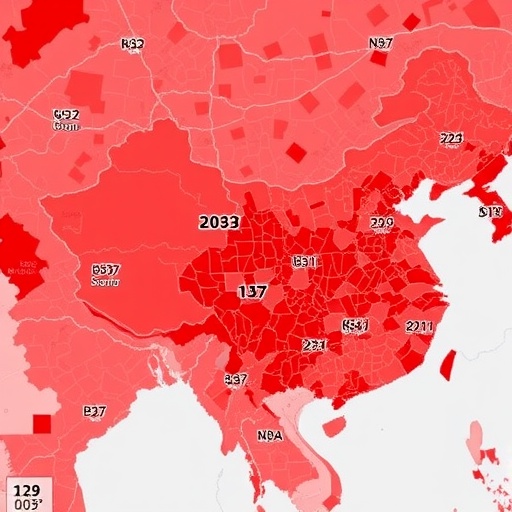
A groundbreaking study published in Nature Communications in 2026 unveils the most detailed satellite mapping of every building’s function in urban China, revealing profound disparities in the country’s built environment. Employing cutting-edge remote sensing technology combined with advanced machine learning algorithms, the research team led by Li, Z., Li, L., and Hu, T. represents a major leap forward in our ability to classify urban infrastructure at an unprecedented scale and resolution. This work not only provides a comprehensive urban atlas for one of the world’s fastest-growing nations but also offers critical insights into socio-economic inequality encoded within the physical fabric of China’s cities.
Urbanization in China has proceeded at a staggering pace over recent decades, dramatically reshaping the built environment and urban landscapes. However, the sheer scale and diversity of urban structures—ranging from dense residential blocks to sprawling industrial complexes—have made it challenging to accurately characterize the functions of individual buildings across entire metropolitan areas. Traditional geographic information system (GIS) methods or government cadastral records have often been limited by incomplete data, spatial granularity, or outdated surveys. The present study circumvents these limitations by integrating high-resolution multispectral satellite imagery with novel deep learning classifiers trained on carefully curated ground truth datasets.
The research team utilized satellite images obtained from multiple earth observation platforms, including Sentinel-2 and commercial high-resolution satellites, capturing data across several spectral bands to enhance differentiation of building materials and structures. By applying convolutional neural networks (CNNs) tailored to urban morphology, their model could identify subtle patterns associated with residential units, commercial offices, industrial plants, public facilities, and mixed-use constructions. This approach achieves pixel-level granularity, enabling functional classification of tens of millions of individual buildings throughout major urban centers such as Beijing, Shanghai, and Guangzhou.
A key innovation in the study is the multi-modal data fusion strategy that augmented satellite imagery with ancillary datasets, including nighttime light emissions, street network maps, and socioeconomic indices. This comprehensive integration allowed the deep learning framework to infer functional attributes more accurately than any single source alone. For example, nighttime luminosity helped distinguish commercial and industrial zones due to their distinct diurnal activity patterns, while road connectivity provided additional clues about accessibility and land use intensity. Moreover, the researchers incorporated temporal analysis by comparing imagery across multiple years to observe dynamic transformations in urban function.
The immense dataset generated offers new empirical evidence on spatial disparities in urban development across China. The findings highlight stark contrasts between affluent city centers, where modern multifunctional buildings dominate, and peripheral or less-developed areas, characterized by segregated land uses and lower building quality. Such disparities reflect long-standing regional economic inequalities exacerbated by uneven infrastructure investments and planning policies. The research uncovers clusters of urban marginalization where residential and industrial zones are intermixed with substandard facilities, indicating potential public health and environmental challenges.
Importantly, their functional mapping also reveals emerging trends associated with China’s rapid modernization and urban renewal initiatives. The proliferation of mixed-use developments, characterized by integrated commercial, residential, and recreational spaces, appears concentrated in newly constructed districts, signaling shifts toward more sustainable urban layouts. Conversely, the data points to the persistence of aging industrial zones within city boundaries that remain underutilized or undergoing gradual conversion. These insights provide urban planners and policymakers with empirical benchmarks for prioritizing redevelopment projects and targeting infrastructure upgrades.
The methodological framework established in this paper can be adapted and scaled to monitor urbanization in other developing and developed regions globally. The combination of full-coverage satellite mapping and machine learning enables near-real-time assessment of urban function transitions, potentially informing disaster response, economic forecasting, and environmental impact evaluations. For developing economies facing rapid spatial transformations, such automated, high-resolution monitoring tools are essential for sustainable and equitable urban management.
Furthermore, the open-access nature of the dataset and analytical pipeline promotes transparency and collaboration within the geographical and urban studies communities. By releasing their trained models and processed data alongside the publication, Li and colleagues encourage replication and further refinement by other researchers, which can catalyze innovations in remote sensing and urban informatics. This open science approach could revolutionize traditional urban studies practices that typically rely on limited survey samples or aggregated census data.
From a technical standpoint, the challenges addressed in the study include handling immense data volumes, managing heterogeneity in satellite image sources, and avoiding classification errors arising from atypical or mixed-function structures. The research team implemented advanced parallel computing techniques to efficiently process petabytes of satellite imagery and applied rigorous cross-validation protocols to ensure model robustness. They also tackled the issue of domain adaptation, training models capable of generalizing across different cities with diverse architectural styles and environmental conditions without extensive retraining.
Socially, the paper underscores the urban built environment’s role as a critical lens for understanding inequality, migration patterns, and economic development. By providing a fine-grained functional map, the study reveals previously invisible urban pockets—such as informal residential clusters, industrial backwaters, or neglected public spaces—that databases aggregating at larger administrative scales fail to capture. Such resolution enables more nuanced assessments of urban well-being and infrastructure access disparities, essential for crafting inclusive urban policies.
Environmental implications are also profound, as the spatial juxtaposition of industrial sites with residential neighborhoods highlighted in the satellite mapping raises concerns over localized pollution exposure and vulnerabilities to climate risks. The high-resolution functional data can facilitate targeted interventions to mitigate health risks, improve air quality monitoring, and promote green infrastructure deployment. As China confronts challenges related to sustainable development and carbon neutrality, these insights help urban managers direct resources efficiently.
Technological convergence represented in this study sets a precedent for harnessing artificial intelligence in satellite remote sensing beyond traditional land cover classification. The semantic differentiation of fine-scale urban functions represents a substantial evolution, with potential extensions toward indoor usage prediction, energy consumption modeling, and real estate valuation. By decoding the physical built environment’s signatures from space, the research exemplifies how AI-driven space technologies empower smart city initiatives and future-proof urban resilience strategies.
Interestingly, the study also sheds light on urban morphology’s role in socio-economic stratification, as building functions directly influence accessibility to services, employment opportunities, and social interactions. The spatially explicit data enables tracing how urban form and functionality co-evolve with demographic shifts and economic transitions, opening new avenues for urban sociological research and urban economics modeling. This intersection between technology, geography, and social science embodies a frontier of 21st-century urban studies.
In summary, this pioneering satellite mapping project represents a landmark achievement in urban science, providing a comprehensive, data-rich portrayal of China’s urban building functions at unprecedented scales. It delivers actionable knowledge to address disparities embedded in the physical cityscape, offering policymakers, researchers, and urban planners an invaluable tool for monitoring, managing, and envisioning the future of urban environments. As rapidly urbanizing regions across the world grapple with similar challenges, this approach paves the way for global applications and more equitable cities.
As urban populations continue to surge and city landscapes grow increasingly complex, the ability to unravel every individual building’s purpose from above is not merely a scientific curiosity but a strategic necessity. The insights derived here exemplify the transformative power of combining satellite technology with artificial intelligence to foster smarter, fairer urban futures. Through this lens, urban China’s multifaceted development narrative is not only documented but can be actively shaped to reduce inequality and enhance livability for millions of inhabitants.
Subject of Research: Urban building function classification and spatial disparities in the built environment of China using satellite imagery and machine learning.
Article Title: Satellite mapping of every building’s function in urban China reveals deep built environment disparities.
Article References:
Li, Z., Li, L., Hu, T. et al. Satellite mapping of every building’s function in urban China reveals deep built environment disparities. Nat Commun (2026). https://doi.org/10.1038/s41467-026-69589-5
Image Credits: AI Generated
Tags: advanced GIS technology limitationscomprehensive urban atlas Chinadeep learning in geographic information systemshigh-resolution multispectral imagerymachine learning for building classificationmetropolitan building function analysisremote sensing in urban planningsatellite mapping of urban buildingssocio-economic disparities in urban Chinaspatial granularity in urban studiesurban infrastructure inequality Chinaurbanization impact on built environment