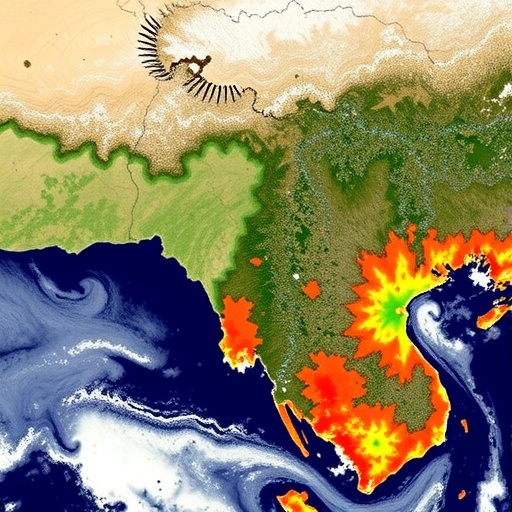
In recent years, countries like Iceland, Switzerland, and Norway have consistently secured top ranks on the United Nations’ Human Development Index (HDI), a critical metric assessing well-being and quality of life worldwide. This index synthesizes key indicators such as health, education, and income, to provide a composite picture of human development across nations. However, broad national averages can obscure significant variations within countries. A groundbreaking study published in Nature Communications on February 17, 2026, leverages satellite imagery coupled with advanced machine learning to estimate HDI at unprecedented granular levels—down to municipalities and grid-sized areas. This innovation exposes stark differences in development tiers previously hidden by aggregated data.
The traditional HDI has been a powerful tool in shaping global policy and development agendas since its inception in 1990, yet it fundamentally relies on national or large administrative unit statistics which mask inequalities and localized needs. This new research advances the methodology by employing computer vision techniques trained on satellite images to predict human development characteristics with remarkable detail. The study analyzed more than 61,000 municipalities worldwide, revealing that over half of the global population resides in areas where municipal HDI diverges from national-level rankings, indicating vast intra-country disparities unaccounted for by earlier assessments.
What sets this work apart is its integration of complex machine learning models that decode visual signatures from satellite data—such as the density of roads, buildings, and urban layouts—to infer socio-economic variables. These visual features correlate with human development metrics, affording a spatial resolution high enough to reflect the real lived conditions of smaller communities. When scaled down further to grid tiles approximately the size of Paris, the mismatch between predicted HDI and country-level data swells to about 13%, emphasizing the magnitude of local variation and the limitations of prior indices.
Importantly, while this satellite-driven approach offers great promise, it does not intrude into the privacy of individual households or neighborhoods, instead serving as a macro-level lens to focus developmental attention at more actionable scales. According to Solomon Hsiang, a co-author and professor of environmental social sciences at Stanford University, this method could revolutionize how aid programs target populations by moving beyond broad national labels to identify pockets of need within countries, helping to optimize resource allocation and policy effectiveness.
The researchers’ method confronts a significant challenge in remote sensing: administrative boundaries like states and provinces are irregular polygons rather than simple rectangular grids, complicating the application of standard computer vision techniques. Yet, their model adeptly learned relationships between satellite image patterns and existing HDI data at provincial levels before extrapolating to municipal and grid levels internationally. This adaptability underlines the robustness of the machine learning framework used to transform complex spatial data into meaningful socio-economic insights.
Historically, the HDI helped reframe development discourse by incorporating dimensions beyond income, highlighting human-centric factors often neglected in economic projections. However, comprehensive census data remain sparse in many low-income countries, sometimes outdated by over a decade, limiting the scope for accurate local measurements. Satellite data pipelines generate exponentially more daily observations than traditional surveys, offering a potentially transformative data source that has been underutilized in the development sector.
The timing of this research is critical. Recent global challenges including the COVID-19 pandemic, climate-induced disasters, and resource scarcities have stalled or reversed progress in human development globally. Heriberto Tapia, head of the UNDP Human Development Report Office, underscores the urgency of these shocks, which disproportionately impact vulnerable regions and necessitate granular understanding to craft responsive policies. The study’s findings provide clarity on how development dynamics unfold at micro scales amid these complex global crises.
Central to the modeling approach is the use of satellite images that capture built infrastructure and population density, key visual proxies indicative of higher human development outcomes. The study found that these two factors alone explain about one-third of the variation in municipal HDI predictions worldwide, while the remaining variability points to other latent socio-economic and environmental elements not yet fully captured by remote sensing. This invites further research into integrating additional data streams for even more refined estimates.
The team also explored the broader applicability of their machine learning pipeline, extending preliminary tests to over 100 socio-economic variables. Early results show the model’s versatility in predicting parameters such as crop yields, asset ownership (including vehicles and livestock), and electricity access. This breadth underscores a future where administrative data of various kinds can be enhanced at much finer spatial resolutions, democratizing access to critical development information and enabling more localized decision-making.
Accessibility and scalability were foundational design principles for the model, aiming to provide a pragmatic solution for practitioners beyond specialized remote sensing experts. Jonathan Proctor, an assistant professor and co-lead author, likens the approach to a “Toyota Camry” in the remote sensing landscape—while it may not have extreme sophistication, it is reliable, straightforward, and practical for widespread use. This democratization of satellite data analytics unlocks powerful insights across government agencies, NGOs, and researchers aiming to target interventions effectively.
Ultimately, this pioneering study not only fills critical data gaps on human development but also ushers in a new paradigm for leveraging Earth observation technology. It challenges policymakers and development practitioners to reconsider strategies grounded in national averages, urging a move toward data-driven, spatially nuanced frameworks. The fusion of satellite imagery and machine learning does not just produce numbers; it crafts a detailed narrative of human conditions across the globe—enabling smarter, more equitable progress toward sustainable development goals amidst the uncertainties of the 21st century.
Subject of Research: Global estimation of Human Development Index (HDI) at municipal and grid levels using satellite imagery and machine learning.
Article Title: Global high-resolution estimates of the UN Human Development Index using satellite imagery and machine learning
News Publication Date: 17-Feb-2026
Web References:
https://doi.org/10.1038/s41467-026-68805-6
References:
Sherman et al., Nature Communications, 2026
Image Credits:
Adapted from Sherman et al. (Nature Communications, 2026)
Keywords
Human Development Index, satellite imagery, machine learning, remote sensing, socio-economic data, global development, spatial analysis, computer vision, UNDP, policy targeting, sustainable development, environmental shocks
Tags: AI in socioeconomic analysiscomputer vision in development studiesdetailed socioeconomic mappingglobal well-being assessment methodsgranular human development index dataHDI limitations and advancementsintra-country inequality detectionlocal disparities in human developmentmachine learning and development gapsmunicipality-level HDI estimationremote sensing for social indicatorssatellite imagery for human development