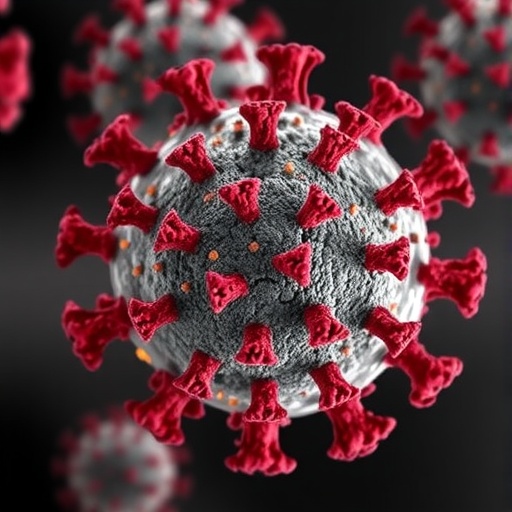
In the ongoing battle against the COVID-19 pandemic, scientists continue to uncover essential nuances in the virus’s genetic makeup that influence its behavior, severity, and transmissibility. A groundbreaking study recently published in Nature Communications by Tsujino, Tsuda, Deguchi, and colleagues sheds new light on a specific mutation outside the spike protein’s well-studied changes. This mutation, labeled R204P, occurs in the nucleocapsid protein of the SARS-CoV-2 Omicron XEC variant and significantly impacts the virus’s inflammatory response and pathogenicity, revealing critical insights into viral dynamics and potential therapeutic targets.
The nucleocapsid protein, often overshadowed by the spike protein in public discourse, plays vital roles in viral RNA packaging, replication, and modulation of host immune responses. The R204P mutation marks a substitution of arginine (R) with proline (P) at position 204, an alteration that appears to enhance the virus’s ability to provoke inflammation and increase its disease-causing potential. This discovery is particularly noteworthy given the current focus on the spike protein mutations that mainly dictate viral entry into host cells.
Molecular analyses conducted by the research team highlight that the R204P mutation influences the structural conformation of the nucleocapsid protein, potentially altering its interaction with viral RNA and host cellular machinery. This structural shift may disrupt the delicate balance normally maintained within infected cells, leading to increased activation of inflammatory pathways. The consequences are twofold: more robust viral replication and a heightened inflammatory milieu that can exacerbate disease severity.
The study employed a comprehensive approach combining in vitro experiments, in vivo animal models, and patient-derived samples to dissect the functional implications of the R204P mutation. In cell cultures, viruses harboring R204P showed significantly increased replication rates compared to counterparts lacking this mutation. This increased replicative fitness correlates tightly with elevated levels of pro-inflammatory cytokines such as IL-6 and TNF-alpha, hallmark molecules linked to severe COVID-19 outcomes.
Animal models mimicking human disease further corroborated these findings. Mice infected with the R204P-containing Omicron XEC variant developed more severe lung pathology, with increased immune cell infiltration and tissue damage. These observations strongly suggest that the mutation not only boosts viral replication but also exacerbates immunopathology, which may contribute to enhanced transmission and worse clinical outcomes.
Clinically, the relevance of R204P emerges from its consistent detection in isolates associated with more severe disease presentations, even among vaccinated individuals. This mutation, therefore, raises concerns regarding potential immune evasion strategies that transcend the spike protein-focused vaccine designs. It may also influence the virus’s interaction with innate immune sensing mechanisms, leading to altered disease progression trajectories.
Mechanistically, the nucleocapsid protein contributes to suppressing interferon signaling, a cornerstone of antiviral innate immune defense. The R204P mutation seems to enhance this suppression, dampening early antiviral responses and providing a window of opportunity for uncontrolled viral proliferation before adaptive immunity kicks in. This delay can shift the host immune response towards a hyperinflammatory state, often seen in severe COVID-19 cases and linked with detrimental outcomes.
From a virological standpoint, the identification of such a mutation outside the spike region underscores the virus’s evolving complexity. It challenges the assumption that pathogenicity and immune escape primarily arise from spike alterations. Instead, it highlights that mutations in other structural proteins can profoundly affect viral fitness and host interactions, urging a reevaluation of diagnostic and therapeutic strategies to encompass a broader spectrum of viral components.
The study’s findings also have direct implications for antiviral drug development. Since the nucleocapsid protein is essential for viral RNA packaging and replication, drugs targeting this protein’s altered structure or function due to the R204P substitution could offer new avenues for intervention. Current therapeutics largely target viral enzymes or spike-mediated entry, but expanding to nucleocapsid-focused drugs could increase treatment effectiveness, especially against variants like Omicron XEC.
Importantly, tracing the evolutionary trajectory of the R204P mutation offers insight into the virus’s adaptive landscape. The researchers report that R204P has independently emerged in multiple lineages, suggesting a strong selective advantage. This convergent evolution points to an intrinsic benefit the mutation confers, likely linked to enhancing both viral fitness and the inflammatory state that facilitates transmission dynamics within populations.
Epidemiologically, the emergence of Omicron XEC harboring R204P coincides with localized surges in severe COVID-19 cases, indicating that surveillance systems should integrate detailed genomic analyses beyond the spike region. This mutation’s presence could serve as a biomarker for aggressive viral variants, aiding public health responses in targeting prevention efforts and resource allocation.
While vaccines remain a critical tool in reducing COVID-19 morbidity and mortality, understanding mutations like R204P emphasizes the persistent threat of SARS-CoV-2’s genetic versatility. Vaccine strategies may need to adapt by incorporating components that elicit broader immunity against diverse viral proteins, possibly including nucleocapsid epitopes, to mitigate the impact of such mutations.
The nuance introduced by the R204P mutation also adds complexity to diagnostic approaches. Since many current PCR tests target spike or ORF1ab sequences, incorporating nucleocapsid mutation screening could optimize variant detection and risk stratification. This refinement could be instrumental in clinical decision-making, enabling tailored treatment plans for patients infected with more inflammatory and pathogenic viral forms.
This research further highlights the dynamic interplay between viral genetics and host immune responses. Understanding how a single amino acid substitution can reposition the viral-host equilibrium emphasizes the importance of integrated viral genomics and immunology research. Such multidisciplinary insights pave the way for more precise epidemic modeling and the development of next-generation therapeutics and vaccines.
In conclusion, the discovery of the R204P mutation in the SARS-CoV-2 Omicron XEC variant nucleocapsid protein dramatically enhances our comprehension of viral pathogenesis beyond the spike protein’s realm. Its contribution to increased inflammation and pathogenicity underlines the virus’s evolving capacity to challenge existing public health measures and medical countermeasures. Continued surveillance and focused research on non-spike mutations are essential for anticipating future viral adaptations and safeguarding global health against COVID-19’s relentless evolution.
Subject of Research: The impact of the non-spike nucleocapsid R204P mutation in SARS-CoV-2 Omicron XEC on inflammation and pathogenicity.
Article Title: A non-spike nucleocapsid R204P mutation in SARS-CoV-2 Omicron XEC enhances inflammation and pathogenicity.
Article References:
Tsujino, S., Tsuda, M., Deguchi, S. et al. A non-spike nucleocapsid R204P mutation in SARS-CoV-2 Omicron XEC enhances inflammation and pathogenicity. Nat Commun (2025). https://doi.org/10.1038/s41467-025-67455-4
Image Credits: AI Generated
Tags: COVID-19 severity factorsimmune response modulationinflammation response in COVID-19molecular analysis of SARS-CoV-2nucleocapsid protein functionsOmicron XEC variant insightsR204P mutation impactSARS-CoV-2 nucleocapsid mutationstructural conformation of nucleocapsidtherapeutic targets for COVID-19viral pathogenicity mechanismsviral RNA packaging and replication