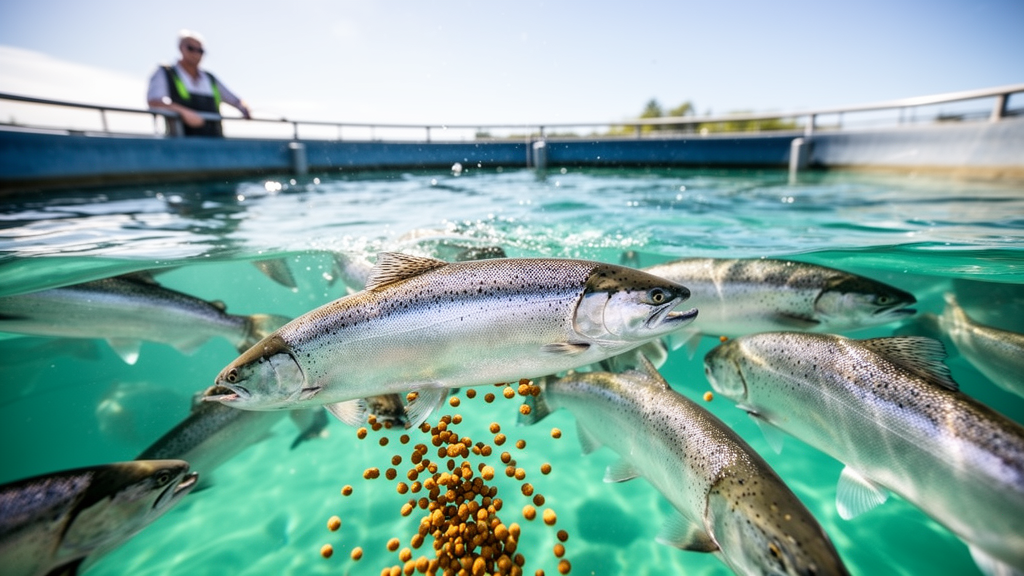
Researchers from Mowi Genetics and Nofima have identified a genetic selection strategy for Atlantic salmon that improves feed efficiency without requiring the difficult measurement of individual feed intake. The study, published in Genetics Selection Evolution, demonstrates that selecting for increased weight gain while simultaneously selecting against the energy density of the gained weight—primarily driven by body fat—can significantly enhance the feed efficiency ratio (FER). This approach addresses a long-standing challenge in aquaculture, where direct selection for feed efficiency is hindered by the intractable problem of accurately measuring long-term feed intake in large numbers of individual fish.
The research team conducted a phenotypic and genetic analysis of energy partitioning traits among 35 full-sib families of Atlantic salmon from the Mowi Genetics breeding nucleus population. The experimental design involved individually tagged and genotyped parr, each weighing an average of 40 grams, which were transported to the Nofima Research Station for Aquaculture in Sunndalsøra, Norway. After a one-month acclimation period, 50 randomly selected fish from each family were distributed into two 150-liter experimental tanks per family, with 25 fish assigned to each tank. The fish were kept in fresh water at a stable temperature averaging 12.1 degrees Celsius under continuous light for a seven-week experimental period.
The fish were fed in excess with water-stable 3 mm feed pellets that contained yttrium oxide as an inert digestibility marker. At the end of the trial, the fish were fasted for two days to empty their guts before being euthanized, weighed, and stored for chemical analysis. A random sample of 60 fish was analyzed individually for whole-body moisture, crude fat, crude protein, and energy, while the remaining 1,688 fish were pooled into tank samples to obtain final tank and family mean values for nitrogen and energy content.
Phenotypic analysis revealed substantial variation among the families in growth and feed traits. The weight gain per family ranged from 28 to 84 grams, with a mean of 60.1 grams, while feed intake varied from 26 to 61 grams per fish. The feed efficiency ratio, defined as weight gain divided by feed intake, varied from 1.10 to 1.38 among families, representing a 27% difference. The energy density of the gained weight, a key indicator of body composition, ranged from 7.9 to 9.7 kJ/g. Individual analysis of the 60 fish showed that body fat was strongly negatively correlated with body moisture and strongly positively correlated with body energy, confirming that deposited fat primarily replaces water in the fish’s body composition.
The genetic analysis estimated moderate genomic heritability for most traits, including feed intake (0.35), weight gain (0.42), feed efficiency ratio (0.19), and energy density of the gained weight (0.26). In contrast, the heritability for residual feed intake, which represents feed intake independent of growth and body composition, was very low at 0.04. This low heritability suggests that most of the genetic variation in feed intake is explained by growth and body composition traits, leaving little room for additional genetic improvement through direct selection on residual feed intake alone.
The study found a strong genetic correlation between feed efficiency ratio and weight gain (0.68), as well as a negative genetic correlation between feed efficiency ratio and energy density of the gained weight (-0.64). These correlations indicate that selecting for increased weight gain and reduced body energy density will result in correlated improvements in feed efficiency. The researchers calculated that a selection index including weight gain and energy density of the gained weight was the most beneficial strategy to increase FER. This index allowed for a 33% increase in feed efficiency ratio and a 163% reduction in energy density of the gained weight, compared to scenarios that did not include energy density as a selection criterion.
Energy budget analysis revealed that the fish retained 50% of the energy intake and 49% of the protein intake. Energy loss was primarily due to heat (29% of intake), faecal loss (18%), and nitrogen excretion (3%). The study found that the effect of body energy, which reflects fat deposition, was half of what could be predicted if energy efficiency were constant. This suggests that fish with reduced body energy deposition have higher feed efficiency but at the cost of reduced energy efficiency, as some of the energy that would have been stored as fat is instead lost as heat.
The researchers noted that the improvement in feed efficiency ratio was strongly associated with an improvement in protein efficiency, which was 49% on average. This association was expected because body protein content varies only within a narrow range among fish, and all groups were given the same feed. The strong correlation between feed efficiency ratio and protein efficiency (R2 = 0.86) indicates that improved feed efficiency through reduced body energy deposition also enhances the utilization of protein in the diet.
The study has important implications for the breeding of Atlantic salmon, as it provides a practical method for improving feed efficiency without the need for individual feed intake records. The results suggest that by selection against body energy, and given the same weight gain, 50% of the reduction in body energy can be realized as reduced feed intake and thus improved feed efficiency ratio. This finding supports the contention that body fat can be used as an alternative selection criterion trait to increase feed efficiency in fish, as suggested by previous studies in other fish species.
However, the study also has limitations. The fish were tested during a relatively short seven-week period in the freshwater phase, and the results may not be directly transferable to the seawater phase, where most of the growth takes place. Additionally, the use of tank means for most traits implies that tank residuals cannot be split into environmental effects of the tank and individual environmental effects, which may affect the estimates of heritability. The researchers emphasize that further studies are needed to confirm these findings in the seawater phase and to develop non-destructive methods for estimating body fat in whole fish.
Feed represents approximately half of production costs and accounts for 85 percent of greenhouse gas emissions generated by Norwegian Atlantic salmon at harvest. Although historical breeding programs improved feed efficiency indirectly as a correlated response to selection for faster growth, that strategy faces diminishing returns because the relationship between feed intake and growth efficiency is curvilinear. The researchers framed feed efficiency ratio through an explicit physiological relationship: the product of feed energy density and energy efficiency divided by the energy density of gained weight. In slaughter-sized farmed salmon, crude fat typically constitutes 21 to 23 percent of whole-body weight and accounts for roughly two-thirds of total body energy. Because fat depots in the carcass and viscera represent costly processing waste, targeting body energy also holds potential to improve edible carcass yield, provided fat levels remain sufficient to safeguard fish health and consumer acceptance.
To analyze genetic architecture across the population, researchers genotyped 1,748 surviving salmon using a customized Affymetrix single nucleotide polymorphism array. After quality filtering based on minor allele frequency and genotype completeness, 55,648 genetic markers were retained for genomic parameter estimation. Mixed linear modeling of tank-level records identified initial body weight, weight gain, gained energy density, and family background as distinct drivers of feed intake. Weight gain was the predominant factor, causing a 925 percent increase in error variance when excluded from the model, followed by family variance at 64.2 percent and energy density of gain at 55.3 percent.
The trial also quantified nutrient partitioning in the nitrogen budget, where fish excreted 40 percent of ingested protein through branchial and urinary pathways and lost 12 percent in faeces. Accounting for marker-derived digestibility, mean digestible energy efficiency reached 61 percent and digestible protein efficiency reached 55 percent. The team compared four selection scenarios applying relative economic weights of positive 1.0 for weight gain and negative 0.25, negative 0.5, or negative 1.0 for feed costs. While adding feed intake or feed efficiency ratio to an index containing weight gain yielded modest overall breeding goal improvements of approximately 2.5 percent, incorporating energy density of gained weight increased overall genetic gain by 11.6 percent. This advantage held because weight gain and feed intake were almost perfectly correlated genetically at 0.98, leaving minimal room for independent progress without compositional traits.
Examining residual feed intake further clarified why direct selection on residual consumption offers limited promise in aquaculture. When the authors omitted energy density from their residual feed intake model, differences in energy density accounted for 47 percent of the remaining variation among rearing tanks. Because growth rate and body composition explain virtually all systematic genetic variance in feed consumption, the residual heritability of 0.04 carried substantial statistical uncertainty. Finally, the authors emphasized that their genomic heritability calculations treated tank-level environmental variance conservatively by assuming zero correlation between replicate tanks. If environmental tank effects were present, the actual heritabilities for growth, intake, and efficiency would be higher than reported, reinforcing the reliability of indirect genomic selection against body energy.
Subject of Research: Genetic selection for feed efficiency in Atlantic salmon
Article Title: Phenotypic and genetic analysis of energy partitioning and feed efficiency in Atlantic salmon
Article References: Sonesson, A. K., Difford, G. F., Norris, A., & Hatlen, B. (2026). Phenotypic and genetic analysis of energy partitioning and feed efficiency in Atlantic salmon. Genetics Selection Evolution, 58(1), Article 26. https://doi.org/10.1186/s12711-026-01045-w
Image Credits: AI Generated
DOI: 10.1186/s12711-026-01045-w
Keywords: Atlantic salmon, feed efficiency, genetic selection, aquaculture, energy partitioning, body composition, feed intake, weight gain, heritability, breeding strategy, protein efficiency, energy density, Mowi Genetics, Nofima, Genetics Selection Evolution
News Source: Juliet Wilcox. (November 14, 2026). Salmon Breeding Strategy Improves Feed Efficiency Without Intake Records. Scienmag.