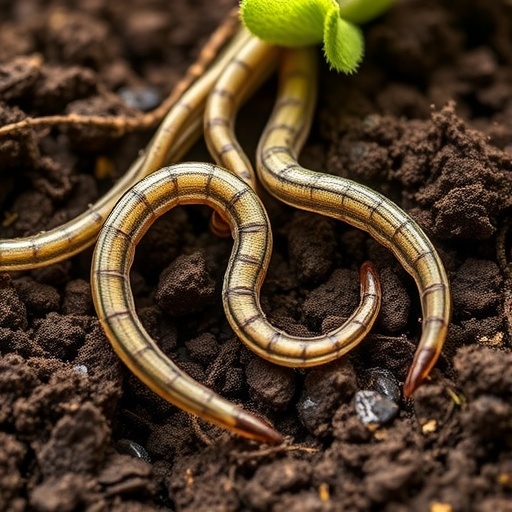
In a groundbreaking study set to redefine our understanding of soil ecology and plant-pathogen interactions, researchers have uncovered a sophisticated mechanism by which root-knot nematodes (RKNs) locate their host plants. This discovery unravels the complex interplay between plant metabolites, the rhizosphere microbial community, and the parasitic nematode’s host-seeking behavior—a process previously shrouded in mystery and often oversimplified.
Root-knot nematodes, Meloidogyne incognita, represent one of the most destructive groups of soil-borne pests, posing an enormous threat to global agriculture through their parasitic attacks on a wide array of crops. Despite decades of research, the environmental cues and biochemical interactions that facilitate nematode host detection have remained obscure, limiting the development of effective control strategies. The new study breaks this deadlock by demonstrating that secondary metabolites exuded by maize roots do not merely fend off attackers but play a paradoxical role in attracting these nematodes.
At the heart of this discovery is a particular class of plant-derived defensive compounds known as benzoxazinoids (BXs). These compounds have been recognized for their antimicrobial and insect-deterring properties. Yet, intriguingly, researchers found that BXs, and in particular the derivative 6-methoxy-benzoxazolin-2-one, act as powerful attractants for root-knot nematodes, enhancing their infection potential. This paradoxical phenomenon suggests an unprecedented role of plant secondary metabolites not only in defense but also in shaping belowground biotic interactions in a way that benefits plant parasites.
The intriguing role of BXs was evident only in the presence of natural soil matrices, pointing toward a complex, tri-partite interaction between plant roots, soil microbes, and nematodes. This soil-dependency indicated that BXs might exert their influence indirectly by modifying the rhizosphere microbial community, thereby altering the chemical environment that nematodes use as navigational cues. Therefore, BXs do not appear to attract nematodes through direct chemoreception alone but through orchestrating microbial shifts that generate nematode-attracting signals.
Delving deeper, the study revealed that 6-methoxy-benzoxazolin-2-one modulates both the abundance and composition of rhizosphere bacterial populations. These bacteria, in turn, produce a bouquet of volatile organic compounds (VOCs), including methyl ketones and 2-phenylethanol. Such compounds are known microbial metabolites with potential signaling roles. These microbially derived volatiles act as beacons that root-knot nematodes exploit to hone in on their host plants, effectively turning the rhizosphere microbial landscape into a map for nematode host seeking.
The chemoperception apparatus of RKNs was found to be finely tuned to detect these microbial volatiles. The nematodes rely on specific chemosensory genes such as Mi-odr-1, Mi-odr-7, and Mi-gpa-6 to sense the cues emanating from the rhizosphere volatiles. This genetic insight underscores the complexity of nematode sensory ecology and identifies molecular players that could be targeted to disrupt the nematode’s host-location ability.
This remarkable synergy between plant metabolites and soil bacteria reveals a novel soil chemical ecology axis where secondary metabolites serve a dual function. While traditionally considered defensive, these compounds inadvertently structure soil microbial communities to emit attractant signals that enhance nematode infection success. The discovery challenges the entrenched view of plant metabolites as straightforward defensive agents and calls for a nuanced appreciation of their multifaceted ecological roles.
Furthermore, the study highlights the critical importance of the soil matrix in mediating plant-nematode interactions. Controlled environment studies devoid of natural soil failed to replicate the BX effect on nematode behavior, underscoring that microbial mediation is indispensable. This finding elevates the significance of considering the whole soil ecosystem, rather than isolated components, when studying belowground biotic interactions and pest management.
From an applied perspective, these insights might open new avenues for nematode control strategies. Targeting the microbial shifts induced by BXs or interfering with the biosynthesis of VOCs could potentially disrupt the nematode’s homing capability. Alternatively, breeding or engineering maize varieties with altered BX profiles might recalibrate rhizosphere microbial communities to make the plant less attractive to nematodes without compromising their defensive properties against other pests and pathogens.
Moreover, the identification of nematode chemosensory genes involved in volatile detection provides promising molecular targets for novel nematicides or repellents. Chemicals that block Mi-odr-1, Mi-odr-7, or Mi-gpa-6 receptor function could impair nematode navigation and infection, offering a precision-based approach that minimizes collateral damage to beneficial soil organisms.
This study also points to the broader ecological implications of plant secondary metabolites in shaping rhizosphere food webs. It reminds scientists that the rhizosphere is a dynamic chemical hub, where metabolites mediate complex interactions among plants, microbes, and soil fauna. Understanding these conduits of communication and coevolution may yield profound insights into ecosystem resilience and productivity.
The findings from this research demand a paradigm shift in plant pathology and soil microbiology. Instead of a simple binary between plant defense and pathogen attack, we now appreciate an intricate network where plant metabolites indirectly modulate pathogen behavior by reshaping microbial communities. Such sophisticated multitrophic interactions underscore the delicacy and complexity of belowground ecosystems, urging a holistic approach to their study and management.
Importantly, the ecological context elucidated in this study transcends maize and root-knot nematodes. It is conceivable that similar secondary-metabolite-driven microbial shifts might regulate host-pathogen interactions across diverse cropping systems and soilborne diseases. This could prompt a wider search for analogous metabolite-microbe-pathogen paradigms in other important agricultural systems.
In conclusion, this research heralds a new era in understanding soilborne pest behavior and opens up innovative strategies for sustainable pest management. Through advanced chemical ecology, microbial ecology, and molecular biology, scientists are now better positioned to unravel the subterranean battles that determine crop health and yield. Exploiting these insights could help safeguard global food security against the relentless threat of root-knot nematodes.
As the scientific community digests these paradigm-shifting findings, one thing is clear: the soil beneath our feet is far from inert. It is a vibrant, chemically mediated landscape where plant metabolites shape microbial assemblages that, in turn, modulate the behavior of devastating pathogens. Harnessing this knowledge promises to revolutionize agricultural practices and secure crop production in an increasingly challenging world.
Subject of Research: The study explores the complex interactions between maize-derived benzoxazinoids, rhizosphere bacterial communities, and the host-seeking behavior of the root-knot nematode Meloidogyne incognita.
Article Title: Root-knot nematode Meloidogyne incognita uses secondary-metabolite-mediated soil microbiome shifts to locate host plants.
Article References:
Wu, Z., Liu, Z., Wang, W. et al. Root-knot nematode Meloidogyne incognita uses secondary-metabolite-mediated soil microbiome shifts to locate host plants. Nat. Plants (2026). https://doi.org/10.1038/s41477-025-02205-4
Image Credits: AI Generated
DOI: https://doi.org/10.1038/s41477-025-02205-4
Tags: agricultural pest managementbenzoxazinoids and nematodesbiochemical interactions in soil ecologycrop protection strategieshost-seeking behavior of nematodesMeloidogyne incognitanematode attraction mechanismsplant-pathogen relationshipsrhizosphere microbial communityroot-knot nematodessecondary metabolites in plantssoil microbiome interactions