• HOME
  • NEWS
  • EXPLORE
    • CAREER
      • Companies
      • Jobs
    • EVENTS
    • iGEM
      • News
      • Team
    • PHOTOS
    • VIDEO
    • WIKI
  • BLOG
  • COMMUNITY
    • FACEBOOK
    • INSTAGRAM
    • TWITTER
Sunday, February 8, 2026
BIOENGINEER.ORG
No Result
View All Result
  • Login
  • HOME
  • NEWS
  • EXPLORE
    • CAREER
      • Companies
      • Jobs
        • Lecturer
        • PhD Studentship
        • Postdoc
        • Research Assistant
    • EVENTS
    • iGEM
      • News
      • Team
    • PHOTOS
    • VIDEO
    • WIKI
  • BLOG
  • COMMUNITY
    • FACEBOOK
    • INSTAGRAM
    • TWITTER
  • HOME
  • NEWS
  • EXPLORE
    • CAREER
      • Companies
      • Jobs
        • Lecturer
        • PhD Studentship
        • Postdoc
        • Research Assistant
    • EVENTS
    • iGEM
      • News
      • Team
    • PHOTOS
    • VIDEO
    • WIKI
  • BLOG
  • COMMUNITY
    • FACEBOOK
    • INSTAGRAM
    • TWITTER
No Result
View All Result
Bioengineer.org
No Result
View All Result
Home NEWS Science News Chemistry

Room-temperature superionic conduction achieved using pseudorotation of hydride complexes

Bioengineer by Bioengineer
May 13, 2020
in Chemistry
Reading Time: 2 mins read
0
IMAGE
Share on FacebookShare on TwitterShare on LinkedinShare on RedditShare on Telegram

IMAGE

Credit: Shigeyuki Takagi

There is currently a strong demand to replace organic liquid electrolytes used in conventional rechargeable batteries, with solid-state ionic conductors which will enable the batteries to be safer and have higher energy density.

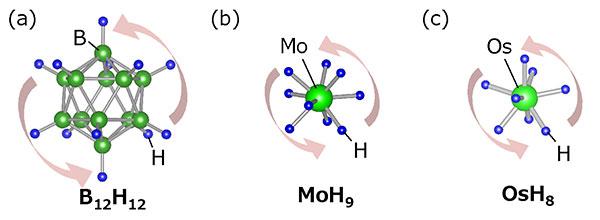
To that end, much effort has been devoted to finding materials with superior ionic conductivities. Among the most promising, are solid-state ionic conductors that contain polyanions such as B12H122- (Fig. 1a). They constitute a particular class of materials due to their unique transport behavior, which has the polyanions rotating at an elevated temperature, thereby greatly promoting cation conductivities.

However, a major drawback is the high temperature (=energy) required to activate the rotation, which conversely means low conductivities at room temperature.

To address that problem, a research group at Tohoku University, led by Associate Professor Shigeyuki Takagi and Professor Shin-ichi Orimo, has established a new principle for room-temperature superionic conduction. Its findings were recently published in Applied Physics Letters.

The research group was able to reduce the activation temperature by using transition metal hydride complexes as a new class of rotatable polyanions, wherein hydrogen is the sole ligand species, covalently binding to single transition metals. Unlike in B12H122- polyanions (Fig. 1a), the rotation of transition metal hydride complexes only requires displacements of highly mobile hydrogen (Figs. 1b, 1c) and can therefore be expected to occur with low activation energy.

The group then studied the dynamics of transition metal hydride complexes in several existing hydrides, and found them reoriented – as if rotating by repeating small deformations (Fig. 2) – even at room temperature.

This kind of motion is known as “pseudorotation,” and is rarely observed in solid matter. Due to the small displacements of hydrogen atoms, the activation energy of the pseudorotation is relatively low – more than 40 times lower than what’s reportedly needed for the rotation of B12H122-.

As a result of a cation conduction being promoted from a low temperature region by pseudorotation, the lithium ion conductivity in Li5MoH11 containing MoH93- (Fig. 1b), for example, can reach 79 mS cm-1 at room temperature (Fig. 3). This is more than three times the world record of room-temperature lithium ion conductivity reported so far. This suggests that an all-solid-state lithium ion battery with shorter charging time at room temperature can be realised.

The discovered mechanism is quite general and would be useful in lowering the temperature required to activate the rotation of polyanions. This may positively contribute towards finding compositions that are amenable to room-temperature superionic conductors.

###

Media Contact
Shigeyuki Takagi
[email protected]

Original Source

https://www.tohoku.ac.jp/en/press/room_temperature_superionic_conduction_achieved.html

Related Journal Article

http://dx.doi.org/10.1063/5.0002992

Tags: Chemistry/Physics/Materials Sciences
Share12Tweet8Share2ShareShareShare2

Related Posts

blank

Breakthrough in Environmental Cleanup: Scientists Develop Solar-Activated Biochar for Faster Remediation

February 7, 2026
blank

Cutting Costs: Making Hydrogen Fuel Cells More Affordable

February 6, 2026

Scientists Develop Hand-Held “Levitating” Time Crystals

February 6, 2026

Observing a Key Green-Energy Catalyst Dissolve Atom by Atom

February 6, 2026
Please login to join discussion

POPULAR NEWS

  • Robotic Ureteral Reconstruction: A Novel Approach

    Robotic Ureteral Reconstruction: A Novel Approach

    82 shares
    Share 33 Tweet 21
  • Digital Privacy: Health Data Control in Incarceration

    63 shares
    Share 25 Tweet 16
  • Breakthrough in RNA Research Accelerates Medical Innovations Timeline

    53 shares
    Share 21 Tweet 13
  • Mapping Tertiary Lymphoid Structures for Kidney Cancer Biomarkers

    50 shares
    Share 20 Tweet 13

About

We bring you the latest biotechnology news from best research centers and universities around the world. Check our website.

Follow us

Recent News

Decoding Phantom Limb Movements via Intraneural Signals

Attitudes Toward Aging Impact Early Nursing Home Quality

Transforming Healthcare: Just Culture and Restorative Practices

Subscribe to Blog via Email

Enter your email address to subscribe to this blog and receive notifications of new posts by email.

Join 73 other subscribers
  • Contact Us

Bioengineer.org © Copyright 2023 All Rights Reserved.

Welcome Back!

Login to your account below

Forgotten Password?

Retrieve your password

Please enter your username or email address to reset your password.

Log In
No Result
View All Result
  • Homepages
    • Home Page 1
    • Home Page 2
  • News
  • National
  • Business
  • Health
  • Lifestyle
  • Science

Bioengineer.org © Copyright 2023 All Rights Reserved.