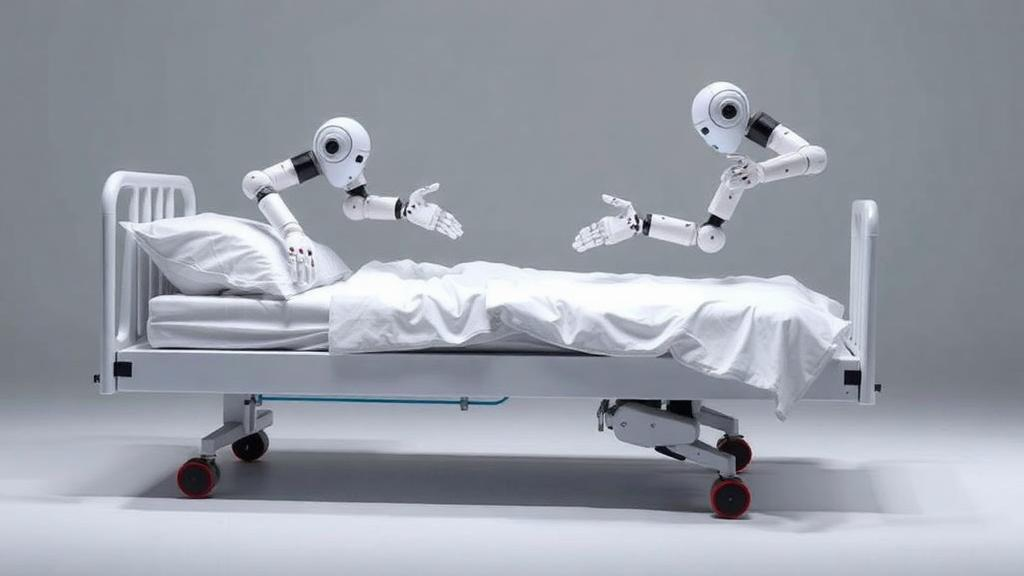
Making a hospital bed is one of those tasks that humans perform almost without thinking, yet it has long stood as a stubborn benchmark problem in robotics. A bed sheet is a deformable object: it drapes, folds, slips, and entangles in ways that defy the rigid geometry that robots handle so well. Now, a team of researchers in Taiwan has built a robotic system that can autonomously make a bed using two coordinated arms, a vision-language perception pipeline, and a closed-loop recovery mechanism that lets the robot detect its own failures and try again. The work, published in the International Journal of Intelligent Robotics and Applications by Chih-Hsuan Shih, Po-Hsun Cheng, and Yung-Yu Chuang, reports an average step-wise success rate of 91.9 percent on a real physical robot, offering one of the clearest pictures yet of both the promise and the remaining limits of deformable object manipulation in assistive robotics.
The motivation is practical and pressing. Nursing staff spend significant time and physical effort making beds, and the repetitive bending, lifting, and reaching involved contributes to musculoskeletal strain. Automated bed-making could reduce that physical burden while also lowering infection risk, since consistent, standardized bed preparation matters in clinical environments. Surveys cited in the study suggest that nurses and patients are generally willing to work alongside service robots in healthcare settings, and recent studies indicate that nursing robots can reduce workload in general adult wards. But translating that demand into a working machine requires solving a problem that has resisted a decade of research: reliably manipulating cloth, the archetypal deformable object, in an unstructured real-world environment.
The core of the new framework is a formal twelve-step task decomposition of bed-making. Rather than treating the job as one monolithic skill, the researchers broke it into a reproducible sequence of task-level stages, bridging high-level semantic reasoning and low-level manipulation control. This structured representation matters because long-horizon tasks compound errors: a small mistake in an early stage, such as a poor grasp of a sheet corner, propagates through every subsequent action. By formalizing the task as a discrete sequence, the team created a framework in which each step can be monitored, evaluated, and recovered from independently, and in which performance can be measured stage by stage rather than only as an overall pass-or-fail outcome.
Perception is driven by semantic keypoints, a technique that has become a powerful tool for handling deformable objects. Instead of asking a vision system to label every pixel of a crumpled sheet, the robot uses vision-language models to localize semantically meaningful points: the corner of a sheet, the edge of a mattress, the midpoint of a fold. The approach builds on open-vocabulary detection systems such as Grounding DINO and YOLO-World, and on the visual grounding tradition established by CLIP, allowing the robot to identify task-relevant points from natural language descriptions without needing task-specific retraining. Earlier work on general-purpose clothes manipulation with semantic keypoints demonstrated the promise of this representation, and the new study extends it to the more demanding setting of dual-arm bed-making, where two manipulators must act on the same deformable object in a coordinated way.
Once keypoints are localized, the system plans coordinated dual-arm motion for fabric handling. Two arms are not merely a convenience here; they are essential. Spreading a sheet across a mattress, aligning its edges, and folding it flat all require simultaneous control of two distant points on the same cloth, with continuous tension maintained between them. The manipulation planner generates motions that respect the coupled geometry of the fabric, drawing on a research lineage that includes model-free visual servoing for deformation control, dynamic movement primitives for deformable manipulation, and learned pick-point detection for robotic bed-making. The team also employed hand-eye calibration using 3D-to-3D correspondences to align what the cameras see with where the arms actually move, a deceptively mundane step that is critical for millimeter-level grasp accuracy.
Perhaps the most consequential engineering contribution is the closed-loop recovery mechanism. In open-loop systems, a robot executes a planned sequence and hopes for the best; any failure, such as grasping two layers of fabric instead of one, silently corrupts everything that follows. The new system instead monitors each step, detects unsuccessful grasps, and updates its perception, planning, and execution accordingly. If a grasp fails, the robot re-perceives the scene, re-plans, and retries, treating uncertainty as an expected condition rather than an exception. This probabilistic stance toward real-world execution, long a theme in robotics, is what lifts the system’s average step-wise success rate to 91.9 percent across the twelve stages, a figure that would be unattainable with naive open-loop execution.
The experimental evaluation on a real robotic system reveals a striking asymmetry in difficulty. Rigid manipulation tasks, such as moving objects with well-defined geometry, achieved near-perfect reliability. Deformable operations, particularly sheet folding, remained the primary bottleneck, hampered by perception and grasp uncertainty. The most troublesome failure mode identified by the researchers occurs in the early stages, when the robot must distinguish individual fabric layers. Grabbing two layers of a sheet when only one is intended may look superficially successful, but the error cascades through the task, distorting subsequent folds and alignments in ways that later recovery steps cannot fully undo. This error propagation across task stages is precisely why the overall task success rate lags behind the per-step figure, and it encapsulates the central challenge of long-horizon deformable manipulation.
The study situates itself within a rapidly evolving research landscape. Deep-learned pick-point detection for robot bed-making dates back to work presented at the International Symposium on Robotics Research in 2019, and simulation-to-real reinforcement learning for deformable objects has been explored since at least 2018. More recently, large language models have been used for symbolic planning in long-horizon deformable assembly, and open-source vision-language-action models such as OpenVLA have begun to unify perception and control. Tactile sensing is emerging as a complementary channel: researchers have shown that robots can singulate layers of cloth using tactile feedback, and transformer-based multimodal frameworks are being developed for material perception. The Taiwanese team’s contribution is to integrate these threads, vision-language keypoint localization, dual-arm planning, and closed-loop recovery, into a single working system tested end-to-end on hardware, rather than in simulation alone.
The authors are candid about the limitations and the path forward. Future work will integrate tactile and visual feedback to improve layer-state estimation, giving the robot a direct physical sense of how many fabric layers it holds, and to enable adaptive recovery strategies that respond to the actual state of the cloth rather than only its appearance. This is a sensible direction, since vision alone struggles with the self-occlusion and ambiguity that make layered fabric so treacherous. The research was supported by Taiwan’s National Science and Technology Council and the Industrial Technology Research Institute, reflecting an institutional commitment to translating assistive robotics from laboratory demonstrations into clinically useful systems.
For the field of embodied AI, the 91.9 percent step-wise success rate is both an achievement and a diagnostic. It shows that structured task decomposition, semantic perception, and failure-aware control can carry a robot through a genuinely long-horizon household task on real hardware. It also shows, with unusual clarity, exactly where the frontier lies: not in rigid grasping, which is essentially solved at this scale, but in the entangled physics of cloth, where seeing is not always knowing. If the next generation of these systems can feel the difference between one layer and two, the humble act of making a bed may become one of the first full-scale deformable manipulation tasks that robots perform reliably alongside nurses, and a template for the laundry-folding, dressing-assisting, and linen-handling robots that would follow.
Subject of Research: Autonomous dual-arm robotic bed-making using semantic keypoint perception and closed-loop recovery for deformable object manipulation
Article Title: Dual-arm manipulation driven by semantic keypoints for autonomous bed-making
Article References: Shih, C.-H., Cheng, P.-H., & Chuang, Y.-Y. (2026). Dual-arm manipulation driven by semantic keypoints for autonomous bed-making. International Journal of Intelligent Robotics and Applications. https://doi.org/10.1007/s41315-026-00597-w
Image Credits: AI Generated
DOI: 10.1007/s41315-026-00597-w
Keywords: assistive robotics, deformable object manipulation, semantic keypoints, dual-arm manipulation, vision-language models, closed-loop recovery, long-horizon planning, hospital automation, robotic perception, fabric handling, embodied AI, nursing robots
News Source: Denise Maddox. (October 7, 2026). Robots Learn to Make Hospital Beds Using Semantic Keypoints and Two Arms. Scienmag.