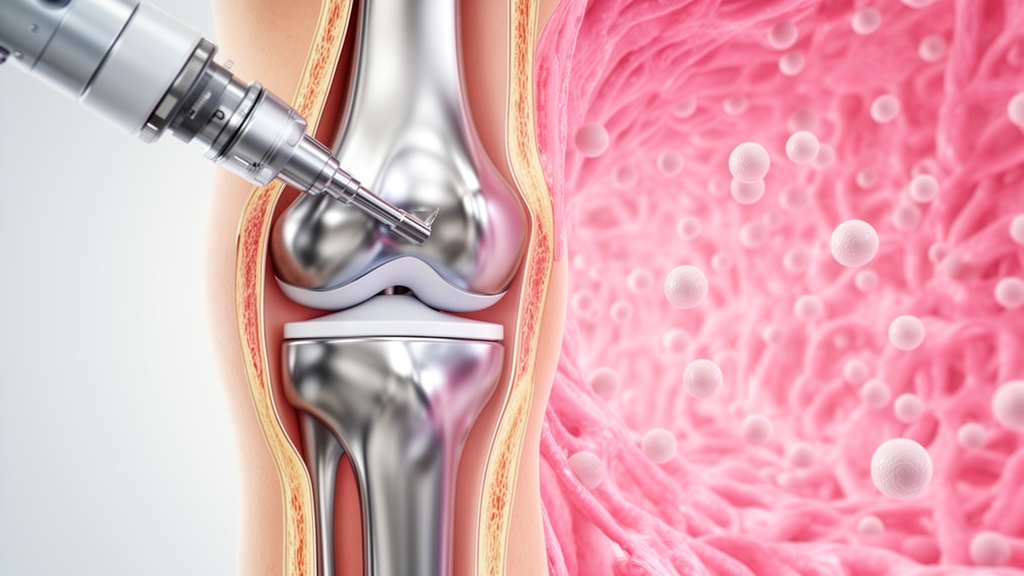
Robotic-arm–assisted total knee arthroplasty is associated with significantly lower local and systemic inflammatory responses compared to conventional manual total knee arthroplasty, according to a prospective comparative study published in the Journal of Orthopaedic Surgery and Research.
The clinical study was designed to compare postoperative inflammatory activity between conventional total knee arthroplasty and robotic-arm–assisted procedures, testing the proposition that robotic assistance reduces surgical trauma and subsequent inflammation.
The prospective trial included a total of sixty patients undergoing primary total knee arthroplasty, comprising thirty-four patients who underwent conventional manual surgery and twenty-six patients treated with robotic-arm–assisted surgery.
Local joint inflammation was monitored through surgical drain fluid collected at six, twenty-four, and forty-eight hours postoperatively, with researchers analyzing concentrations of tumor necrosis factor-alpha, interleukin-1beta, interleukin-6, and interleukin-8.
To evaluate systemic inflammation, venous blood samples were drawn prior to surgery, at six hours, and on postoperative days one, two, seven, fourteen, thirty, and sixty to track total white blood cell counts, differential counts, neutrophil-to-lymphocyte ratio, monocyte-to-lymphocyte ratio, erythrocyte sedimentation rate, C-reactive protein, creatine kinase, lactate dehydrogenase, tumor necrosis factor-alpha, interleukin-6, and interleukin-8.
Analysis of local joint drain fluid demonstrated significantly lower inflammatory markers in the robotic-arm–assisted cohort compared to conventional surgery, including lower interleukin-8 on postoperative day one and postoperative day two, as well as significantly lower tumor necrosis factor-alpha on postoperative day two.
Systemic circulation markers also demonstrated significant reductions among robotic-assisted patients, who exhibited lower serum interleukin-6 at six hours and on postoperative days one, two, and thirty, alongside lower serum interleukin-8 and tumor necrosis factor-alpha at six hours and postoperative day one, with interleukin-8 remaining lower on postoperative day two.
Additional systemic markers reflected diminished inflammatory activity in the robotic-assisted group, which showed lower C-reactive protein on postoperative days two, seven, fourteen, and thirty, lower lactate dehydrogenase on days seven and fourteen, reduced white blood cell counts at six hours and days two, seven, fourteen, and thirty, as well as lower neutrophil and monocyte counts extending up to sixty days postoperatively.
The reduction in drain fluid interleukin-8 reached statistical significance on the first postoperative day with a p-value of 0.017, strengthening further on the second postoperative day to a p-value of less than 0.001. Similarly, the local reduction in tumor necrosis factor-alpha on day two achieved statistical significance at a p-value of 0.015.
Across the systemic blood evaluations, every identified comparative difference met a uniform significance threshold of p less than 0.05. The protocol established baseline measurements prior to surgery and monitored markers across an extended sixty-day timeline, contrasting with the forty-eight-hour limit of local drainage. Notably, the data revealed divergent leukocyte trajectories: monocyte reductions persisted continuously from six hours through day sixty, whereas neutrophil decreases occurred at six hours and then resumed from day seven through day sixty.
Their findings were published on October 22, 2026, as an open-access research paper in the Journal of Orthopaedic Surgery and Research. Released early to provide timely access to peer-reviewed data prior to the final Version of Record, the report concluded that robotic-arm–assisted total knee arthroplasty was associated with lower local and systemic inflammatory responses compared to conventional manual knee replacement.
Subject of Research: Local and systemic inflammatory responses in conventional versus robotic-arm-assisted total knee arthroplasty
Article Title: Local and systemic inflammatory responses in conventional manual versus robotic-arm-assisted total knee arthroplasty: a prospective comparative study
Article References: Shin, J.-S., Seo, Y. J., Lee, S., Kim, D. J., & Song, S. Y. (2026). Local and systemic inflammatory responses in conventional manual versus robotic-arm-assisted total knee arthroplasty: a prospective comparative study. Journal of Orthopaedic Surgery and Research. https://doi.org/10.1186/s13018-026-07336-8
Image Credits: AI Generated
DOI: 10.1186/s13018-026-07336-8
Keywords: total knee arthroplasty, robotic-arm-assisted TKA, conventional knee arthroplasty, local inflammation, systemic inflammation, interleukin-6, interleukin-8, tumor necrosis factor-alpha, C-reactive protein, lactate dehydrogenase, white blood cell count, neutrophils, monocytes, drain fluid, prospective comparative study, orthopaedic surgery
News Source: Ophelia Keating. (November 20, 2026). Robotic Knee Replacement Shows Reduced Local and Systemic Inflammatory Responses. Scienmag.