In an experimental investigation published in Wearable Technologies, biomedical roboticists tested how different robotic joint constraints affected healthy participants learning an unfamiliar, physics-based movement task. The team discovered that while robotic constraints have previously enhanced performance during static reaching movements, imposing external joint coordination patterns onto learners tackling an unfamiliar dynamic task frequently degraded overall training success. Introducing physical constraints altered the intrinsic task dynamics that users needed to master, severely impeding natural motor exploration. Crucially, when an exoskeleton instead enforced a personalized movement constraint derived from an individual’s own initial attempts, participants preserved their capacity to learn, demonstrating that wearable robotic training paradigms must incorporate user-specific coordination behaviors to avoid impairing motor skill acquisition.
In therapeutic environments, upper-limb exoskeletons are frequently engineered with the objective of retraining functional arm coordination in individuals recovering from neurological injuries, such as stroke, or assisting individuals with limb loss in operating prostheses. Most foundational research into robotic motor training, however, has examined motor adaptation within static environments, such as guiding the hand along predefined paths toward fixed visual targets. In those settings, an individual primarily adapts an already known baseline reaching synergy against artificial mechanical perturbations or force fields. In contrast, acquiring entirely new motor skills within dynamic environments requires a human learner to actively discover how bodily kinematic movements couple with environmental mechanics, demanding continuous motor exploration that rigid robotic assistance schemes may inadvertently suppress.
To rigorously investigate whether exoskeleton guidance facilitates or impedes genuine motor skill acquisition, the research team evaluated learning dynamics through a virtual recreation of Kendama, a traditional Japanese ball-and-cup coordination toy. In this task, the player manipulates a cup attached by a string to a ball, swinging the ball upward along a controlled trajectory to catch it neatly inside the cup. The investigators created a simplified virtual edition of the task within Unreal Engine 4 and rendered it to users via an Oculus Rift virtual reality headset, enforcing a standardized frontal-plane movement strategy where participants kept their arm motions aligned parallel to the torso to maintain comparable movement geometries across trials.
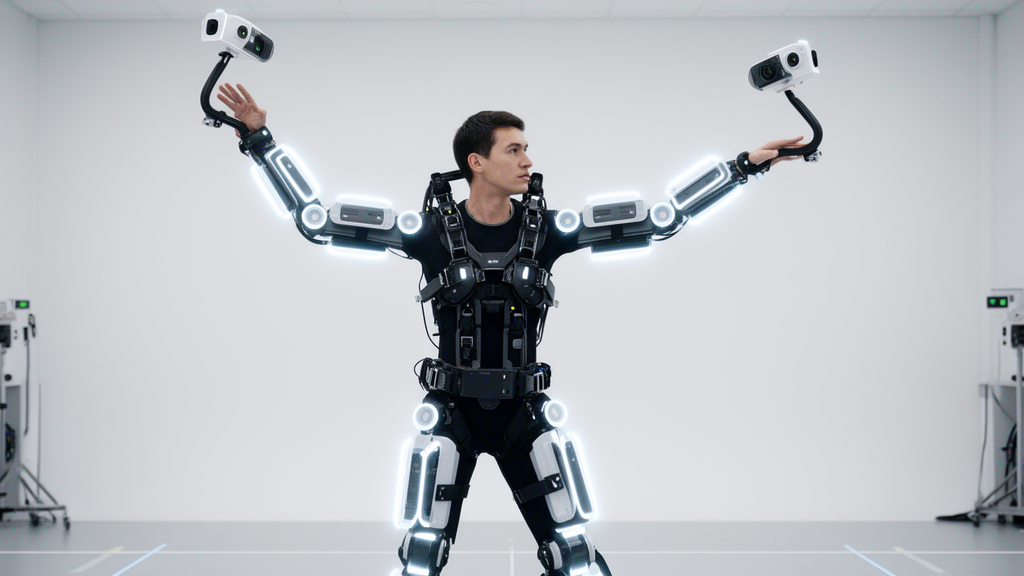
The physical training platform was the Harmony exoskeleton, a bimanual upper-limb robotic system featuring seven active degrees of freedom per arm, covering shoulder elevation and depression, protraction and retraction, abduction and adduction, internal and external rotation, shoulder flexion and extension, elbow flexion and extension, and forearm pronation and supination. Because the Harmony system mechanically restricts wrist flexion and extension, all participants were constrained to perform the virtual Kendama task without articulating their wrists, establishing an unfamiliar movement baseline across all experimental cohorts. The robotic hardware operated via torque control running at a frequency of 200 Hz, while the accompanying virtual reality simulation updated at 60 Hz. Each individual catching attempt lasted under four seconds, segmented uniformly by identifying the peak end-effector velocity and capturing data from one second prior to the peak velocity through two seconds following it.
To formalize and enforce joint movement patterns without dictating the exact timing or speed of the motion, the researchers employed joint angle coordination control, an impedance-controlled force-field framework. Rather than forcing the arm to follow an artificial time-dependent trajectory, the controller governed spatial relationships among joint angles. By applying principal component analysis across the seven-dimensional joint angle trajectories of task attempts, the researchers isolated the dominant coordination vector that accounted for the primary variance in human joint motion. Using unsupervised k-means clustering across attempt profiles, the system pinpointed the specific coordination vector most strongly correlated with successful catches. The robotic controller then generated joint-level restorative torques proportional to the angular deviation between the user’s real-time limb configuration and the target coordination manifold, compelling the limb toward the desired joint synergy while granting the user full voluntary control over movement pacing.
The study protocol recruited 43 healthy novice participants with a mean age of 24.9 years, including 13 female participants, who were allocated into four distinct experimental training cohorts across a single session of 200 discrete attempts. Each session was divided into three operational stages: an initial baseline evaluation block of 50 attempts, an experimental training block spanning 100 attempts, and a final post-training evaluation block comprising 50 attempts. During the initial and final 50-attempt blocks, the exoskeleton operated exclusively in an active gravity-support mode that compensated for the robot’s physical mass and friction, imparting a sensation analogous to moving submerged in water without restricting joint coordination. The baseline control cohort, composed of 13 participants, completed all 200 attempts in this passive gravity-support mode. Data from this control group served to define the normative expert-level task-specific coordination vector that informed the constraint structures applied to subsequent intervention cohorts.
The remaining 30 participants were divided into three experimental intervention groups of 10 individuals each, receiving distinct robotic torque control schemes during their central 100-attempt training block. The preferred constraint group trained under a personalized coordination constraint calculated directly from each participant’s own initial successful movement clusters observed during their first 50 gravity-supported attempts. In contrast, the fixed constraint group trained under a generalized, task-specific coordination vector derived from the high-performing attempts of the control cohort. The fourth cohort, designated the null-space constraint group, trained with an intervention mode that permitted movement within the null space perpendicular to the expert coordination vector while penalizing alignment with the expert coordination itself. By comparing these distinct mechanical interventions against unconstrained baseline training, the researchers systematically assessed whether forcing adherence to normative movement forms actually improved learning outcomes.
To quantify participant performance, the authors evaluated both extrinsic behavioral outcomes and intrinsic biomechanical kinematic changes across experimental phases. The primary extrinsic metric was the raw success rate, defined as the total number of successful ball catches within each 50-attempt block. Because catches in Kendama represent a highly challenging, discrete binary event, the researchers also recorded a close-attempt rate, defined as any attempt in which the virtual ball passed within a five-centimeter margin of the cup rim. Intrinsic kinematic measures captured the angular distance between a participant’s observed joint trajectories and three distinct reference coordinations: the participant’s own initial coordination, their post-training learned coordination, and the normative task-specific coordination established by the control group. Statistical comparisons relied on two-way repeated-measures analyses of variance, paired t-tests, and non-parametric Wilcoxon rank-sum tests where normality checks failed.
The extrinsic performance metrics revealed striking differences in how the training regimens altered catching competence from the initial baseline block to the final post-training evaluation. Participants in the unconstrained control group exhibited clear, statistically significant skill gains, improving their average catching score by 7.9 successes per 50-attempt block. Participants training with the personalized preferred constraint also achieved significant motor learning, improving their success rate by an average of 2.0 catches per block. In stark contrast, participants subjected to the generalized fixed constraint demonstrated zero mean improvement, recording an average change of 0.0 successes after completing 100 constrained practice attempts. Similarly, the null-space constraint group achieved an insignificant change averaging just 0.6 additional successes per block. Furthermore, analysis of the close-attempt metric showed that the fixed constraint cohort improved significantly less than all other groups, demonstrating that enforcing an external, non-personalized synergy severely hindered functional skill acquisition.
Biomechanical evaluation of intrinsic joint coordination provided crucial insights into why the generalized constraints suppressed extrinsic task success. Repeated-measures analyses demonstrated a significant effect of training phase on participant convergence toward individual learned coordinations across all experimental cohorts. Regardless of whether an individual trained freely, under personalized guidance, or under rigid task-specific constraints, every participant converged toward a more internally consistent, repeatable kinematic synergy by the final 50 attempts. However, in the fixed constraint and null-space groups, participants converged upon non-optimal coordinations that did not translate into higher catching rates once the robotic guidance was removed. While participants in the control and non-personalized groups naturally drifted away from their initial movement habits as they adapted, participants in the preferred constraint group maintained close kinematic proximity to their initial coordination, demonstrating that the personalized intervention stabilized individual movement tendencies without arresting the learning process.
The researchers explained these divergent outcomes through the operational framework of the motor exploration-exploitation trade-off. When human novices encounter an unfamiliar dynamic task, they must initially explore a broad operational landscape of joint combinations and timing relationships to deduce the physical dynamics of the external environment. The unconstrained control group enjoyed total mechanical freedom to explore this dynamic landscape, allowing learners to discard ineffective joint strategies and autonomously settle upon functional solutions. The fixed and null-space interventions, however, artificially restricted the kinematic workspace to a single dominant principal component, severely penalizing deviations from a predetermined pattern. Because participants were denied the mechanical liberty to probe alternative coordinations or adapt to environmental feedback, their ability to synthesize internal models of the dynamic ball-and-cup system was severely degraded. When the constraint was tailored to an individual’s organic movement tendencies, as in the preferred constraint cohort, exploration was not stifled to the same damaging degree.
Although forcing learners into standardized, expert-derived movement patterns can assist execution during simple, static reaching exercises, the same strategy proves counterproductive when applied to complex dynamic motor learning. For robotic systems to effectively foster genuine motor acquisition rather than passive reliance, rehabilitation curricula must adapt to the idiosyncratic biomechanics of the patient rather than enforcing rigid, one-size-fits-all kinematics. The authors concluded that future robotic training systems should implement personalized, curriculum-based control architectures that permit broad exploratory movement freedom during early practice, selectively introducing tailored coordination constraints only after an individual’s unique motor tendencies have been established.
Subject of Research: Upper-limb robotic exoskeleton constraints and motor learning in dynamic tasks
Article Title: Joint coordination constraints using an upper limb exoskeleton impact novel skill acquisition
Article References: Ghonasgi, K., Mirsky, R., Haith, A. M., Stone, P., & Deshpande, A. D. (2025). Joint coordination constraints using an upper limb exoskeleton impact novel skill acquisition. Wearable Technologies, 6, Article e52. https://doi.org/10.1017/wtc.2025.10028
Image Credits: AI Generated
Keywords: Robotic exoskeletons, Motor learning, Upper limb rehabilitation, Kinematic coordination, Dynamic motor tasks, Kendama task, Harmony exoskeleton, Joint angle coordination control, Principal component analysis, Personalized motor training, Human-robot interaction, Physical human-robot interaction, Impedance control, Motor skill acquisition, Rehabilitation robotics, Motor adaptation, Virtual reality training
News Source: Denise Maddox. (November 26, 2026). Robotic Exoskeleton Constraints Can Hinder Dynamic Skill Learning Unless Personalized to Users. Scienmag.