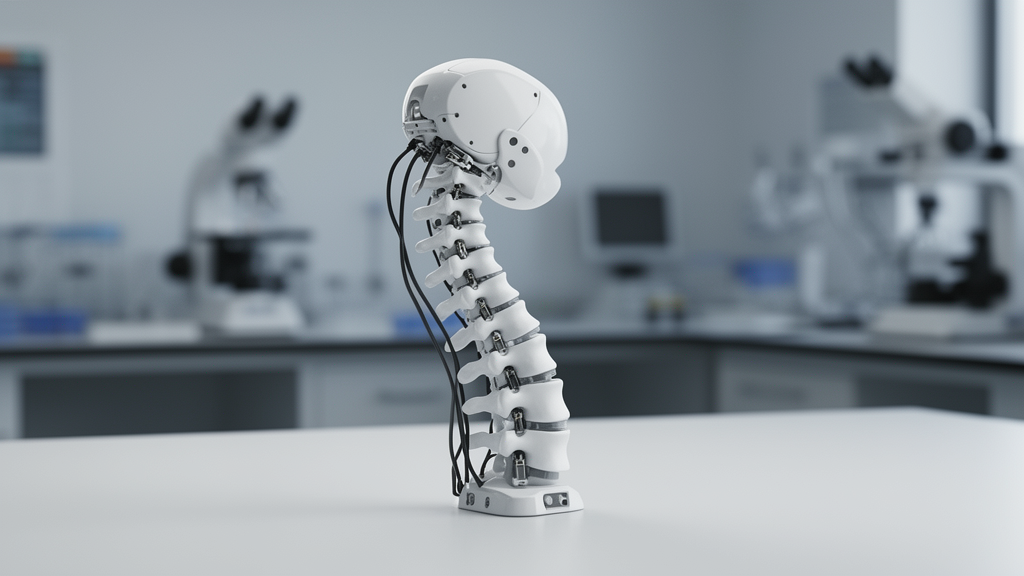
Engineers in China have built a robot neck that bends, stiffens and relaxes like the real thing. In a study published on 19 October 2026 in the journal Mechanical Sciences, a team led by Yutong Wu and Xinlei Xiao of Jilin Agricultural Science and Technology College, together with Haochen Wang and Da Song of Northeast Electric Power University, unveiled a cable-driven parallel robot designed to reproduce the motion characteristics of the human cervical spine. The machine combines a rigid–flexible coupling structure with a variable stiffness system, and its simulations show it can bend up to 30 degrees while its operational stiffness is dynamically modulated from 3900 to 4700 newtons per metre — a tuning bandwidth of up to 100 percent.
The inspiration is anatomical. The human neck consists of seven vertebrae whose coordinated action with joints, ligaments and muscles produces an extraordinary repertoire of movement: flexion, extension, lateral bending and rotation. Existing humanoid robots have struggled to copy this. Honda’s ASIMO and Honda–AIST’s HRP-2 carry serial neck structures with just two degrees of freedom, while later machines such as Albert Hubo and iCub added a yaw joint for more complex head motion. Parallel neck designs, which use multiple actuators working against a common platform, offer higher rigidity and lower inertia, but the authors argue they have consistently lacked the compliance needed to simulate the bending motion of a real cervical spine.
The new robot attacks that gap with a five-part architecture: a moving platform, a fixed platform, a six-bar spring system, a rotating mechanism and an external flexible support system, all driven by three lightweight cables. The six-bar spring system — three sets of crossed spring push rods distributed at 120-degree intervals between the two platforms — plays the role of the cervical vertebrae, providing structural stability while allowing controlled bending compliance. The external flexible support system mimics the neck muscles, and a motor-driven rotating mechanism adjusts that system’s radius across an angle range of 0 to 60 degrees, changing the cable geometry and thereby the robot’s overall stiffness in real time.
Controlling such a hybrid machine is the hard part, because rigid and flexible elements deform together in ways that are difficult to predict. The team’s solution is a mathematical mapping they call function G, which links the robot’s configuration space — the bending angle and azimuth angle of the platform — to its actuation space, the length changes of the three driving cables. Cable length variations are constrained within ±40 millimetres. Because the mapping is invertible, the researchers also derived a companion function A that recovers the robot’s posture from measured cable lengths, allowing force–position control in which motors adjust cable tension to hold or change a pose precisely.
On top of the kinematics sits a full dynamics model. The team built a static analysis using torque and force balance based on Newton’s laws and the conservation of angular momentum, calculating how cable tension distributes against the resistive torques of the spring system and the flexible support in any bent posture. They then extended this into dynamic territory with Euler–Lagrange equations, incorporating inertial forces, Coriolis and centrifugal effects, and the elastic potential energy stored in both spring systems. The result is a coupled rigid–flexible dynamic model in which the driving torque of the cables balances the resistance torque generated by the deforming flexible structure — the mathematical analogue of muscles straining against bone.
The stiffness trick is the study’s centrepiece. When the rotating mechanism turns, it slides the attachment radius of the external flexible support system outward or inward, altering the pre-tension and effective stiffness of the whole assembly without changing the cable lengths that hold the pose. In a fixed posture, the robot can therefore sit still while its resistance to external disturbance rises or falls — exactly the stabilising function human neck muscles perform when the head is jostled. Simulations across four different values of the adjustable radius show overall stiffness climbing smoothly as the rotation angle increases, with the total stiffness combining contributions from the six spring rods, the three support springs and the cables themselves.
The quantitative results are grounded in human biomechanics. The maximum bending angle was set at 30 degrees, reflecting the normal flexion range of the human neck reduced by roughly 30 percent to account for the restriction caused by wearing heavy protective equipment. Under cable tensions ranging from 0 to 80 newtons, the robot reached that angle while cable tension and actuation curves followed clean trigonometric trajectories across the workspace. The team also mapped the robot’s task space in three dimensions, showing that cable trajectories remain within the platform’s motion envelope throughout — an important sanity check for a machine intended eventually to carry a head-like load.
The authors are candid about what the design does not yet do. The current stiffness adjustment works by changing the robot’s external dimensions, which may compromise biomimetic fidelity and practical packaging. Friction was neglected in the dynamic calculations, even though the team acknowledges it can measurably degrade motion performance and end-effector accuracy in real hardware; they propose lubricants, reduced contact areas and self-lubricating bushings as mitigations. The model also omits nonlinear cable friction and structural hysteresis, and the stiffness response speed and adjustment accuracy have not yet been verified on a physical prototype. Future work will integrate the mass and volume distribution of a human head into the load profile, refine the bone–muscle coupling with detailed anatomical data, and add force and pose sensors for closed-loop feedback control.
Even so, the study stakes out a clear position in the race toward lifelike humanoid machines. Compared with an earlier cable-driven design with a spring spine by Gao and Song, the new robot expands the usable bending range and more faithfully reproduces the interplay of cervical bones and muscles. Beyond humanoid heads, the authors see the architecture as a reference for cable-driven flexible mechanisms generally — a class of machines that includes surgical manipulators, rehabilitation devices and soft industrial arms. If a robot is going to work alongside people, absorb bumps, carry loads and move with something approaching natural grace, the neck may be the place where that realism is decided, and this machine offers a concrete, quantified step toward it.
The work, published as volume 17, pages 917–933 of Mechanical Sciences under a Creative Commons licence, was supported by a science and technology innovation and entrepreneurship training program for college students at Jilin Agricultural Science and Technology University. Its deeper significance may lie in the design philosophy rather than any single number: instead of treating compliance and precision as competing goals to be traded off, the robot treats them as two faces of one system, coordinated the way evolution coordinated them — bones for structure, muscles for adjustable tension, and a control law that keeps the two in conversation. That principle, validated here in simulation with explicit stiffness figures and workspace maps, gives roboticists a template for building machines that are simultaneously strong, precise and soft enough to be safe around the people they are built to serve.
Subject of Research: A cable-driven parallel robot with variable stiffness and rigid–flexible coupling that replicates human cervical spine motion
Article Title: Design and analysis of a novel cable-driven parallel robot with variable stiffness and rigid–flexible coupling
Article References: Wu, Y., Xiao, X., Wang, H., & Song, D. (2026). Design and analysis of a novel cable-driven parallel robot with variable stiffness and rigid–flexible coupling. Mechanical Sciences, 17(2), 917-933. https://doi.org/10.5194/ms-17-917-2026
Image Credits: AI Generated
Keywords: cable-driven parallel robot, variable stiffness, rigid–flexible coupling, cervical spine, biomimetic robotics, humanoid robots, kinematics, dynamics modeling, Euler–Lagrange equations, compliant mechanisms, Mechanical Sciences, stiffness modulation
News Source: Denise Maddox. (October 19, 2026). Robot Neck With Tunable Stiffness Mimics the Human Cervical Spine. Scienmag.