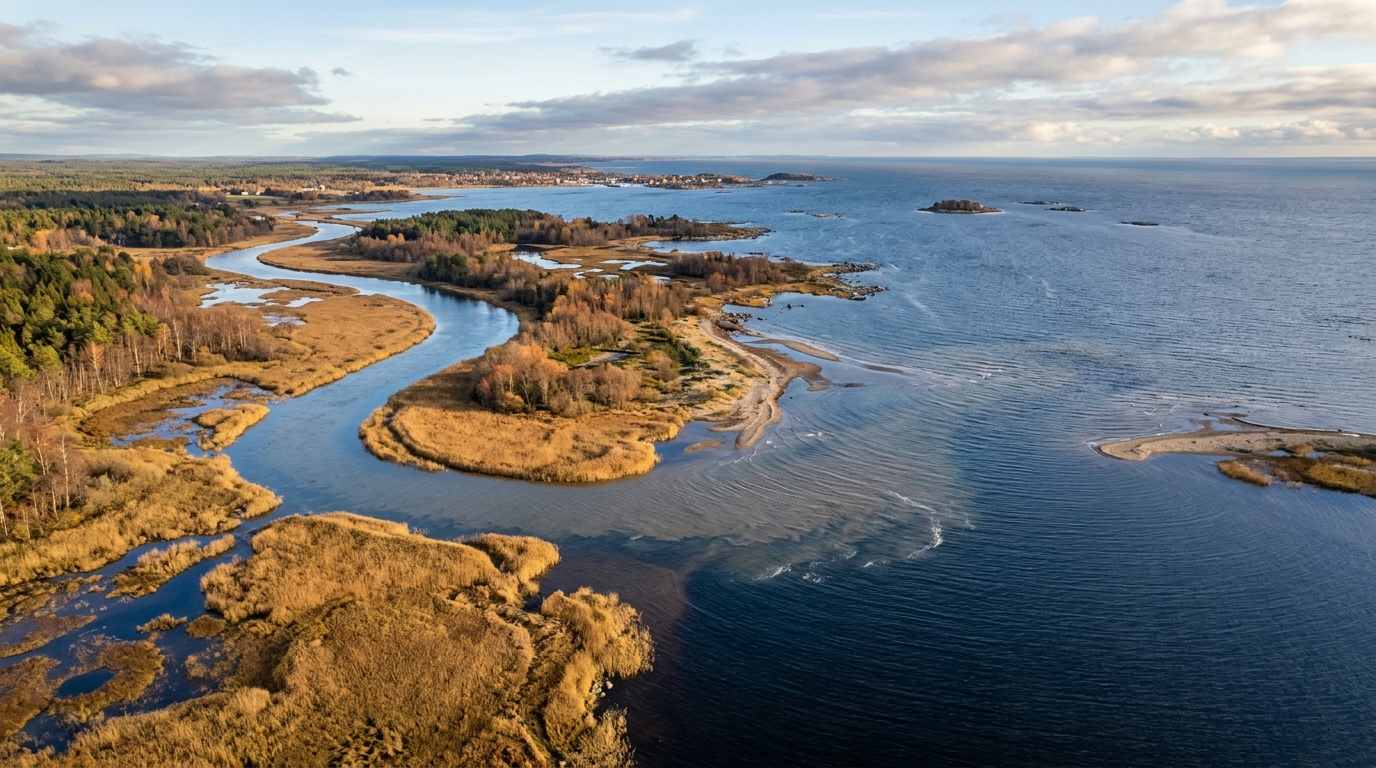
In two shallow bays of the Baltic Sea, the bacteria living in sediments and water respond far more strongly to local hydrology and the seasons than to the presence of the common reed, Phragmites australis. That is the central finding of a new open-access study published in Environmental Microbiome on 2 November 2026, which compared bacterial communities in Haapsalu Bay and Pärnu Bay, two Baltic Sea bays separated by roughly 83 kilometres. The authors include Fabio Ercoli, Helen Tammert, Veljo Kisand, Kätlin Blank, Carmen Kivistik and Daniel P. R. Herlemann, with the article shared early as a citable, peer-reviewed accepted version.
Aquatic macrophytes such as the common reed are known to shape microbial habitats in shallow coastal waters, but the relative weight of plant-driven effects against local hydrology and seasonal environmental variation has been poorly resolved. To address this, the researchers examined how P. australis influences bacterial communities across three distinct substrates: sediment, water and the phyllosphere, the microbial community associated with the plant’s surfaces. Sampling covered both bays, allowing a comparison between the two sites, with Pärnu Bay experiencing stronger riverine influence.
The clearest pattern in the data was a strong clustering of bacterial communities by substrate. Sediment, water and phyllosphere each harboured recognisably distinct assemblages, regardless of bay or season. Sediments stood out for their higher alpha-diversity and stronger site specificity compared with the other two habitats. Notably, bulk sediments without reed influence harboured greater bacterial richness than sediments associated with Phragmites, indicating that the plant does not simply enrich the sediment microbiome beneath it.
Seasonality left a clear imprint on diversity, but its strength depended on the habitat. In sediments, alpha-diversity peaked in summer and autumn and reached its minimum in spring. Water communities, by contrast, showed weaker seasonality over the same period. Beta-diversity analyses added a temporal dimension to this picture: sediments maintained lower seasonal turnover, meaning their communities were more temporally stable, while water and phyllosphere communities underwent rapid compositional shifts and displayed higher seasonal dissimilarity. In practical terms, the sediment acts as a relatively fixed, site-specific reservoir of bacterial diversity, whereas the water column and plant surfaces are far more labile.
The contrast between the two bays proved equally informative. Pärnu Bay, which experiences stronger riverine influence, exhibited larger temporal shifts in both alpha- and beta-diversity than Haapsalu Bay. Taxonomic differences between the sites followed the same geographic split: Cyanobium dominated in Haapsalu Bay while Synechococcus prevailed in Pärnu Bay, a difference the authors attribute most likely to site-specific hydrology and nutrient regimes rather than to the presence of reeds.
When the researchers accounted for environmental gradients statistically, the effect of P. australis on bacterial community composition turned out to be only modest and context-dependent. In other words, the reed does influence associated microbes, but its influence is small compared with the overriding effects of riverine inputs and salinity dynamics. The study’s conclusions state explicitly that local hydrology and seasonal variation exert stronger control over coastal bacterial community composition in top-layer sediment and water than the presence of P. australis.
These results carry a caution for coastal research. Because sediments behave as stable, site-specific reservoirs while water and phyllosphere communities shift rapidly with the seasons, findings from one shallow bay cannot be safely generalised to another, even one only tens of kilometres away. The authors underscore the importance of site-specific assessments in shallow coastal studies, a point reinforced by the pronounced biological divergence between Haapsalu and Pärnu despite their relative proximity.
The researchers examined how P. australis influences bacterial communities across three distinct substrates: sediment, water and the phyllosphere, in two bays that are approximately 83 km from each other. The observation that bulk sediments outperform Phragmites-associated sediments in bacterial richness suggests that reed beds are not universal hotspots of sediment microbial diversity, at least not in these Baltic settings.
The study concludes that local hydrology and seasonal variation, particularly riverine inputs and salinity dynamics, exert stronger control over coastal bacterial community composition in top-layer sediment and water than the presence of P. australis. Sediments preserve a local signature; water and plant surfaces respond quickly to environmental fluctuation. The authors underscore the importance of site-specific assessments in shallow coastal studies and caution against generalizing results across bays.
Subject of Research: The influence of Phragmites australis, local hydrology and seasonality on bacterial communities in sediments, water and phyllosphere across two shallow Baltic Sea bays
Article Title: Local hydrology and seasonality outweigh the influence of Phragmites australis on coastal bacterial communities across two Baltic Sea bays
Article References: Ercoli, F., Tammert, H., Kisand, V., Blank, K., Kivistik, C., & Herlemann, D. P. R. (2026). Local hydrology and seasonality outweigh the influence of Phragmites australis on coastal bacterial communities across two Baltic Sea bays. Environmental Microbiome, 21(1), Article 129. https://doi.org/10.1186/s40793-026-00979-4
Image Credits: AI Generated
DOI: 10.1186/s40793-026-00979-4
Keywords: Baltic Sea, Phragmites australis, bacterial communities, sediment microbiome, phyllosphere, alpha-diversity, beta-diversity, seasonality, riverine influence, salinity, Haapsalu Bay, Pärnu Bay
News Source: Violet Maxwell. (November 7, 2026). River inputs and seasons, not reeds, steer Baltic bacterial communities. Scienmag.