


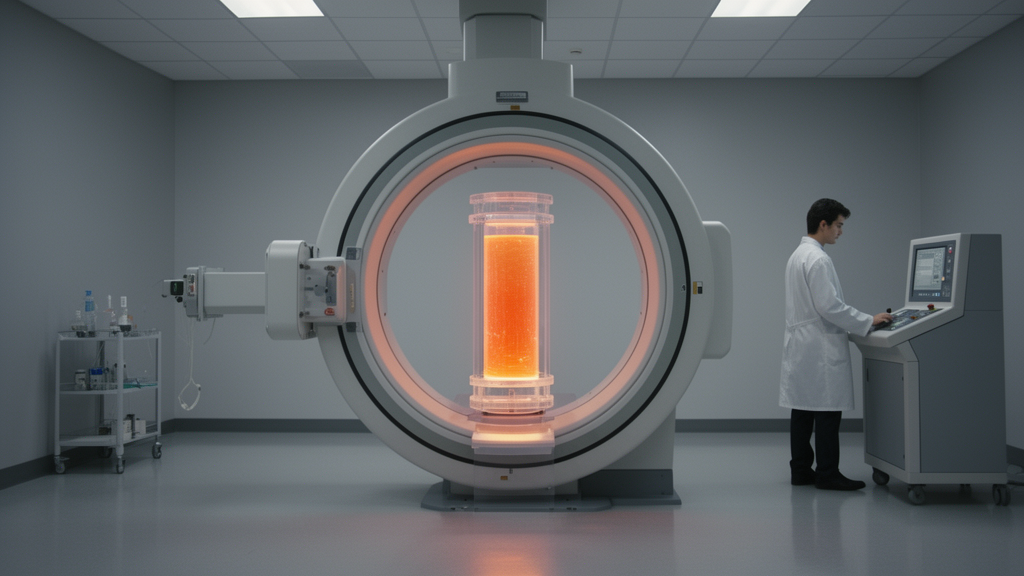
Dynamic single-photon emission computed tomography (SPECT), which tracks how radioactivity distributes and changes in the body over time, has drawn renewed interest since ring-type semiconductor SPECT/CT systems entered clinical use. Yet the clinical value of dynamic SPECT has not been firmly established. A new phantom study published in EJNMMI Physics set out to measure how well a ring-type semiconductor system performs in dynamic imaging, and to identify the reconstruction settings and calibration factors that give the most reliable quantitative results.
The researchers built a controlled model of changing radioactivity: two 40-millilitre balloon tubes, one at the centre and one at the periphery of a cylindrical phantom, were filled with a Tc-99m solution infused at a constant rate by a syringe pump. The team then acquired dynamic SPECT images with the ring-type system and, for comparison, dynamic planar images with a conventional Anger-type camera. Radioactivity concentrations in the balloons were measured during imaging to generate time–activity curves, the basic quantitative output of any dynamic study.
Reconstruction conditions mattered greatly. Dynamic SPECT data were reconstructed using acquisition times of 5 and 15 seconds and eight different values of beta, the noise-suppression parameter in a Bayesian penalty likelihood method, ranging from 0.005 to 0.2. The team also examined whether specific conversion factors were needed to translate reconstructed image values into true radioactivity concentrations, and compared the time–activity curves from the two systems to find the optimal settings.
The results revealed a clear trade-off. Time–activity curves from planar imaging showed better linearity than those from SPECT, and the SPECT curves fluctuated considerably, especially at short acquisition times. However, the two modalities behaved very differently when geometry got crowded: when the two adjacent balloons overlapped, planar imaging merged them into a single combined curve, while SPECT resolved and measured them separately.
The beta parameter proved critical. Under low-count-rate conditions, high beta values between 0.12 and 0.2 suppressed noise so aggressively that signal was lost. The Becquerel calibration factor, used to convert reconstructed image values into radioactivity concentration, was highly dependent on both acquisition and reconstruction conditions. The values closest to theoretical expectations were obtained with a beta of 0.02, identifying that setting as the most appropriate of those tested for dynamic SPECT on this system.
The authors conclude that time–activity curves from the ring-type system showed reduced linearity and greater fluctuations than those from the Anger-type system, but that dynamic SPECT accurately separated and measured adjacent targets even when they overlapped in planar images, and that suitable reconstruction parameters and calibration factors were identified. As a phantom study, the work defines the operating conditions for future clinical evaluation rather than demonstrating patient benefit; the authors themselves note that the efficacy of dynamic SPECT in clinical practice has not yet been sufficiently demonstrated.
Subject of Research: Phantom evaluation of dynamic SPECT imaging performance and reconstruction parameters on a ring-type semiconductor SPECT/CT system compared with an Anger-type system
Article Title: Phantom evaluation of dynamic SPECT imaging with a ring-type semiconductor SPECT/CT system: comparison with an anger-type system
Article References: Tanaka, Y., Hebiguchi, H., Odagiri, H., Hatano, A., Miyoshi, A., Ooura, K., Jimbo, H., Takeuchi, T., Kodama, H., Takanami, K., Usui, A., & Kaneta, T. (2026). Phantom evaluation of dynamic SPECT imaging with a ring-type semiconductor SPECT/CT system: comparison with an anger-type system. EJNMMI Physics. https://doi.org/10.1186/s40658-026-00953-6
Image Credits: AI Generated
DOI: 10.1186/s40658-026-00953-6
Keywords: dynamic SPECT, SPECT/CT, ring-type semiconductor detector, Anger camera, phantom study, Tc-99m, time–activity curves, image reconstruction, Bayesian penalty likelihood, Becquerel calibration factor, EJNMMI Physics, quantitative imaging
News Source: Denise Maddox. (October 28, 2026). Ring-type semiconductor SPECT shows promise for dynamic imaging in phantom tests. Scienmag.



