In a groundbreaking advancement in water treatment technology, researchers have unveiled a novel electrochemical ion pumping system that promises to revolutionize desalination processes by eliminating the need for terminal electrodes. This development addresses longstanding challenges associated with redox reactions and electrolysis, which often impose operational limitations and energy penalties on conventional electrochemical separation methods. The innovative configuration, termed flow-synchronized ring-shaped electrochemical ion pumping (FS-R-EIP), represents a new paradigm in sustainable and efficient desalination technology.
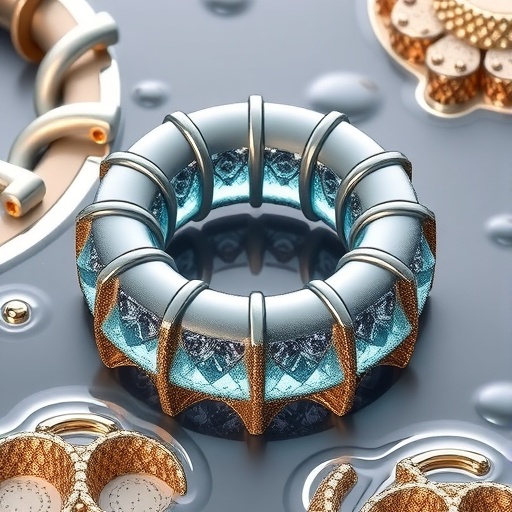
At the heart of this innovation is the replacement of conventional terminal electrodes with a circular architecture wherein each capacitive symmetric electrode (CSE) is sandwiched between two adjacent CSEs. This ring-shaped configuration removes the terminal electrodes that traditionally drove redox reactions such as electrolysis, which produce bubbles and toxic byproducts that compromise system reliability and complicate maintenance. By doing so, FS-R-EIP harnesses a purely capacitive mechanism to facilitate ion transport, significantly enhancing the stability and lifespan of activated carbon electrodes used in the device.
However, achieving effective desalination without terminal electrodes posed significant engineering challenges. Previous attempts utilizing ring-shaped electrochemical ion pumping (R-EIP) configurations encountered a critical issue: when all fluid channels remained filled with solutions, cumulative ion transport was hindered due to symmetrical potential distribution across the CSEs. This symmetry prevented the establishment of a unidirectional driving force essential for continuous desalination cycles, effectively nullifying ion transport over multiple charging and discharging operations.
To overcome this fundamental limitation, researchers devised a sophisticated operational strategy that integrates synchronized switching of both electrical circuits and fluidic pathways. By ensuring that flow channels corresponding to disconnected circuits are filled with air instead of solution, the system reinstates the necessary asymmetry in electric potential distribution across the electrodes. This flow synchronization forms the crux of FS-R-EIP’s capability to perform pseudo-continuous desalination without relying on electrochemical redox reactions, paving the way for unidirectional ion flux solely through capacitive charge storage and release mechanisms.
With this dual innovation—a circular electrode configuration coupled with flow-synchronized operation—FS-R-EIP achieves unidirectional ion pumping in a redox-free manner using only a single power source. This is a crucial distinction from the plate-and-frame EIP (PF-EIP) design that necessitates terminal electrodes and multiple power inputs to maintain charge balance through electrolysis. The single-source operation of FS-R-EIP not only simplifies system architecture but also enhances energy efficiency and operational reliability across various scales.
Quantitatively, FS-R-EIP demonstrates superior performance metrics compared to PF-EIP and conventional capacitive deionization (CDI) techniques when evaluated using the frameworks of specific energy consumption and ion flux. For equivalent ion flux, FS-R-EIP consumes less energy than even small-scale electrodialysis (ED) systems, which traditionally depend on electrochemical redox reactions at their membranes or electrodes. The elimination of electrolytic processes is particularly beneficial because it removes energy-intensive and potentially detrimental side reactions, enabling cleaner and more sustainable desalination.
Furthermore, FS-R-EIP’s high modularity ensures facile scalability from small-scale applications—such as mobile water purification units or household systems—to larger, industrial-scale desalination plants. The ability to maintain robust performance with a minimal number of cell pairs offers practical advantages in terms of system footprint, cost, and operational flexibility. This adaptability underscores the system’s potential to fill critical gaps in decentralized water treatment infrastructure, where compact, efficient, and low-maintenance technologies are urgently needed.
Another remarkable benefit of eliminating terminal electrode electrolysis in FS-R-EIP is the virtual absence of bubble formation and toxic byproduct generation, phenomena that have traditionally plagued electrochemical separations and reduced operational durability. By relying exclusively on capacitive ion storage and release, FS-R-EIP achieves long-term electrode stability, significantly less material degradation, and decreased maintenance burdens. The avoidance of electrolyte rinse solutions, a necessity in ED and PF-EIP systems to contain redox reactions at terminal electrodes, further reduces system complexity and operational costs.
Moreover, the FS-R-EIP design alleviates compositional drift issues commonly encountered in electrochemical systems deploying recirculated electrode rinse solutions. Such drift can lead to gradual performance degradation and require stringent system monitoring and maintenance regimes. By using the same feed solution across all flow channels and generating both diluate and brine streams without external electrolyte compartments, the FS-R-EIP simplifies system management and enhances process robustness, which is vital for long-term field deployment.
Beyond its promising application in seawater desalination and brackish water treatment, the FS-R-EIP platform opens exciting possibilities for broader electrochemical separations. The fundamental architecture lends itself to selective ion removal through tailored electrode materials and innovative operational protocols. Advances in electrode design could enable the selective capture of target ions from complex mixtures, positioning FS-R-EIP as a transformative tool in chemical separations and resource recovery efforts.
Additionally, FS-R-EIP may be integrated with electrochemical conversion processes, allowing for sequential capture-transform-release workflows. For instance, ions or molecules could be adsorbed capacitive manner, subsequently converted electrochemically through oxidation or reduction reactions, and then released into a separate stream as transformed products. This hybrid approach could enable unique chemical manufacturing pathways or environmental remediation strategies leveraging the modular and adaptable RS-EIP platform.
Looking ahead, the path to widespread adoption of FS-R-EIP involves sophisticated modeling and optimization to refine electrode architectures and cell designs tailored to specific application demands. Coupling these engineering efforts with automated controls for the precise synchronization of flow and circuit switching will enable fully autonomous, high-efficiency water treatment systems poised to impact global water security. The convergence of materials science, electrochemical engineering, and process automation embedded within FS-R-EIP symbolizes a new frontier in sustainable separation technology.
In conclusion, the emergence of flow-synchronized ring-shaped electrochemical ion pumping marks a significant leap forward in desalination science. By creatively circumventing limitations imposed by redox-driven electrochemical systems, FS-R-EIP offers a redox-free, energy-efficient, and scalable solution poised to transform water purification landscapes worldwide. Its combination of configurational innovation and operational ingenuity fosters enhanced reliability, simplified design, and modularity, promising wide-reaching implications for future electrochemical separation technologies across diverse sectors. The work stands as a testament to the profound impact of electrochemical engineering innovation on addressing critical environmental and resource challenges.
Subject of Research: Electrochemical ion pumping for redox-free desalination without terminal electrodes.
Article Title: Flow-synchronized ring-shaped electrochemical ion pumping for redox-free desalination without terminal electrodes.
Article References:
Xu, L., Zhao, B., Liu, W. et al. Flow-synchronized ring-shaped electrochemical ion pumping for redox-free desalination without terminal electrodes. Nat Chem Eng (2025). https://doi.org/10.1038/s44286-025-00336-1
Image Credits: AI Generated
DOI: https://doi.org/10.1038/s44286-025-00336-1
Tags: activated carbon electrode stabilitycapacitive symmetric electrodesefficient desalination processeselectrochemical ion transport mechanismselectrode-free desalination technologyengineering challenges in desalinationflow-synchronized electrochemical systemsinnovative water purification methodsredox reaction challengesrevolutionary advancements in desalination technologyring-shaped ion pumpingsustainable water treatment solutions