• HOME
  • NEWS
  • EXPLORE
    • CAREER
      • Companies
      • Jobs
    • EVENTS
    • iGEM
      • News
      • Team
    • PHOTOS
    • VIDEO
    • WIKI
  • BLOG
  • COMMUNITY
    • FACEBOOK
    • INSTAGRAM
    • TWITTER
Sunday, February 8, 2026
BIOENGINEER.ORG
No Result
View All Result
  • Login
  • HOME
  • NEWS
  • EXPLORE
    • CAREER
      • Companies
      • Jobs
        • Lecturer
        • PhD Studentship
        • Postdoc
        • Research Assistant
    • EVENTS
    • iGEM
      • News
      • Team
    • PHOTOS
    • VIDEO
    • WIKI
  • BLOG
  • COMMUNITY
    • FACEBOOK
    • INSTAGRAM
    • TWITTER
  • HOME
  • NEWS
  • EXPLORE
    • CAREER
      • Companies
      • Jobs
        • Lecturer
        • PhD Studentship
        • Postdoc
        • Research Assistant
    • EVENTS
    • iGEM
      • News
      • Team
    • PHOTOS
    • VIDEO
    • WIKI
  • BLOG
  • COMMUNITY
    • FACEBOOK
    • INSTAGRAM
    • TWITTER
No Result
View All Result
Bioengineer.org
No Result
View All Result
Home NEWS Science News Chemistry

Rich interface defects accelerate the electro-oxidation of 5-HMF

Bioengineer by Bioengineer
May 11, 2020
in Chemistry
Reading Time: 2 mins read
0
IMAGE
Share on FacebookShare on TwitterShare on LinkedinShare on RedditShare on Telegram

IMAGE

Credit: ©Science China Press

2,5-furandicarboxylic acid (FDCA), which is produced by oxidation of 5-hydroxymethylfurfural (HMF), is the crucial precursor for the production of polyethylene 2,5-furandicarboxylate to replace petroleum-derived polyethylene terephthalate. Electrochemical oxidation of HMF to FDCA is regarded as a clean and environment-friendly process since electrons drive the reaction at the cathode without extra chemical oxidants. Since abundant 3d electrons and unique eg orbitals enhance the covalency of transition metal-oxygen bonds, Ni-based catalysts have been considered as a great candidate for HMF electrocatalysis. For instance, a porous Ni-based electrocatalyst was prepared by the electrodeposition method for alcohol and hydrogen evolution reactions. Ni2P nanoparticles and porous Ni3S2 were reported as efficient electrocatalysts for HMF oxidation.

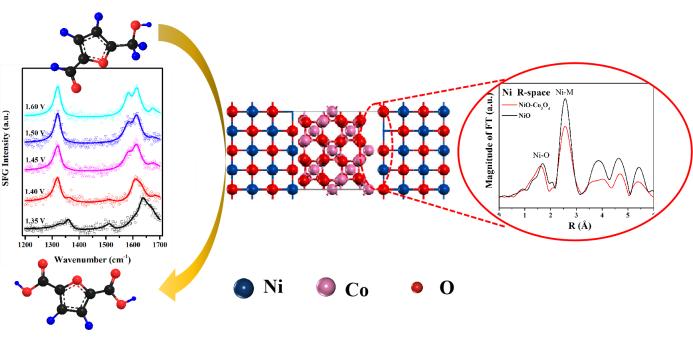
Very recently, Dr. Yuqin Zou and colleagues in Hunan University elaborately prepared a hierarchically nanostructured NiO-Co3O4 electrode with plentiful interface defects through a simple hydrothermal-annealing method. The interface effect could create rich cation vacancies, modulate the electronic properties of Co and Ni atoms, and raise the oxidation state of Ni species. As a result, the as-synthesized hierarchical NiO-Co3O4 nanosheets exhibited the excellent HMF oxidation activity and stability. Furthermore, in-situ SFG results and ex-situ HPLC were used to better understand the reactive intermediates and pathways during the HMF oxidation. The current study offers an efficient way to create cation vacancies at the interfacial sites and proves the positive role of cation vacancies on catalyzing the HMF electro-oxidation. The current study offers an efficient way to create cation vacancies and proves the positive role of cation vacancies on catalyzing the HMF electro-oxidation.

Recently, this research group also demonstrated the catalytic activity of Ni3N for HMF oxidation. Besides, NiO electrocatalysts are impressive in biomass conversion due to their low cost and simple synthetic methods. On the other hand, the interface engineering is a promising approach to modulate the electronic properties, tune the intermediate adsorption, and expose more active sites. For example, the core/shell NiO@Co3O4 nanocomposites with abundant edge sites because the interface effect shows enhanced catalytic activities for oxygen evolution reactions (OER).

###

See the article:

Lu YX, Dong CL, Huang YC, Liu YB, Li YY, Zhang NN, Chen W, Zhou L, Zou YQ, Lin HZ, Wang SY. Hierarchically Nanostructured NiO-Co3O4 with Rich Interface Defects for the Electro-oxidation of 5-hydroxymethylfurfural. Sci China Chem, 2020, 63, doi: 10.1007/s11426-020-9749-8
http://engine.scichina.com/doi/10.1007/s11426-020-9749-8

Media Contact
Zou Yuqin
[email protected]

Related Journal Article

http://dx.doi.org/10.1007/s11426-020-9749-8

Tags: Chemistry/Physics/Materials Sciences
Share12Tweet8Share2ShareShareShare2

Related Posts

blank

Breakthrough in Environmental Cleanup: Scientists Develop Solar-Activated Biochar for Faster Remediation

February 7, 2026
blank

Cutting Costs: Making Hydrogen Fuel Cells More Affordable

February 6, 2026

Scientists Develop Hand-Held “Levitating” Time Crystals

February 6, 2026

Observing a Key Green-Energy Catalyst Dissolve Atom by Atom

February 6, 2026
Please login to join discussion

POPULAR NEWS

  • Robotic Ureteral Reconstruction: A Novel Approach

    Robotic Ureteral Reconstruction: A Novel Approach

    82 shares
    Share 33 Tweet 21
  • Digital Privacy: Health Data Control in Incarceration

    63 shares
    Share 25 Tweet 16
  • Breakthrough in RNA Research Accelerates Medical Innovations Timeline

    53 shares
    Share 21 Tweet 13
  • Mapping Tertiary Lymphoid Structures for Kidney Cancer Biomarkers

    50 shares
    Share 20 Tweet 13

About

We bring you the latest biotechnology news from best research centers and universities around the world. Check our website.

Follow us

Recent News

Decoding Phantom Limb Movements via Intraneural Signals

Attitudes Toward Aging Impact Early Nursing Home Quality

Transforming Healthcare: Just Culture and Restorative Practices

Subscribe to Blog via Email

Enter your email address to subscribe to this blog and receive notifications of new posts by email.

Join 73 other subscribers
  • Contact Us

Bioengineer.org © Copyright 2023 All Rights Reserved.

Welcome Back!

Login to your account below

Forgotten Password?

Retrieve your password

Please enter your username or email address to reset your password.

Log In
No Result
View All Result
  • Homepages
    • Home Page 1
    • Home Page 2
  • News
  • National
  • Business
  • Health
  • Lifestyle
  • Science

Bioengineer.org © Copyright 2023 All Rights Reserved.