Researchers at a Vietnamese university have developed a porous bio-aerogel derived from rice husk cellulose nanocrystals, chitosan, and sodium alginate that effectively captures polystyrene microplastics from water. Published in Results in Engineering in December 2026, the study demonstrates that this composite material can remove up to 85.37 mg of polystyrene per gram of aerogel under optimized conditions. The work addresses the persistent challenge of microplastic contamination in aquatic environments, where conventional wastewater treatment plants often fail to remove all small plastic particles before releasing effluent into receiving waters.
The central motivation for this research stems from the limitations of existing microplastic removal technologies. While filtration, coagulation, and adsorption methods can achieve substantial removal, their performance is heavily influenced by particle size, surface chemistry, and water composition. The authors argue that a key materials challenge is not merely maximizing adsorption capacity, but creating accessible structural domains capable of retaining discrete plastic particles while minimizing the environmental burden of the sorbent itself. Renewable porous materials derived from natural polymers are increasingly relevant to this remediation goal.
The study utilized cellulose nanocrystals (CNCs) extracted from rice husk, an agricultural residue abundant in Vietnam. The CNCs were produced through a chemical purification process involving alkali treatment, bleaching, and sulfuric acid hydrolysis. This process yielded CNCs with a crystallinity index of 76.45%, indicating that the native cellulose I structure was preserved during the harsh chemical pretreatment. The resulting nanocrystals bear sulfate half-ester groups on their surfaces, which impart negative surface character and contribute to their colloidal stability in aqueous systems.
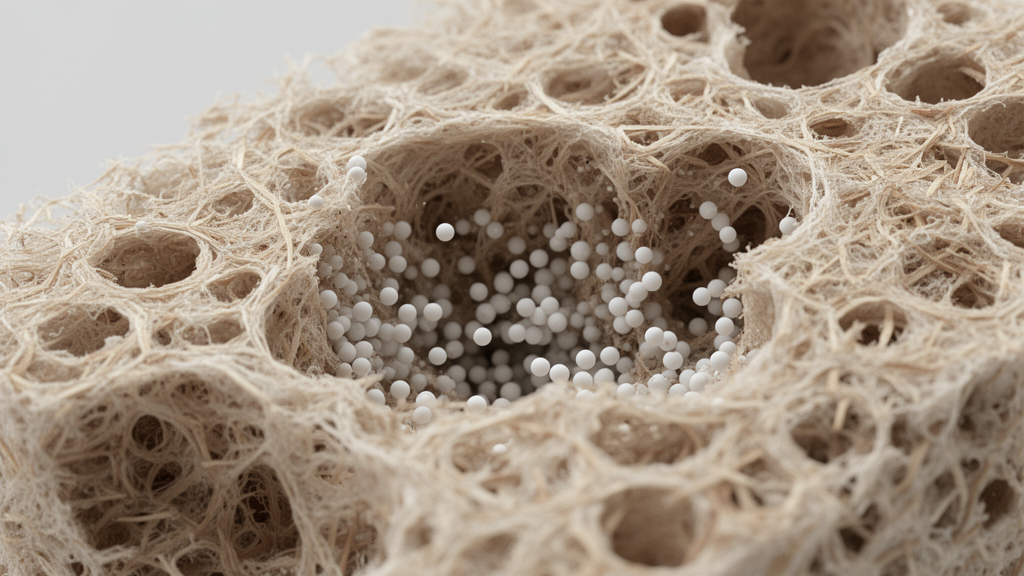
To create the final bio-aerogel, the researchers combined the rice husk-derived CNCs with chitosan and sodium alginate. Chitosan provides cationic character through its protonated amino groups, while sodium alginate offers anionic carboxylate functionalities. The combination of these polyelectrolytes with the anionic CNCs creates a chemically heterogeneous interface containing hydroxyl, amino, carboxyl, and sulfate functionalities. The mixture was homogenized, cast into molds, frozen, and freeze-dried to form a lightweight, interconnected porous network. This structural design aims to facilitate both chemical interaction and physical retention of microplastic particles.
The adsorption experiments were conducted using polystyrene microplastics with a measured size range of 100 to 190 micrometers. The particles were dispersed in water containing 0.1% (w/v) Tween 80 to minimize aggregation and maintain a stable suspension. Quantification of the polystyrene was performed using UV–Vis spectrophotometry at a wavelength of 255 nm. The researchers established a calibration curve across a working range of 10 to 100 mg/L, ensuring that the analytical method could accurately track the concentration of particles remaining in the solution after exposure to the aerogel.
The effect of solution pH on adsorption performance was a primary focus of the investigation. The results showed that polystyrene uptake remained relatively stable between pH 3.0 and 7.0, varying within approximately 80 to 82 mg/g. The highest adsorption capacity was observed at pH 5.0, reaching 84.39 mg/g. However, a pronounced decline occurred under alkaline conditions, with the capacity dropping to approximately 29 mg/g at pH 10.0. This behavior is attributed to the protonation state of chitosan amino groups, which influences the ionic interactions with sodium alginate and the overall accessibility of the aerogel network.
Temperature also influenced the adsorption process, though to a lesser degree than pH. Increasing the temperature from 35 to 60 degrees Celsius resulted in a gradual decrease in adsorption capacity, from approximately 83.3 mg/g to 74.9 mg/g. This reduction of about 10% suggests that the interactions responsible for particle retention are more favorable at lower temperatures. The authors interpret this trend as consistent with an exothermic capture process, where elevated thermal energy may increase particle mobility and weaken reversible interfacial interactions, leading to the detachment of loosely retained particles.
Kinetic analysis revealed a two-stage adsorption behavior. A rapid uptake phase occurred during the first 60 minutes, achieving approximately 72% of the equilibrium capacity. This was followed by a slower phase, with equilibrium approached after about 150 minutes. The experimental data were best described by the pseudo-first-order kinetic model, which yielded a calculated equilibrium capacity of 86.15 mg/g, closely matching the experimental value of 85.37 mg/g. The authors note that these kinetic models serve as empirical mathematical descriptions of the uptake rate rather than definitive proof of specific rate-limiting mass-transfer steps.
The equilibrium adsorption data were fitted to both Langmuir and Freundlich isotherm models. Both models provided satisfactory fits with coefficients of determination exceeding 0.97, though the Freundlich model exhibited slightly lower residual errors. The Langmuir maximum capacity parameter was unrealistically high, indicating that saturation was not reached within the tested concentration range. The authors caution that these classical adsorption models, originally developed for molecular solutes, are used here primarily as phenomenological descriptors for the macroscopic capture of micrometer-sized particles rather than to define molecular-level equilibria.
Thermodynamic analysis using the van’t Hoff relationship indicated that the capture process is thermodynamically favorable, with negative apparent Gibbs free energy values at all tested temperatures. The negative apparent enthalpy change confirmed the exothermic nature of the process. The negative apparent entropy change may reflect a localized decrease in randomness at the solid-liquid interface as particles become immobilized within the aerogel framework. These parameters are reported as apparent values that describe the macroscopic capture trend rather than rigorous molecular-level adsorption equilibria.
The reusability of the bio-aerogel was evaluated over five consecutive adsorption-desorption cycles. The removal efficiency decreased from 80.2% in the first cycle to 50.9% in the fifth cycle, representing a retention of about 63.5% of the initial performance. This gradual decline is likely due to the progressive occupation of binding sites and minor structural compaction during repeated washing and drying. Despite this reduction, the aerogel maintained its structural integrity, suggesting it has potential for practical reuse in water treatment applications.
The proposed mechanism for polystyrene capture involves a combination of interfacial attachment, pore-mouth interception, and physical retention within accessible cavities. Given the large size of the polystyrene particles relative to many of the aerogel’s internal pores, unrestricted penetration into the smaller internal pores was unlikely. Instead, the porous and irregular surface facilitated adsorption and physical retention at the external surface and larger pore openings. The chemical functionality of the network, including hydroxyl, amino, and carboxyl groups, likely contributes to surface interactions, although the specific contribution of electrostatic forces remains tentative as surface charges were not directly characterized.
The study acknowledges several limitations, including the use of a single aerogel dosage and the indirect quantification of microplastics via UV–Vis spectroscopy. The presence of Tween 80 as a dispersing agent may have influenced particle-surface interactions, and the specific contribution of CNC incorporation to uptake was not independently determined. Further research is needed to investigate dosage-dependent performance, quantitative pore characteristics, and removal efficiency in realistic water matrices using independent analytical verification. Nonetheless, the findings highlight the potential of agricultural residues as sustainable materials for microplastic remediation.
During material development, the chemical extraction process yielded cellulose nanocrystal powder at approximately 10 weight percent based on the isolated cellulose fraction, representing an overall recovery of 2.0 weight percent relative to the raw rice husk biomass. The final composite formulation of cellulose nanocrystals, chitosan, and sodium alginate in a 3:2:1 mass ratio was established through qualitative screening trials. Formulations prepared without nanocrystals collapsed in water and showed excessive swelling, confirming that the rigid crystalline particles provide the structural skeleton required to preserve aerogel geometry. Testing different nanocrystal loadings revealed that one gram per batch produced a precursor too dilute to assemble a stable network, two grams caused severe shrinkage and structural deformation during freeze-drying, and three grams yielded intact cylindrical aerogels with stable interconnected porous networks.
Structural characterization tracked the assembly and interfacial behavior of the ternary network across purification, synthesis, and adsorption. Infrared spectroscopy verified the progressive removal of noncellulosic components, evidenced by prominent polysaccharide backbone and glycosidic linkage bands at 1021, 895, and 1158 reciprocal centimeters. In the synthesized aerogel, the broad hydroxyl and amine stretching absorption appeared at 3416 reciprocal centimeters before shifting to 3261 reciprocal centimeters after microplastic exposure, indicating active hydrogen bonding interactions involving chitosan and alginate functional groups. Complementary X-ray diffraction patterns showed that isolated nanocrystals retained native cellulose I crystallographic reflections at 14.8, 16.3, and 22.6 degrees two-theta. Upon incorporation into the biopolymer matrix, these sharp diffraction peaks transitioned into a broad diffraction region between 10 and 20 degrees two-theta, confirming structural reorganization and the loss of long-range crystalline order within the predominantly amorphous polysaccharide network.
Varying the initial microplastic concentration confirmed that adsorption capacity increased substantially from 10.70 to 84.17 milligrams per gram as suspension loading rose from 20 to 100 milligrams per liter, reflecting greater particle availability and increased contact with exposed capture sites. Benchmarking against published composite sorbents underscores the utility of this unmodified natural matrix. Whereas previous engineered adsorbents relied on synthetic quaternary ammonium grafting or silane modification to capture fine plastic debris, the rice husk-derived aerogel attained an 80.2 percent initial removal efficiency for 100 to 190 micrometer particles without requiring secondary chemical functionalization.
Subject of Research: Polystyrene microplastic capture from water using rice husk-derived cellulose nanocrystal/chitosan/alginate bio-aerogels
Article Title: Polystyrene microplastic capture from water using rice husk-derived cellulose nanocrystal/chitosan/alginate bio-aerogels
Article References: Nguyen, N. K., Nguyen, P. K., Do, H. A. T., Luu, D. T., Trinh, L. K., Nguyen, H. P., Doan, T. K., & Nguyen, D. Q. (2026). Polystyrene microplastic capture from water using rice husk-derived cellulose nanocrystal/chitosan/alginate bio-aerogels. Results in Engineering, 32, Article 114228. https://doi.org/10.1016/j.rineng.2026.114228
Image Credits: AI Generated
DOI: 10.1016/j.rineng.2026.114228
Keywords: Polystyrene, microplastic, capture, water, rice, husk-derived, cellulose, nanocrystal, chitosan, alginate, bio-aerogels
News Source: Alan Morgan. (November 19, 2026). Rice Husk Aerogels Capture Polystyrene Microplastics in Water. Scienmag.