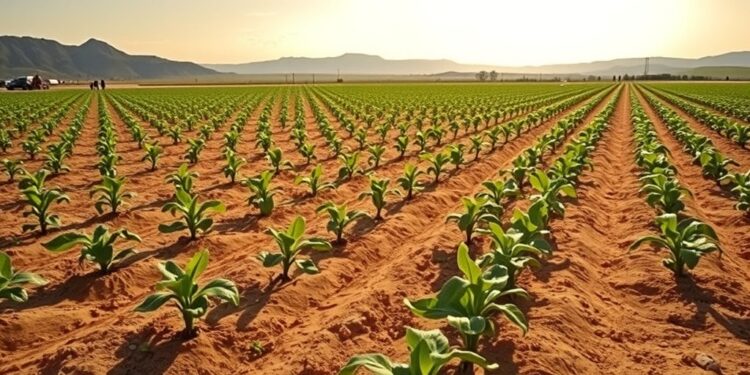

In a groundbreaking study conducted at the King Abdullah University of Science and Technology (KAUST), researchers have unveiled a remarkable advancement in agricultural technology designed for arid regions. The study focuses on the development of a novel nanoplastic and biodegradable mulch that serves the dual purpose of enhancing greenhouse efficiency through passive cooling and promoting sustainable agricultural practices. This innovation is poised to significantly impact crop yields and resource conservation in hot climates, particularly in the Middle East.
The researchers, led by KAUST Professor Qiaoqiang Gan, have fabricated a unique nanoplastic composed primarily of polyethylene, the most prevalent form of plastic, which has been enriched with nanoparticles made of cesium tungsten oxide. These nanoparticles play a crucial role; they are engineered to absorb infrared light, a predominant contributor to greenhouse heating, while allowing visible light to pass through virtually unimpeded. This selectivity is vital as it enables the plants to photosynthesize effectively while minimizing unnecessary heat accumulation within the greenhouse environment.
Traditionally, greenhouse covers made from materials like glass or polycarbonate allow more than 90% of incoming light, including the unwanted infrared spectrum, to enter. The KAUST team’s innovative approach centers on creating a cover that filters out the harmful infrared light. “Our goal was to create a cover that lets good light in and keeps bad light out,” Gan explains. This targeted light management not only optimizes the internal climate of the greenhouse but also reduces energy costs associated with cooling operations.
While the innovative nanoplastic significantly mitigates the heat-related challenges, the KAUST team has also addressed the issue of soil temperature elevation caused by solar radiation on any light entering the greenhouse. The introduction of a newly designed biodegradable mulch, crafted from cellulose paper, smartly reflects sunlight away from the soil surface. This is essential, as maintaining cooler soil temperatures enhances photosynthetic activity, directly contributing to greater plant growth and improving crop yields.
In experimental trials conducted in miniature greenhouses in Saudi Arabia, the researchers tested these two technologies with a focus on cultivating Chinese cabbage. The results were impressive, showcasing an astounding 200% increase in crop yield compared to those grown under conventional mulch and greenhouse covers. The project not only highlights the potential for elevated agricultural productivity but also improves water retention in the soil, a fundamental aspect of successful agriculture in arid regions.
The environmental implications of this research extend beyond mere crop yield. As traditional commercial mulches tend to be plastic-based and contribute to significant waste—with approximately 1.5 million tons accumulated annually and over 40% going unrecycled—the KAUST team’s biodegradable mulch offers an eco-friendly alternative. “Most commercial mulch is plastic and extremely wasteful, leaving microplastics that potentially enter the food chain,” states Yanpei Tian, a postdoctoral researcher at KAUST. The cellulose paper mulch dissolves naturally as plants mature, thus eliminating the long-term environmental issues associated with synthetic alternatives.
This innovative cooling and cultivation approach could revolutionize farming in hot cities worldwide, providing a sustainable method to ensure food security amid escalating climate challenges. The KAUST researchers have estimated that employing their dual system could lead to energy consumption reductions of over 40% in major urban areas like Riyadh and Houston, which are plagued by sweltering temperatures.
In addition to the immediate benefits discovered in their research, the KAUST team is exploring the potential applications of their technology on a larger scale. They believe that harnessing this dual technology could pave the way for adapting a wider variety of crops to thrive in harsher environments, thereby enhancing food security on a global scale.
Agricultural practices are facing considerable challenges in light of climate change and increasing population demands. Thus, employing less energy-intensive methods for greenhouse cooling represents a significant step toward a more sustainable agricultural future. As Gan points out, “The cooling of greenhouses can be extremely expensive. Our approach can make a number of crops available to arid regions, increasing their food security while at the same time helping to meet carbon emission targets.”
This dedication to sustainable development reflects a broader shift in agricultural research, one that prioritizes ecological harmony alongside productivity. As the agricultural sector adapts to the realities of climate change, technologies like the one developed at KAUST will be critical in supporting farmers to navigate these complexities.
Looking to the future, the KAUST team is committed to not only refining this innovative technology but also disseminating their findings to influence agricultural policy and practice worldwide. By showcasing the tangible benefits of integrating scientific research with practical farming techniques, there is potential for widespread adoption of this greenhouse cooling technology, potentially transforming agricultural landscapes across arid regions.
As the conversation around sustainable agriculture continues to evolve, the implications of this research are profound. The intersection of science, innovation, and environmental stewardship illustrated by this study offers a compelling narrative for how we can leverage technology to create resilient food systems that thrive—even in the most challenging conditions.
With this impressive breakthrough in passive greenhouse cooling and biodegradable practices, KAUST sets the stage for a renewed approach to farming that is mindful of both resource conservation and the need for higher food production in a warming world.
Subject of Research: Passive cooling of greenhouses in extreme climates through spectral control film
Article Title: Passive cooling of greenhouses in extreme climates through spectral control film
News Publication Date: 18-Mar-2025
Web References: Nexus
References: 10.1016/j.ynexs.2025.100058
Image Credits: KAUST
Keywords
Applied sciences and engineering, Agriculture, Farming, Conventional farming, Physical sciences, Physics, Energy, Radiation, Infrared radiation, Materials science, Materials, Porous materials, Soils, Agronomy, Crop science.
Tags: agricultural technology advancementsbiodegradable mulch for cropscesium tungsten oxide nanoparticlesenhancing crop yields in arid regionsgreenhouse cover materials evolutiongreenhouse efficiency improvementsinfrared light absorption in plantsinnovative materials for farmingnanotechnology in agriculturepassive cooling techniques for greenhousesresource conservation in hot climatessustainable agricultural practices