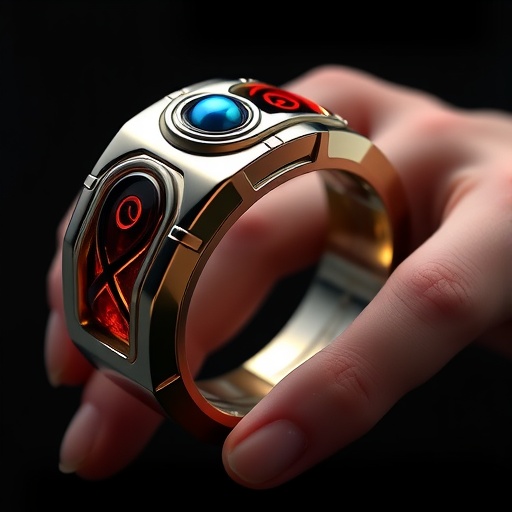
In the realm of wearable technology, innovations continue to captivate researchers and consumers alike, propelling us closer to a future where human-computer interactions are not just functional but also immersive. A pioneering development in this field is a haptic feedback ring that weighs only 18 grams, yet promises to deliver a compelling experience with its advanced three-degrees-of-freedom force sensing. This new device is poised to redefine how individuals engage with virtual and augmented reality environments, transforming mundane objects into interactive portals that create genuine touch sensations in a digital landscape.
The haptic ring’s innovative design is rooted in an origami-inspired structural framework, allowing for efficient force transmission while maintaining compactness. Unlike conventional wearable haptic devices that often struggle with bulkiness and weight, this ring prioritizes portability and comfort, making it suitable for prolonged use without causing strain. Its lightweight nature ensures that users can enjoy extended gaming or simulation sessions without discomfort, a significant advantage in today’s fast-evolving landscape of virtual interactions.
At its core, the haptic ring features a sophisticated force-sensing skin that distinguishes itself with the ability to detect both shear and normal forces simultaneously. This dual-sensing capability is not just a technical gimmick; it serves as the backbone of the user experience, offering nuanced feedback that reflects the complexities of real-world interactions. Whether it’s the subtle resistance felt when manipulating virtual objects or the sensation of pushing against a force field, the ring aims to make digital interactions feel infinitely more realistic, bridging the gap between the virtual and the physical.
The underlying technology of the force-sensing skin combines several advanced materials and designs. A strikingly innovative approach is utilized in creating a topology-optimized, laser-patterned layer that incorporates pyramid microstructures. This layer ensures that the system is not only responsive but also exhibits a linear sensitivity, providing a reliable and rapid feedback mechanism. Users can expect quick and accurate responses to their movements, enhancing the overall interactivity of the experience.
Additionally, the haptic ring is powered by soft pneumatic actuators, which deliver the necessary force feedback while maintaining a discreet profile. The integration of inkjet-printed bending sensors contributes to the ring’s overall functionality, resulting in a seamless interface that melds high-tech features with stylish design. Soft actuators allow for a softer, more natural feedback effect, further enhancing the palpable nature of virtual interactions. It’s a design philosophy that prioritizes not just performance but also user-centric aesthetics.
This cocktail of innovative technologies culminates in the ring’s ability to generate kinaesthetic force feedback of up to 6.5 Newtons. Such force capabilities empower users with the sense of weight and resistance, essential elements in creating a truly immersive virtual experience. The impact of this technology can be profound, transforming how individuals engage with digital spaces—whether in gaming, training simulations, or even therapeutic applications.
The implications of this development extend beyond entertainment. As industries increasingly recognize the potential of virtual reality for training, education, and rehabilitation, tools like the haptic feedback ring could revolutionize these areas. Imagine medical students practicing surgical techniques with true-to-life feedback or athletes training in virtual environments designed to mimic real-world challenges. The applications are vast and varied, showcasing the ring’s role as a facilitator of meaningful experiences.
Moreover, the evolution of this technology aligns perfectly with the growing trend of smart wearables. As more consumers gravitate toward devices that enhance their everyday lives, this haptic ring addresses a unique need within this burgeoning market. It embodies the convergence of utility and experience—offering users not just a product, but an opportunity to interact with their environments in ways previously thought impossible.
As we stand at the precipice of this new era in human-machine interfaces, it’s essential to consider the potential social ramifications. As we equip ourselves with these advanced devices, questions about privacy, accessibility, and ethical use arise. The development of such technology necessitates careful consideration and robust discourse among stakeholders to ensure that the benefits are enjoyed equitably, and that the innovations are directed toward enriching human creativity and interaction rather than alienation.
This haptic feedback ring represents just one facet of a much larger tapestry of innovation. As research progresses, there will inevitably be more breakthroughs that will enhance our understanding of human perception and interaction with technology. Exploring these dynamics offers promising pathways to enrich our living and working environments, ensuring that the fusion of the digital and the physical becomes increasingly seamless.
In conclusion, the introduction of this groundbreaking haptic feedback ring could be a definitive turning point for wearable technology. By offering an innovative blend of portability, efficiency, and advanced sensory feedback capabilities, it paves the way for a future filled with immersive experiences. The keen interest from various industries, researchers, and consumers heralds a transformative phase in how we engage with our digital realities—making every interaction feel more tangible and profoundly impactful.
As the world anticipates further developments in this exciting domain, we can only imagine the endless possibilities that lie ahead. Innovations like the 18-gram haptic ring will undoubtedly shape not only our understanding of technology but also the very fabric of human experience in an increasingly digital age. The future promises to be expansive, interconnected, and vibrantly interactive—a thrilling adventure that beckons us all forward.
Subject of Research: Haptic feedback technology in wearable devices
Article Title: An 18-g haptic feedback ring with a three-axis force-sensing skin
Article References:
Kang, S., Mete, M., Gandla, S. et al. An 18-g haptic feedback ring with a three-axis force-sensing skin.
Nat Electron (2025). https://doi.org/10.1038/s41928-025-01515-x
Image Credits: AI Generated
DOI: https://doi.org/10.1038/s41928-025-01515-x
Keywords: Haptic feedback, wearable technology, virtual reality, augmented reality, human-computer interaction, sensory devices, innovation.
Tags: 3D force sensing devicesadvanced virtual reality accessoriescomfortable wearable technology for prolonged usedual-sensing capability in haptic ringshaptic feedback technologyimmersive human-computer interactioninnovations in tactile feedback systemsinteractive touch sensations in VRlightweight wearable technologyorigami-inspired design in wearablesportable haptic devices for gamingrevolutionizing augmented reality experiences