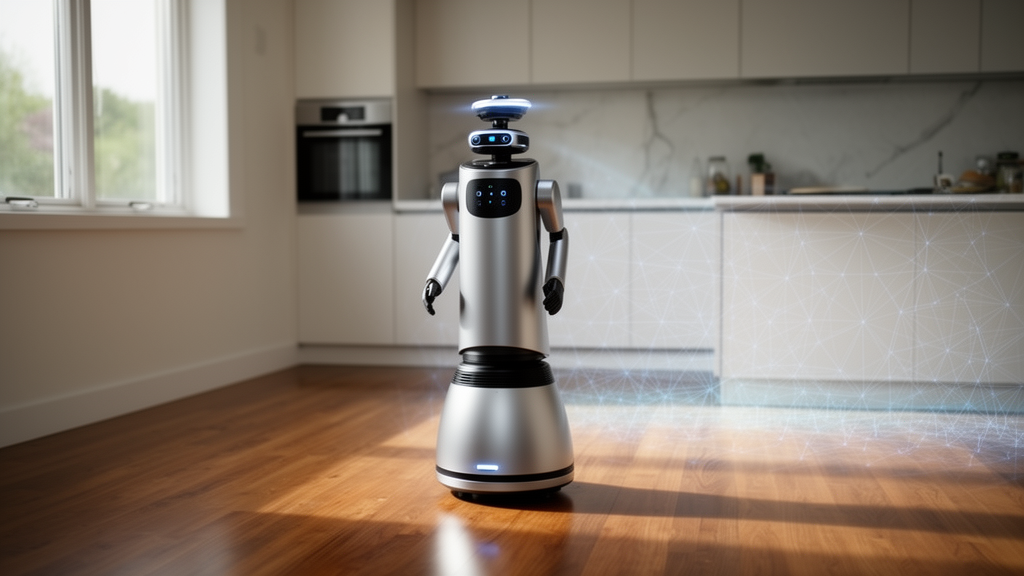
A systematic review published in Discover Applied Sciences examines the integration of natural language interaction and physical environment understanding to enhance the autonomy of home service robots. Researchers Xiaoqing Shao, Juan Ding, Pengwei Zhang, and Qing Zhao analyze how robotic frameworks are evolving from conventional engineering approaches toward embodied intelligence supported by large language models, vision-language models, and vision-language-action models.
In evaluating environmental perception, the survey details a progressive shift away from traditional geometric maps toward semantic representations and behavioral navigation paradigms. The analysis highlights the pivotal operational functions of semantic simultaneous localization and mapping, hierarchical scene representations, and vision-language models in helping intelligent robotic systems interpret complex physical settings.
Addressing communication capabilities, the paper assesses the constraints associated with earlier rule-based interaction frameworks while detailing contemporary developments driven by large language models. The authors document substantial functional improvements across autonomous task planning, contextual reasoning, and automated code generation, illustrating how modern foundation models assist robots in executing complex household instructions.
Unlike prior literature reviews that evaluated environmental perception and linguistic interaction as isolated domains, this work introduces an overarching taxonomy that connects both capabilities. Through this structured classification, the authors evaluate representative robotic systems built upon large language models, vision-language models, and vision-language-action architectures to demonstrate how modern embodied agents unify perceptual inputs with linguistic directives.
The survey identifies prominent research trends shaping the discipline, including multimodal reasoning architectures, language-guided action generation mechanisms, and increasingly adaptive forms of embodied intelligence. Alongside these developments, the review highlights critical technical hurdles that continue to limit widespread deployment, specifically pointing to difficulties surrounding real-world generalization, real-time system performance, operational safety, and algorithmic interpretability.
To conclude the assessment, the review outlines prospective research directions aimed at realizing reliable and adaptive embodied robotic systems for practical deployment in dynamic home environments.
Subject of Research: Embodied intelligence and perception in home service robotics
Article Title: A survey of natural language interaction and environmental perception in intelligent robotics
Article References: Shao, X., Ding, J., Zhang, P., & Zhao, Q. (2026). A survey of natural language interaction and environmental perception in intelligent robotics. Discover Applied Sciences. https://doi.org/10.1007/s42452-026-09890-6
Image Credits: AI Generated
DOI: 10.1007/s42452-026-09890-6
Keywords: home service robots, embodied intelligence, natural language interaction, environmental perception, large language models, vision-language models, vision-language-action models, semantic SLAM, hierarchical scene representations, behavioral navigation, task planning, code generation, multimodal reasoning, language-guided action generation, robotic autonomy, real-time deployment, model interpretability
News Source: Denise Maddox. (November 19, 2026). Review Maps Language and Perception Models in Home Service Robotics. Scienmag.