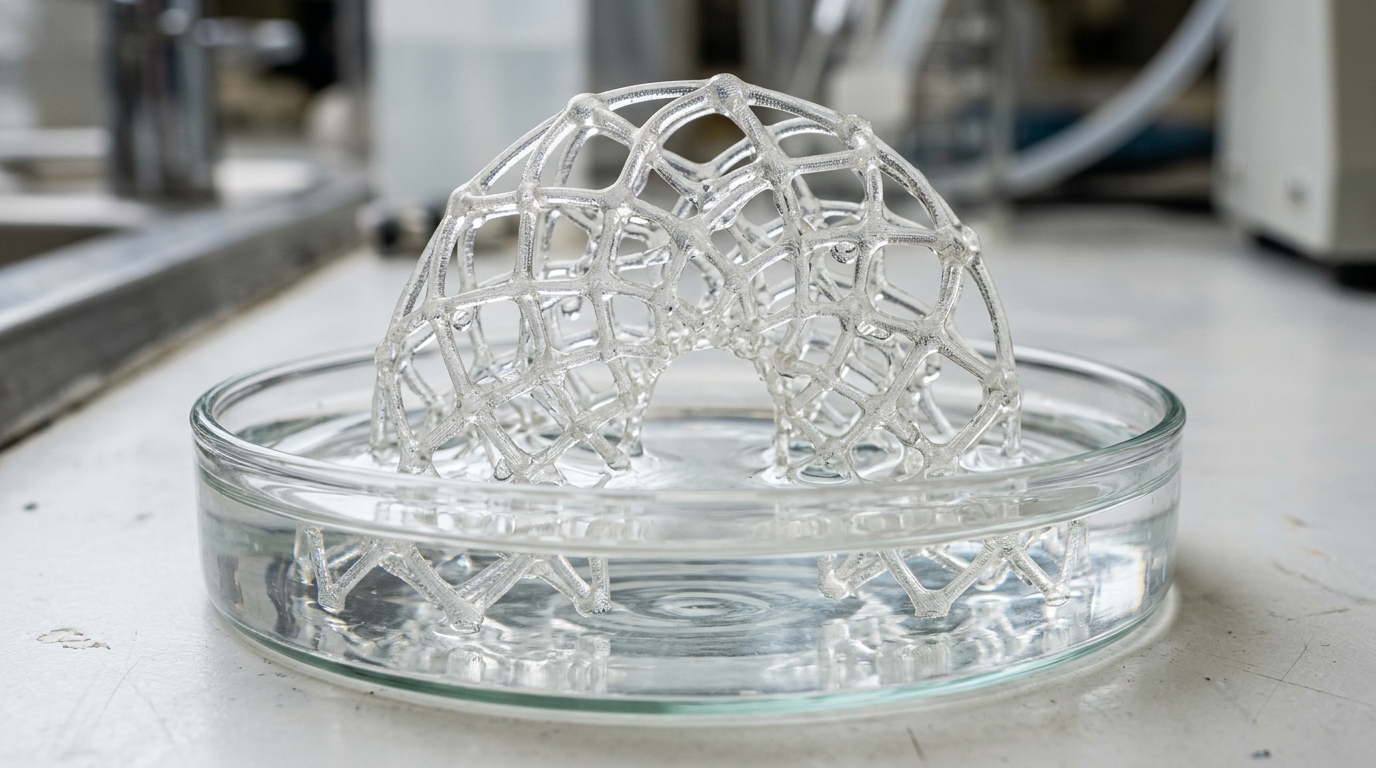
A systematic review published in Annals of Biomedical Engineering evaluates the integration of artificial intelligence with smart hydrogel-based additive manufacturing, reporting that while the convergence introduces computational capabilities for fabricating adaptive structures, the field remains in its early translational stages. The authors systematically examined machine learning, deep learning, and generative models used to optimize the design, processing, and functional performance of stimulus-responsive hydrogels across applications in tissue engineering, drug delivery, and soft robotics.
Computational tools are increasingly deployed to address material behavior complexity and the technical difficulties of high-resolution four-dimensional printing. The review assessed artificial intelligence strategies targeted at hydrogel formulation, real-time manufacturing process control, structural optimization, and biological outcome prediction, with specific emphasis on differentiating between retrospectively fitted computational models and prospectively validated experimental implementations.
A primary conceptual contribution of the analysis is establishing a clear distinction between artificial intelligence-assisted three-dimensional printing and genuine four-dimensional systems. Under this comparative framework, authentic four-dimensional constructs are defined by their capacity to exhibit time-dependent shape transformation, mechanical actuation, or controlled degradation when exposed to external physical or chemical stimuli.
Evaluating domain-specific case studies, the authors observed that artificial intelligence can enhance material printability, manufacturing resolution, and functional outcomes, but they emphasized that reported quantitative claims must be scrutinized against dataset sizes, validation methodologies, and experimental reproducibility. In a comparative evaluation against traditional design-of-experiment methodologies, the review noted that while machine learning holds advantages in exploring complex, high-dimensional parameter spaces, conventional design-of-experiment approaches remain more accessible, interpretable, and reproducible for simpler material systems.
The review concluded by identifying persistent barriers to translation, including pervasive training data scarcity, limited model interpretability, and existing regulatory hurdles. To address these translational challenges, the authors outlined a research roadmap that calls for cross-disciplinary collaboration and standardized data reporting across artificial intelligence and smart hydrogel additive manufacturing research.
Subject of Research: Machine learning applications and challenges in smart hydrogel 4D printing
Article Title: Machine Learning in Smart Hydrogel 4D Printing: Advances, Challenges, and Translational Perspectives
Article References: Almansour, S., Alkwai, L. M., Yadav, K., & Dutta, D. (2026). Machine Learning in Smart Hydrogel 4D Printing: Advances, Challenges, and Translational Perspectives. Annals of Biomedical Engineering. https://doi.org/10.1007/s10439-026-04400-6
Image Credits: AI Generated
DOI: 10.1007/s10439-026-04400-6
Keywords: machine learning, smart hydrogels, 4D printing, additive manufacturing, biomedical engineering, deep learning, process control, tissue engineering, Machine, Learning, Smart, Hydrogel
News Source: Denise Maddox. (November 7, 2026). Review Assesses Machine Learning Roles and Hurdles in Smart Hydrogel 4D Printing. Scienmag.