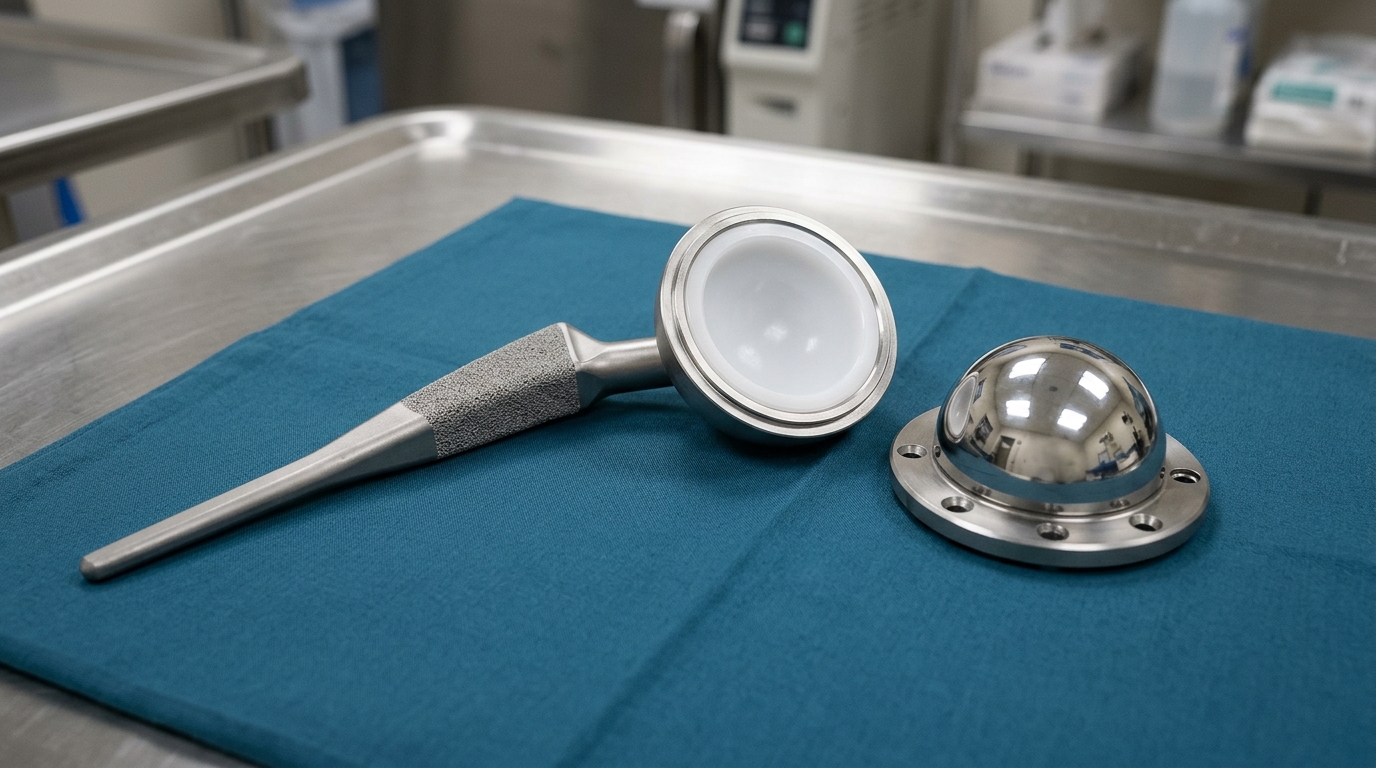
A published systematic review and meta-analysis evaluating complication and revision rates between inlay and onlay humeral stem designs in reverse total shoulder arthroplasty has come under critical examination in the Journal of Orthopaedics and Traumatology. Researchers Yangming Zhu and Peijian Tong identified four methodological and reporting concerns within the work by He and colleagues, demonstrating that the review’s core conclusions—specifically that onlay stems reduce scapular notching and inlay stems decrease infection risks—are substantially weakened by confounding variables, registry weighting, and numerical contradictions.
The first primary issue centers on an implant misclassification that undermines the claim that onlay stems reduce scapular notching independently of neck–shaft angle. In the original meta-analysis, the authors argued this independence based on a study by Beltrame and colleagues, which Table 1 listed as pairing an Ascend Flex inlay stem with an SMR onlay stem. Zhu and Tong showed that the original investigation reported the exact opposite arrangement, contrasting a 145-degree curved onlay stem against a traditional 155-degree Grammont-type inlay stem. Because the Ascend Flex was classified as an onlay implant elsewhere in the review’s own tables, the Beltrame study actually reflected the standard confounded configuration of a 155-degree inlay against a 145-degree onlay component rather than an exception to it.
To evaluate how neck–shaft angle influenced the notching findings, Zhu and Tong re-analyzed the published data by pooling Mantel–Haenszel fixed-effect risk ratios with a 0.5 continuity correction for zero-event cells. While five studies comparing 155-degree inlay stems to 145-degree onlay stems yielded a pooled risk ratio of 2.25 with a 95 percent confidence interval of 1.44 to 3.51 across 50 events in 214 inlay shoulders and 20 events in 205 onlay shoulders, three studies with a matched 135-degree angle produced an imprecise risk ratio of 1.37 with a 95 percent confidence interval of 0.68 to 2.75 across 21 events in 188 inlay shoulders and 12 events in 156 onlay shoulders. With individual matched estimates spanning 0.72, 1.00, and 2.68, and an additional study by Lee leaving angle data unclassified, the re-analysis indicates that humeral tray positioning cannot currently be isolated from neck–shaft angle design differences.
The second major concern involves the meta-analysis’s infection analysis, which was heavily dominated by observational registry datasets. Large registry cohorts contributed 96 percent of the inlay shoulders and 82 percent of the onlay shoulders included in the infection comparison, with a single report from the Norwegian Arthroplasty Register carrying 53.8 percent of the overall statistical weight. This heavy concentration of registry data fundamentally altered the balance of the pooled calculation.
Compounding this weighting issue is an endpoint discrepancy between clinical cohorts and national registries. While clinical cohorts tracked total diagnosed infections, registry databases only captured infections severe enough to require surgical revision. Furthermore, the New Zealand registry data used for the infection analysis represented revision procedures, and the figures extracted from the Norwegian registry displayed conflicting totals between the forest plot, which listed 44 events among 4,696 inlay stems and 17 among 798 onlay stems, and the summary table, which reported 39 and 14 revision events.
Sensitivity calculations demonstrated that removing the single Norwegian registry study altered the pooled infection risk ratio to 0.82 with a 95 percent confidence interval of 0.46 to 1.47 and a p-value of 0.51, while analyzing clinical cohorts alone generated a risk ratio of 0.56 with a 95 percent confidence interval of 0.25 to 1.30. In addition, fixation practices introduced substantial confounding, as 77 percent of inlay stems in the Norwegian registry were cemented compared to only 22 percent of onlay stems. Because antibiotic-loaded cement could directly lower revision rates for infection, and the pooled analysis was never stratified by patient risk factors such as diabetes, obesity, or prior surgical interventions, clinical guidance recommending inlay stems for higher-risk patients remains unsupported by the aggregate data.
The third critique highlights the omission of an eligible registry investigation by Gill and colleagues from the Australian Orthopaedic Association National Joint Replacement Registry. Despite examining 14,807 inlay and 6,590 onlay primary reverse total shoulder arthroplasties—a sample size larger than all thirteen included studies combined—and reporting higher revision rates for inlay implants, this study was cited in the discussion but omitted from the pooled revision analysis without documented justification.
Zhu and Tong also pointed out that revision outcomes were pooled as crude proportions despite pronounced differences in patient follow-up duration, as onlay prostheses were only introduced into the Norwegian registry in 2011. Pooling adjusted hazard ratios would provide a more reliable method, particularly since the Norwegian study reported a similar adjusted revision risk between designs with a hazard ratio of 1.2 and a 95 percent confidence interval of 0.8 to 1.8. Additionally, the Newcastle–Ottawa Scale quality assessment incorrectly claimed that an included study by Colasanti and colleagues lacked comparative groups, even though it evaluated 140 inlay and 123 onlay arthroplasties with differing glenosphere and stem configurations.
The fourth critique documents numerous reporting discrepancies throughout the published manuscript. The abstract divided a stated cohort of 16,309 patients into 5,680 onlay and 3,261 inlay cases—totaling only 8,941—while the primary summary table listed 11,768 inlay and 4,541 onlay shoulders. Dislocation rates also contradicted each other across sections, with the abstract and results reversing percentages and duplicating fracture figures, while the forest plot recorded dislocation rates of 1.04 percent for onlay and 1.16 percent for inlay designs.
Additional inconsistencies included contradictory statements regarding whether revisions were more frequent with onlay or inlay stems, typographical and citation errors in reference listings, and incorrect sex distributions for study cohorts. Zhu and Tong noted that reporting crude pooled fracture percentages created a misleading impression that fractures were three times higher with onlay stems, even though stratified risk ratios indicated a ratio of 0.85 because registry cohorts consisted predominantly of low-event inlay cases. The commentators called for formal re-analyses, stratified evaluations, and numerical corrections before relying on the published findings for surgical implant selection.
Subject of Research: Critical evaluation of meta-analytic evidence comparing inlay and onlay humeral components in reverse shoulder arthroplasty
Article Title: Inlay versus onlay humeral design in reverse shoulder arthroplasty: neck–shaft angle confounding, registry-driven estimates and reporting issues. Comment on He et al.
Article References: Zhu, Y., & Tong, P. (2026). Inlay versus onlay humeral design in reverse shoulder arthroplasty: neck–shaft angle confounding, registry-driven estimates and reporting issues. Comment on He et al.. Journal of Orthopaedics and Traumatology, 27(1), Article 67. https://doi.org/10.1186/s10195-026-00985-9
Image Credits: AI Generated
DOI: 10.1186/s10195-026-00985-9
Keywords: reverse total shoulder arthroplasty, inlay humeral stem, onlay humeral stem, neck–shaft angle, scapular notching, prosthetic joint infection, revision arthroplasty, Norwegian Arthroplasty Register, New Zealand Joint Registry, Australian Orthopaedic Association National Joint Replacement Registry, Mantel–Haenszel risk ratio, antibiotic-loaded cement, prosthetic dislocation, periprosthetic fracture, Newcastle–Ottawa Scale, sensitivity analysis
News Source: Ophelia Keating. (November 25, 2026). Reverse Shoulder Review Questioned Over Neck-Shaft Angle Confounding and Data Errors. Scienmag.