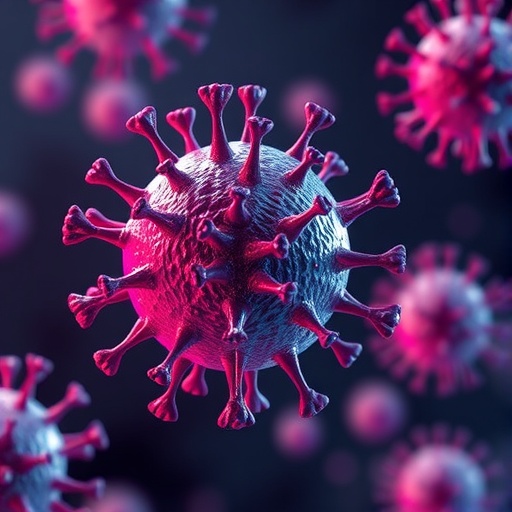
In a groundbreaking study published in the prestigious journal Nature, a team of researchers led by Professor Juan R. Perilla from the University of Delaware has unveiled a transformative insight into the HIV virus, potentially revolutionizing future therapeutic approaches. This discovery sheds light on an unexpected structural function of the viral protein integrase, a revelation that challenges longstanding dogma about HIV’s assembly and infection mechanisms.
HIV, the causative agent of AIDS, affects over 40 million people globally, and its rapid mutation demands continuous advancement in treatment strategies. At the heart of HIV’s formidable infectious power lies a tiny protective shell known as the capsid, roughly the diameter of 120 nanometers—an almost unfathomable scale that dwarfs even the slenderest human hair. The capsid safeguards the viral RNA genome and critical proteins, orchestrating the virus’s maturation and eventual infiltration into host cells.
Historically, integrase has been recognized for its pivotal role in the late stages of HIV infection, facilitating the insertion of viral DNA into the host genome. However, the new research spearheaded by Perilla’s team radically shifts this understanding. Utilizing state-of-the-art cryo-electron microscopy (cryo-EM), the scientists demonstrated that integrase also acts much earlier during the virus life cycle by performing an architectural role within the capsid itself.
Cryo-EM, a cutting-edge imaging technique that involves flash-freezing samples at temperatures colder than outer space and probing them with electron beams, was instrumental in visualizing the intricate internal structure of HIV particles. The researchers performed these highly delicate studies at the Francis Crick Institute in London, where specialized facilities minimize environmental disturbances, allowing atomic-level resolution of HIV components.
The team discovered that integrase assembles into filamentous structures, effectively “glueing” the inner surface of the capsid. These filaments align with the hexagonal tiles forming the capsid shell, securing the viral RNA genome in a meticulously organized “zipper-like” array. This spatial configuration is essential for the virus’s structural stability and infectious capacity.
Professor Perilla emphasized that this architectural role of integrase is critical: without these filamentous anchors, the virus becomes non-infective. This paradigm shift in understanding integrase’s function opens new avenues for antiviral intervention by targeting the protein’s structural role, not just its well-known enzymatic activities.
To validate the structural and functional integrity of integrase filaments, the research team employed molecular modeling and experimented with ALLINIs (allosteric integrase inhibitors). These inhibitors disrupted the oligomerization process of integrase, thereby interrupting its interaction with the capsid and RNA genome. While some ALLINI compounds already show promise in preclinical studies, none of the existing FDA-approved drugs exploit this newfound structural vulnerability, highlighting a clear therapeutic gap and opportunity.
This multidisciplinary approach — combining high-resolution imaging, computational chemistry, and biochemical experimentation — was only possible through extensive collaboration across renowned institutions. Partners range from the Francis Crick Institute and Dana-Farber Cancer Institute to the University of Oxford and several UK-based research centers, underscoring the global scale of this endeavor.
University of Delaware’s investment in training emerging scientists is important to mention as well. Graduate students like Juan Sebastian Rey play substantial roles in ongoing research, often transitioning into pharmaceutical and biomedical careers, thereby continuing to push forward the frontier of HIV research and treatment development.
The investigators also stress the indispensable role of public funding from agencies like the U.S. National Science Foundation, National Institutes of Health, and Department of Energy in facilitating such high-impact research. According to Professor Perilla, without such support, these scientific breakthroughs would be unattainable.
The implications of this study extend beyond fundamental virology; understanding how integrase structurally organizes the viral genome within the capsid adds a crucial piece to the HIV replication puzzle. This, in turn, enhances the rational design of novel drugs capable of disarming the virus at an earlier stage, potentially preventing establishment of infection and viral spread.
In a field continuously challenged by viral mutation and drug resistance, these findings provide fresh hope for patients and clinicians alike. As HIV persists as a global health threat, advancing from knowledge of integrase’s previously undiscovered capability could herald a new epoch in antiretroviral therapy.
This discovery exemplifies how perseverance, technological innovation, and cooperative research efforts converge to unlock hidden viral mechanisms, pushing the boundaries of science and medicine towards a future where HIV infection may be effectively halted in its tracks.
Subject of Research: HIV structural biology; integrase protein function in viral maturation
Article Title: Previously Unknown Structural Role of HIV Integrase Revealed by High-Resolution Cryo-EM
News Publication Date: February 18, 2026
Web References: https://www.nature.com/articles/s41586-026-10154-x
References: 10.1038/s41586-026-10154-x
Image Credits: Evan Krape and Jeffrey Chase / University of Delaware
Keywords
Human immunodeficiency virus, Acquired immune deficiency syndrome, Sexually transmitted diseases, Public health, Health and medicine, Structural biology, Chemical modeling, Immune disorders
Tags: advanced HIV treatment strategiescryo-electron microscopy HIV researchHIV capsid structureHIV infection processHIV replication mechanismsHIV viral RNA protectionintegrase architectural roleintegrase role in HIV assemblynew HIV therapeutic targetsUniversity of Delaware HIV studyviral maturation in HIVviral protein integrase function