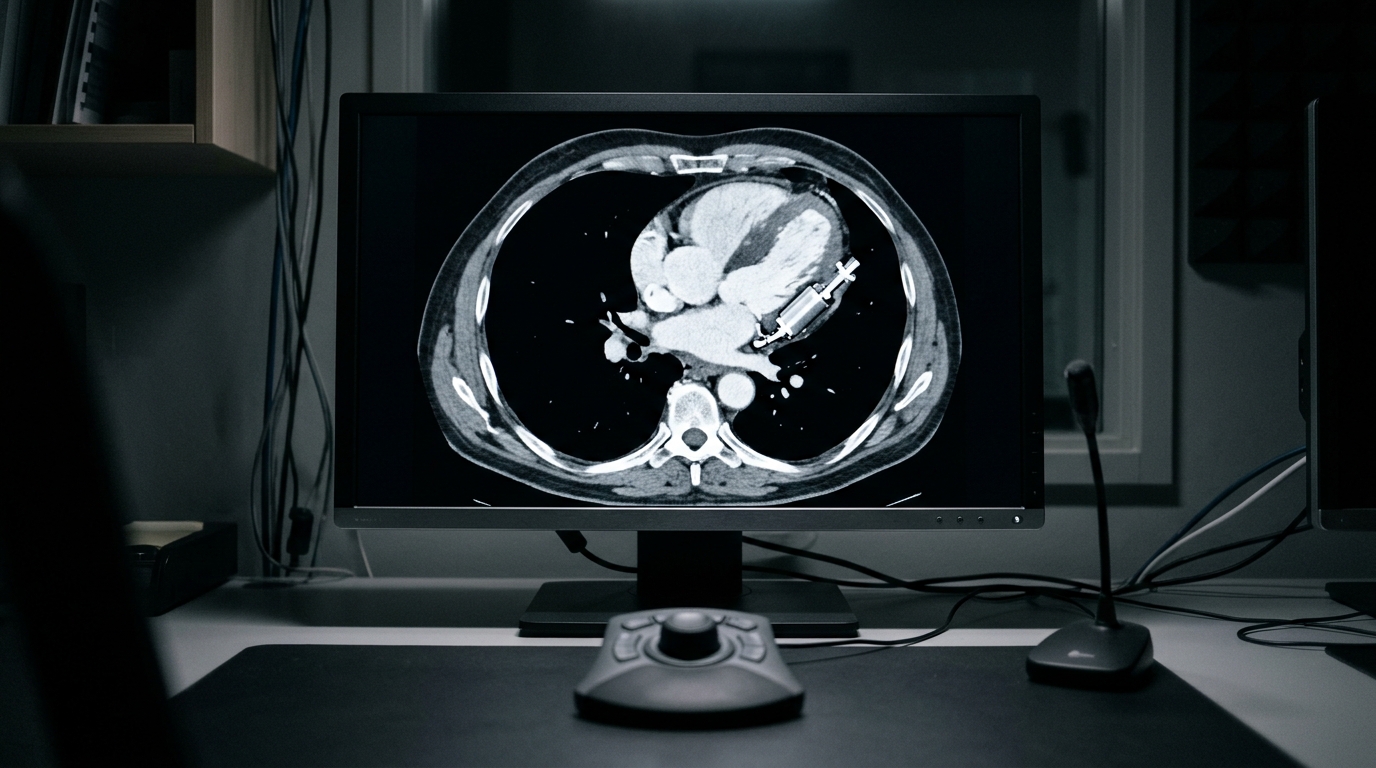
A newly reported clinical case published in the Journal of Cardiovascular Imaging demonstrates that retrospective electrocardiogram-gated cardiac computed tomography angiography can successfully capture dynamic, phase-dependent left ventricular assist device inflow cannula obstruction that standard evaluations may miss. Left ventricular assist device suction events, commonly described as suck-down, occur when the inflow cannula physically contacts the left ventricular endocardium, causing reduced inflow cannula blood flow and potential clinical deterioration. This mechanical complication represents dynamic obstruction driven by cyclical myocardial apposition to the cannula orifice across phases of the heartbeat.
The investigation centers on a 54-year-old male patient with end-stage heart failure resulting from ischemic cardiomyopathy who had undergone implantation of a continuous-flow HeartMate 3 left ventricular assist device four years earlier. The patient presented for clinical evaluation with recurrent low-flow alarms alongside intermittent symptoms concerning for mechanical device dysfunction. Initial diagnostic workup included echocardiography, which remains the conventional first-line imaging modality for ventricular assist device assessments, but the findings were ultimately inconclusive due to inherent acoustic shadowing generated by device components.
To overcome the limitations of acoustic shadowing and accurately determine cannula orientation, clinicians performed contrast-enhanced retrospective electrocardiogram-gated cardiac computed tomography angiography. Two-dimensional multiplanar gated cardiac computed tomography with contrast, evaluated with or without three-dimensional reconstruction, serves as the mainstay for diagnosing suspected mechanical assist device complications. Computed tomography can evaluate inflow cannula positioning and assess for outflow graft kinking across contemporary devices, while electrocardiogram gating is required to suppress motion artifacts during the cardiac cycle.
Inflow obstruction by left ventricular myocardium can develop over time due to substantial changes in ventricular size and geometric shape as the left ventricle is continuously unloaded by the pump. Because the cannula orifice is not surgically anchored within the cavity, its spatial relationship with the surrounding myocardial walls naturally shifts throughout the cardiac cycle and over prolonged implantation durations. When an inflow cannula becomes malpositioned or displaced, mechanical contact with the adjacent endocardium, most frequently the interventricular septum, predisposes patients to intermittent inflow cannula obstruction and ventricular arrhythmias.
Multiphasic long-axis cardiac computed tomography angiography reconstructions revealed clear phase-dependent obstruction of the inflow cannula orifice. During the diastolic phase, multiplanar reformatted long-axis imaging demonstrated partial inflow obstruction as the apical interventricular septum abutted the cannula orifice. This occurred because the cannula was directed toward the interventricular septum rather than aligned in the recommended position parallel to the mitral valve annulus and left ventricular outflow tract. During the systolic phase at the identical slice level, septal myocardium was drawn further into the orifice, resulting in complete inflow obstruction.
Complementary axial multiphasic computed tomography imaging confirmed the spatial orientation responsible for the cyclical suck-down events. An axial diastolic phase image captured above the orifice showed the inflow cannula directed toward the interventricular septum with a narrowed but preserved inflow channel. More inferiorly at the level of the cannula orifice, the imaging demonstrated progression to near-complete inflow obstruction as septal tissue was drawn deeper into the opening, visually confirming the cyclical nature of apical septal apposition.
Prior research cited in the report demonstrates that inflow cannula deviation toward the septum carries significant clinical risks, including an increased risk of pump thrombosis with an odds ratio of 1.35 per 10-degree increase in septal angulation. Cannula malposition toward the ventricular septum or free wall can provoke a damaging cycle of suction events, low pump flow, automatic speed reductions, thrombus formation, arrhythmias, and hemodynamic compromise. In the reported patient, the apical interventricular wall was repeatedly drawn into the orifice during systole, generating chronic, intermittent flow interruption.
The study highlights the critical distinction between retrospective electrocardiogram gating and static or prospective gating techniques in evaluating suspected dynamic device complications. Retrospective gating continuously acquires imaging data throughout the entire cardiac cycle, permitting cine reconstructions at multiple phases to capture intermittent septal contact. Static or prospectively gated protocols acquire images at isolated phases and can fail to identify dynamic obstruction entirely if exposure occurs during a phase when the septum is not actively touching the cannula orifice.
When combined with echocardiography, cardiac computed tomography substantially improves the identification of cardiomechanical assist device complications, with dynamic obstruction representing 26.5 percent of identified complications as the second most common mechanical issue. Published evidence indicates that using both modalities together yields superior diagnostic performance compared to either imaging method alone, achieving a combined sensitivity of 67 percent, a specificity of 93 percent, and an overall diagnostic accuracy of 73 percent. Fully retrospective gated computed tomography uniquely provides both anatomical orientation and dynamic mechanical evaluation within a single diagnostic examination.
The authors note that detailed multiphasic dynamic information directly influences critical clinical management steps, including device speed optimization, adjustments to anticoagulation strategies, and surgical revision planning. Unlike prior literature focusing primarily on acute suction events or static cannula malposition, this case illustrates the chronic, cyclical nature of dynamic inflow obstruction and emphasizes the necessity of retrospective electrocardiogram-gated cardiac computed tomography angiography in patients presenting with unexplained symptoms or recurrent low-flow alarms.
In their published report, researchers Muhammad Umair and Amy Avakian describe the clinical progression of a 54-year-old male patient who developed mechanical assist device complications. The patient had end-stage heart failure caused by ischemic cardiomyopathy and had undergone implantation of a continuous-flow HeartMate 3 device four years prior. When he presented with recurrent low-flow alarms and intermittent symptoms indicating potential device malfunction, clinical assessment required detailed evaluation of cannula behavior. Mechanical inflow obstruction can arise over time because continuous ventricular unloading induces substantial changes in left ventricular size and shape. Because the assist device inflow cannula orifice is not surgically anchored, its spatial relationship with the left ventricular walls shifts throughout the cardiac cycle and over time. When geometric shifts orient the cannula toward the interventricular septum rather than parallel to the mitral valve annulus and left ventricular outflow tract, mechanical contact with the adjacent endocardium causes dynamic obstruction.
The diagnostic pathway highlights the necessity of advanced cross-sectional imaging when initial evaluations prove inconclusive. While echocardiography serves as the standard first-line modality for assist device evaluation, acoustic shadowing from device components poses inherent physical limitations that obscure critical details. To resolve inconclusive echocardiographic findings, clinicians performed contrast-enhanced retrospective electrocardiogram-gated cardiac computed tomography angiography. Two-dimensional multiplanar gated computed tomography with contrast serves as the mainstay for investigating suspected mechanical complications. Computed tomography can verify inflow cannula positioning and assess for outflow graft kinking across contemporary devices. Electrocardiogram gating is essential to avoid motion artifacts, and retrospective gating with or without dose modulation is typically applied when dynamic cannula suction must be examined.
Multiphasic long-axis cine reconstructions provided definitive visual evidence of the phase-dependent nature of the obstruction. By analyzing matched reconstructions from the same cardiac cycle and slice position, clinicians conducted direct phase comparisons between diastolic and systolic anatomy. In diastole, multiplanar reformatted cardiac computed tomography angiography along the long axis demonstrated partial inflow obstruction as the apical interventricular septum abutted the cannula orifice. During systole at the same slice level, imaging revealed progression to complete inflow obstruction as septal myocardium was drawn further into the cannula orifice. This demonstrated cyclical suck-down driven by dynamic myocardial apposition, verifying that obstruction severity fluctuated across different phases of the cardiac cycle.
Complementary axial multiphasic computed tomography views further defined the spatial orientation of the hardware relative to cardiac structures. An axial diastolic phase image obtained above the orifice confirmed that the inflow cannula was directed toward the interventricular septum, showing a narrowed inflow channel as septal myocardium contacted the orifice margin. More inferiorly, at an axial slice directly crossing the inflow cannula orifice, diastolic imaging documented progression to near-complete inflow obstruction as septal myocardium was drawn deeper into the opening. Together with cine video sequences, these multiplanar reconstructions confirmed the chronic and cyclical characteristics of the mechanical interaction, establishing how structural deviation toward the septum directly produced recurrent obstruction.
The clinical significance of cannula positioning is underscored by published risk estimates and pathophysiological relationships. Malpositioning or postoperative displacement that brings the inflow cannula into contact with the interventricular septum or the left ventricular free wall can lead to suction events, arrhythmias, thrombosis, and hemodynamic compromise. Studies utilizing computed tomography demonstrate that cannula deviation toward the septum is associated with higher thrombosis risk, exhibiting an odds ratio of 1.35 per 10-degree increase in septal angulation. Malposition toward the ventricular septum can initiate a cycle in which suction events cause low flow and automatic pump speed reductions, which subsequently contribute to pump thrombosis.
These dynamics also emphasize why fully retrospective electrocardiogram gating is critical compared to prospectively gated or non-gated imaging. Prospective or static protocols acquire images during limited cardiac phases and can fail to detect dynamic obstruction if acquisition occurs when the septum is temporarily disengaged from the orifice. In contrast, retrospective gating collects data across the entire cardiac cycle, allowing multiphasic cine reconstructions to visualize intermittent tissue apposition. Combining cardiac computed tomography with echocardiography substantially enhances diagnostic performance, yielding a combined sensitivity of 67 percent, a specificity of 93 percent, and a diagnostic accuracy of 73 percent, with dynamic obstruction representing the second most common complication at 26.5 percent of cases. Retrospective electrocardiogram-gated computed tomography angiography provides both anatomical and dynamic assessments within a single examination, delivering functional insights that influence device speed optimization, anticoagulation strategies, and surgical revision planning.
Subject of Research: Retrospective cardiac CTA detection of dynamic LVAD inflow cannula suck-down
Article Title: Left ventricular assist device (LVAD) chronic inflow suck-down: a case report demonstrating the need for retrospective cardiac computed tomography angiography for LVAD assessment
Article References: Umair, M., & Avakian, A. (2026). Left ventricular assist device (LVAD) chronic inflow suck-down: a case report demonstrating the need for retrospective cardiac computed tomography angiography for LVAD assessment. Journal of Cardiovascular Imaging, 34(1), Article 5. https://doi.org/10.1186/s44348-026-00070-z
Image Credits: AI Generated
DOI: 10.1186/s44348-026-00070-z
Keywords: left ventricular assist device, computed tomography angiography, retrospective ECG gating, HeartMate 3, inflow cannula obstruction, cannula suck-down, interventricular septum, dynamic obstruction, echocardiography, mechanical LVAD complications, pump thrombosis, cardiac cycle, multiplanar reconstruction, ischemic cardiomyopathy, low-flow alarms, device imaging
News Source: Ophelia Keating. (November 19, 2026). Retrospective Cardiac CT Identifies Chronic Dynamic LVAD Obstruction In Case Study. Scienmag.