Maarten Kamermans, a prominent neurophysiologist who dedicated his career to understanding how the retina processes visual information, passed away on August 11, 2026, at the age of 70. He served as the head of the Retinal Signal Processing Unit, later known as the Vision and Nystagmus Research Group, at the Netherlands Institute for Neuroscience. Additionally, he held the position of Professor of Neurophysiology at the University of Amsterdam. His colleagues and friends describe him as an esteemed scientist who combined deep theoretical knowledge with exceptional experimental ingenuity to unravel the complex mechanisms of human vision.
Kamermans devoted his professional life to investigating how the retina transforms light into the neural signals that allow humans to see and interpret their surroundings. The human eye contains approximately 100 million light-sensitive cells that gather visual information. However, this vast amount of data must ultimately pass to the brain through an optic nerve containing only about one million fibres. Consequently, the retina must rapidly select, transform, and compress the information it receives, preserving essential details while discarding irrelevant data. This process of efficient coding was a central theme throughout his research career.
His academic journey began with a study of biology at the University of Amsterdam, where he also developed a strong interest in physics and mathematics. In 1983, he entered the Laboratory for Medical Physics, where he quickly established himself as a talented and practical experimentalist. He completed his doctoraal examen, equivalent to a Master’s degree, cum laude in 1985. He then undertook his PhD under the guidance of Henk Spekreijse, the scientific director of the Netherlands Ophthalmic Research Institute. Spekreijse was pursuing an ambitious programme to re-investigate the entire visual system, from optical image formation to the visual cortex. Under this mentorship, Kamermans combined sharp-electrode electrophysiology, mathematical modelling, and systems analysis to study retinal signal processing.
A postdoctoral period with Frank Werblin at the University of California, Berkeley, allowed Kamermans to investigate communication between cone photoreceptors and horizontal cells in greater detail. He utilized patch-clamp electrophysiology, a technique that remained central to his experimental work throughout his career. Upon returning to the Netherlands, he established his own research group, launching his independent career with a prestigious Royal Academy Fellowship at the University of Amsterdam. In 1996, he assumed a dual role as a senior researcher at the Netherlands Ophthalmic Research Institute and an assistant professor at the University of Amsterdam. His group later became part of the Netherlands Institute for Neuroscience following a merger with the Netherlands Institute for Brain Research, where he trained scientists who went on to establish research careers globally.
Much of Kamermans’ career focused on the first synapse of the visual system, specifically understanding how and why horizontal cells communicate with cones. His work demonstrated that feedforward and feedback interactions between these cells shape visual signals and contribute to colour constancy and colour induction. He went on to unravel the molecular and genetic basis of this feedback. Ephaptic communication had been demonstrated elsewhere in the nervous system, and in the 1970s, Byzov had proposed it as a possible mechanism for horizontal cell to cone feedback, but the anatomical structure supporting such signalling remained unknown. During a visit to the University of Oldenburg, Kamermans was shown electron-microscope images of connexin hemichannels at the tips of horizontal cells. He immediately recognized that these transmembrane pores could provide the missing structure needed for ephaptic signalling, leading to a fruitful collaboration that changed the understanding of the first visual synapse.
Through subsequent research, Kamermans showed that feedback involves several interacting mechanisms operating over different timescales. Alongside the extremely rapid ephaptic pathway, his group identified another novel, much slower pathway involving transmembrane pores formed by pannexins rather than connexins. Surprisingly, this pathway does not depend on conventional purinergic signalling usually associated with pannexins. Instead, ATP released through these pores is broken down within the confined synaptic space, altering its local pH buffering capacity and thereby changing signalling from the cone. These distinct kinetics allow the outer retina to shape visual signals over different timescales and spatial contexts, revealing a considerably richer system than initially appreciated.
Kamermans also pursued a broader question regarding how the outer retina transforms the statistics of the visual world into an efficient neural representation. Natural scenes contain highly uneven distributions of light intensity, yet neurons must represent this information within a restricted operating range. He and his group investigated how the outer retina reshapes these signals, including the non-linear processes and membrane ionic currents responsible for the transformation. Some of these transformations had been missed previously because they only became apparent when the retina was stimulated with signals resembling those encountered in the natural world. They showed that horizontal-cell feedback helps regulate the gain of the cone synapse, while cones themselves dynamically alter how they filter visual information according to the statistics of the scene.
His deep understanding of retinal organisation allowed Kamermans to recognise an unexpected retinal explanation for a distinctive form of infantile nystagmus, an involuntary movement of the eyes. In a group of infants with congenital stationary night blindness (CSNB) and a rare combination of horizontal and vertical nystagmus with tonic downgaze, mutations in CACNA1F had been identified in most children, while one child carried a mutation in NYX. Kamermans recognized that the cause of the nystagmus lay in the rod to ON-bipolar synapse, as the CACNA1F gene product is on the rod side and the NYX product on the ON-bipolar side of the same synapse. This insight was striking because, at the time, infantile nystagmus was generally believed to originate in the brainstem. Further collaboration with colleagues from the University of Louisville revealed that NYX-mutant mice displayed rhythmic retinal activity and 5 Hz horizontal eye movements, similar to the children. Experiments in his lab confirmed that abnormal oscillations in retinal circuits arising from these mutations could generate infantile nystagmus in CSNB.
At the end of his career, Kamermans was still pursuing unresolved questions about these oscillations and how they might be treated. He was particularly interested in why healthy retinas do not oscillate and whether the oscillations themselves reduce retinal signal fidelity. After learning that AII amacrine cells express dopamine receptors, he saw a possible link. Under normal conditions, dopamine release in the retina is stimulated primarily by activation of the ON pathway. Because NYX and CACNA1F mutations disrupt signalling in this pathway, Kamermans reasoned that dopamine release might be reduced, paradoxically leaving the retina locked in a dark-adapted state despite the patients’ night blindness. In his final paper, published in PNAS shortly after his death, he and his colleagues showed that dopamine or a D1 agonist suppressed these oscillations in a CSNB mouse model and largely restored the signal-to-noise ratio of ganglion-cell output, raising the possibility that dopaminergic treatment might ultimately improve both nystagmus and visual acuity in CSNB.
Beyond his own research, Kamermans was a strong believer in fundamental research for its own sake, believing that the value of new knowledge could not always be predicted in advance. The nystagmus work was a striking example of this, with years of fundamental retinal research providing the understanding that made an unexpected clinical insight possible. This commitment was also reflected in his strong advocacy for the responsible use of animals in research. He worked extensively within his institute and the Royal Netherlands Academy of Arts and Sciences, engaging with national government and the media to explain why animal research remained essential to biomedical science. Much of this work was done quietly and without any desire for recognition.
Those who worked with Kamermans remember how accessible his scientific curiosity was. His door was always open, and he took genuine pleasure in explaining complex ideas, making them understandable to anyone interested. As a mentor, he embodied a combination of hands-off and hands-on leadership, establishing goals collaboratively but trusting his researchers with considerable freedom. His unusually broad expertise spanned biology, physics, electronics, information theory, and signal processing. He kept bureaucracy to a minimum so that attention could remain on the science, and his curiosity-driven approach generated a shared excitement within the group, making the pursuit of difficult questions a collective experience.
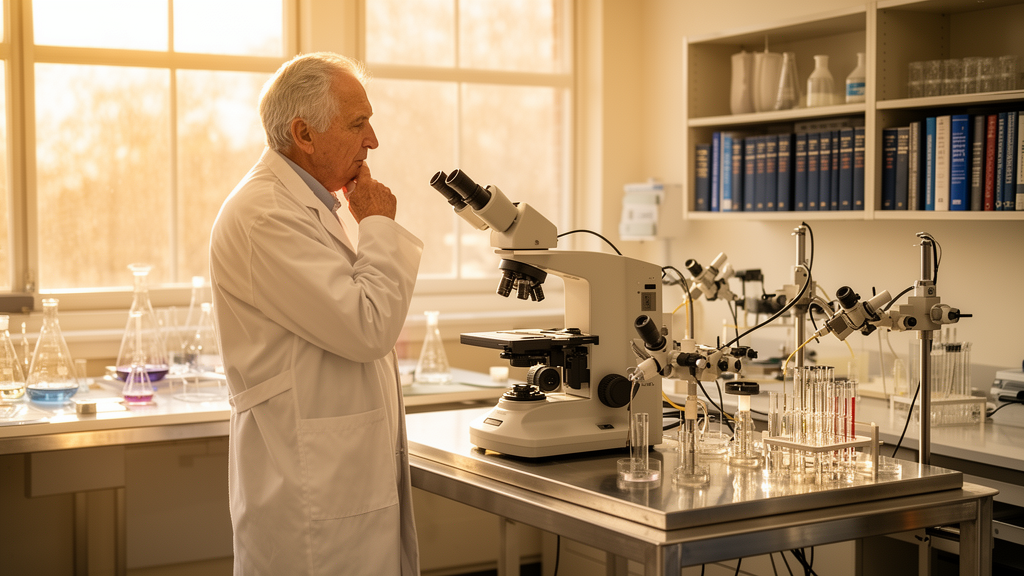
Kamermans was a meticulous and inventive experimentalist, building computers, amplifiers, optical systems, and projectors, and writing his own recording software when necessary. Even late in his career, he remained a master of the demanding art of sharp-electrode recording from horizontal cells, a skill he continued to pass on to many who joined his lab. The same intensity extended well beyond the laboratory. Alongside a demanding scientific career and family life, he took up triathlon at the age of 60, adding it to his passions for skiing and sailing. He cycled around 70 kilometres each day to and from work as part of an annual goal of 10,000 kilometres. During lunch breaks, he would go running, carefully keeping his heart rate at 120 beats per minute while trying to increase the distance he could cover.
In life and at work, Kamermans always strove for excellence; time was secondary, quality was the goal. He was an exceptional scientist, and the curiosity, ingenuity, uncompromising standards, and integrity that characterised him will live on in the many people who worked with him and learned from him. He relished difficult problems and demanding goals, and seemed happiest discovering just how far an idea, an experiment, or his own limits could be pushed. In his own words, “One does not belong on the Olympic team if not running for gold.”
Subject of Research: Retinal signal processing and neurophysiology
Article Title: Obituary Maarten Kamermans 1956 – 2026
Article References: Howlett, M. H. C., Joselevitch, C., Kamermans, A., van den Berg, T., Klooster, J., Winkelman, B. H. J., Kamermans, W., Sermet, B. S., de Zeeuw, C. I., & Simonsz, H. J. (2026). Obituary Maarten Kamermans 1956 – 2026. Frontiers in Ophthalmology, 6, Article 1999471. https://doi.org/10.3389/fopht.2026.1999471
Image Credits: AI Generated
DOI: 10.3389/fopht.2026.1999471
Keywords: retina, neurophysiology, obituary, visual system, nystagmus, horizontal cells, photoreceptors, retinal feedback, efficient coding, signal processing, Maarten, Kamermans
News Source: Ophelia Keating. (November 10, 2026). Retinal Scientist Maarten Kamermans Dies at 70. Scienmag.