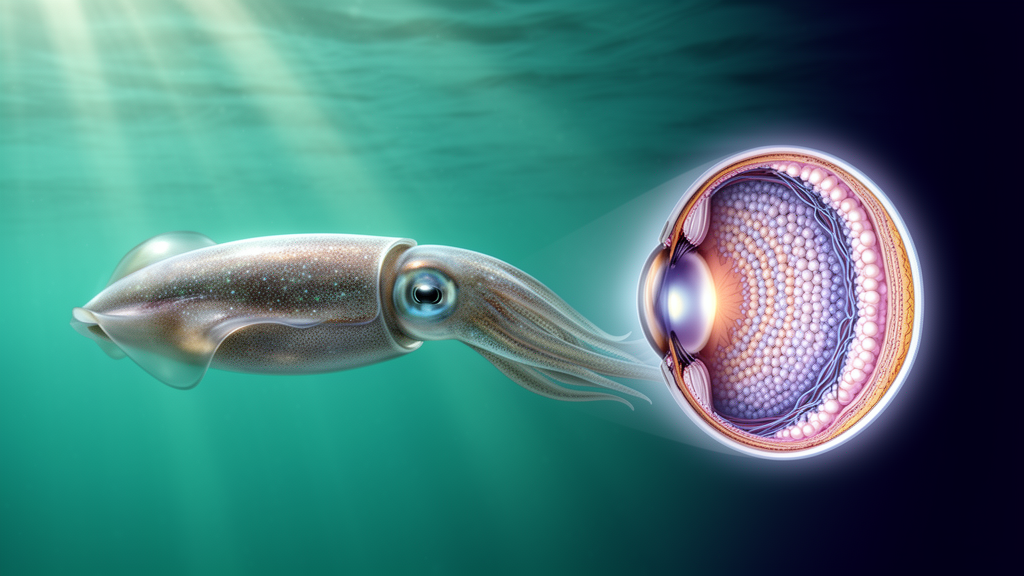
In juvenile oval squid, behavioral eye preference during social interactions correlates directly with microscopic structural variations within the photoreceptors of the retina, according to an experimental investigation published in Zoological Letters. Marine biologists studying Sepioteuthis lessoniana observed that individual squid preferentially orient either their left or right eye toward conspecific tankmates during schooling behavior, reflecting a pronounced visual lateralization. Detailed examination of excised retinal tissue demonstrated that this behavioral dominance does not stem from gross physical differences in focal length or overall photoreceptor cell density across the left and right eyes. Instead, researchers discovered a significant positive association between an individual animal’s dominant viewing side and the proportion of retinal photoreceptor cells that house a single nuclear chromocenter rather than multiple heterochromatin clusters. This structural asymmetry at the sub-cellular scale appears to enhance the light-collecting efficiency of the dominant eye, shedding new empirical light on the physiological mechanisms underpinning sensory lateralization in marine invertebrates.
Visual lateralization represents a widespread biological phenomenon observed across both vertebrate and invertebrate taxa, particularly in species whose eyes are positioned laterally on opposite sides of the head. In animals with lateral ocular placement, monocular vision dominates the overall visual field, often prompting individuals to favor one eye when inspecting visual targets such as approaching predators, elusive prey items, or conspecific school members. Cephalopods share camera-style lens eyes with vertebrates, yet their retinal architecture exhibits several fundamental evolutionary contrasts. Cephalopod retinas lack the complex synaptic interneuron layers characteristic of vertebrate eyes, possessing instead a single layer of photoreceptor neurons whose postsynaptic connections reside directly within the optic lobes of the brain. Furthermore, squid photoreceptors are rhabdomeric and oriented toward the incoming light passing through the crystalline lens, placing the light-absorbing outer segments in front of the supporting cell and nuclear layers. Although earlier studies in Sepioteuthis lessoniana established that eye preferences correlate with schooling position, volume analyses of the optic lobes failed to account for this behavioral divergence.
To investigate whether peripheral ocular structures might explain this visual preference, the research team examined juvenile oval squid reared under rigorously controlled laboratory conditions at Hokkaido University. Squid egg capsules gathered from natural coastal waters in Japan were incubated in an eleven-hundred-liter circular tank supported by an enclosed artificial seawater circulation system. Water quality parameters were systematically held at a temperature between 24.5 and 25.0 degrees Celsius, salinity between 32 and 34 practical salinity units, pH exceeding 7.8, and dissolved oxygen concentrations greater than 6.8 milligrams per liter. Hatched paralarvae and growing juveniles were maintained in floating net-bottom containers enriched with artificial seaweed, sustaining population densities below 0.15 animals per liter at eighty days post-hatching. The growing animals received feedings of live mysid crustaceans, Neomysis japonica, and frozen Japanese anchovies, Engraulis japonica, three times daily. Under this rearing regimen, the juvenile squid reached an age of seventy-eight to eighty-six days and developed cohesive schooling behavior typical of adolescent cephalopod cohorts.
Behavioral recordings were conducted using five tagged juvenile squid exhibiting mantle lengths ranging from 39.2 to 75.5 millimeters. Ten days prior to behavioral testing, individual squid received distinct visible implant fluorescent elastomer markings under mild ethanol anesthesia to ensure reliable visual identification without causing adverse behavioral responses. The behavioral apparatus consisted of a rectangular testing aquarium partitioned into two compartments by a dual barrier made of transparent glass and removable black styrene. An individual focal squid was placed in the smaller compartment occupying one-third of the tank while four conspecifics occupied the larger compartment. Following a one-hour acclimation period, the opaque divider was removed for ten minutes, exposing the conspecifics through the clear glass while an overhead digital camera recorded swimming orientations at thirty frames per second. Video evaluations scored the position of neighboring squid across left monocular, right monocular, and overlapping binocular fields, generating a visual laterality index that revealed significant individual directional preferences in four out of five tested subjects.
Following behavioral assessments, each subject was humanely euthanized in an ethanol solution and fixed in paraformaldehyde to enable comprehensive anatomical and histological analyses of both eyes. The researchers carefully measured ocular focal length, defined as the distance extending from the center of the crystalline lens to the medial retinal surface. Flat-mounted preparations of the retinas were dissected to isolate a five-millimeter square from the posterior area, a specialized retinal region documented to possess the highest photoreceptor packing density in this species. Tissue blocks were embedded in an albumin-gelatin matrix, sectioned into one-hundred-and-fifty-micrometer slices with a linear slicer, and treated with fluorescent nucleic acid stains, including propidium iodide and Hoechst 33342. Using laser scanning confocal microscopy at high magnification and fine z-axis intervals, the investigators generated three-dimensional image stacks of the photoreceptor nuclear layer, facilitating precise volumetric reconstruction and nuclear segmentation through specialized computer software.
Quantitative comparisons between the behavioral visual laterality index and macroscopic eye metrics revealed no statistically significant relationships for gross anatomical parameters. The laterality index of ocular focal length, which quantifies proportional left-versus-right differences in lens-to-retina spacing, showed no meaningful correlation with behavioral side preference across the tested individuals. Similarly, measurements of photoreceptor density within the high-acuity posterior retinal zone demonstrated that neither eye consistently maintained a higher overall cell count, yielding a non-significant correlation with visual lateralization toward conspecifics. These negative findings confirmed that behavioral eye dominance in juvenile oval squid is not driven by asymmetrical eye size, unequal optical focal lengths, or broad variations in the number of light-sensing neurons packed across the left and right retinas. Consequently, the authors directed their investigation toward sub-cellular architectural features within the nuclei of the photoreceptor cells themselves.
Confocal imaging of stained photoreceptor nuclei revealed dense clusters of heterochromatin, termed chromocenters, enveloped by a distinct peripheral heterochromatin rim along the inner nuclear envelope. While the total number of chromocenters inside individual nuclei ranged from one to five, photoreceptors containing a single central chromocenter predominated throughout the posterior retina. Importantly, the proportion of single-chromocenter cells did not alter overall photoreceptor density, yet its laterality index exhibited a strong, statistically significant positive correlation with the behavioral laterality index. Individual squid consistently favored the eye that contained a higher relative percentage of single-chromocenter photoreceptor cells when tracking conspecific schoolmates. This structural asymmetry was evident strictly at the individual level rather than across the pooled population, as left and right eyes showed roughly equivalent mean chromocenter proportions when aggregated across all specimens, closely matching the non-lateralized population distribution of cephalopod eye dominance.
Because cephalopod photoreceptor outer segments face outward toward the lens while their nuclei sit behind them, the authors conducted optical bench experiments to determine how nuclear heterochromatin could influence light absorption. Utilizing three additional juvenile squid aged seventy-three to seventy-five days, the researchers excised intact eyes and isolated fragments of the argentea, the silvery reflective outer tunic of the cephalopod eye. By directing a 532-nanometer green laser beam through the intact ocular globe and through eyes with partially excised outer layers, they established that incoming light traverses the transparent retinal layers and reaches the inner surface of the argentea. Subsequent reflectance measurements demonstrated that the inner face of the argentea reflects approximately as much laser light back toward the retina as its outer surface. This empirical finding proved that light passing unabsorbed through the photoreceptor layer bounces off the internal argentea lining, heading backward through the nuclear layers toward the light-absorbing rhabdomeres.
To model how passing through single versus multiple chromocenters alters this reflected illumination, the team performed three-dimensional finite-difference time-domain simulations using the open-source optical platform MEEP. The computational domain incorporated empirical nuclear dimensions and established refractive indices for heterochromatin, euchromatin, and surrounding cellular tissue, simulating wave propagation at the squid’s 500-nanometer visual pigment absorbance peak. The simulations demonstrated that a photoreceptor nucleus containing a solitary chromocenter functions as a biological converging lens, concentrating reflected light rays directly onto the base of the outer segment. Conversely, nuclei containing two or three chromocenters generated fragmented interference patterns that failed to focus reflected energy efficiently. These numerical findings indicate that photoreceptors containing a single chromocenter collect reflected photons far more effectively, equipping the dominant eye with elevated contrast sensitivity under low-light conditions.
The study provides compelling cellular evidence that subtle heterochromatin organization within sensory neurons can correlate with complex lateralized behaviors in marine invertebrates. For schooling oval squid, enhanced contrast sensitivity in the dominant eye likely facilitates the rapid detection of subtle postural shifts, swimming movements, and faint reflective patterns produced by conspecific iridophores and chromatophores. While nocturnal mammals similarly deploy single-chromocenter rod nuclei to enhance photon collection, Sepioteuthis lessoniana represents the first documented animal possessing a single chromocenter encapsulated within a distinct peripheral heterochromatin envelope. The authors emphasize that their behavioral and histological conclusions rest upon a small cohort of five experimental juveniles, necessitating caution and highlighting the need for broader sampling and in vivo electrophysiology. Nevertheless, these discoveries reveal an unexpected bridge connecting sub-cellular genome architecture, optical physics, and behavioral laterality in cephalopod vision.
Subject of Research: Retinal heterochromatin lateralization and visual eye preference in oval squid
Article Title: Lateralization of retinal structure correlated with behavioral lateralization in the oval squid Sepioteuthis lessoniana
Article References: Sakurai, Y., Kohtsuka, H., Kimbara, R., Miura, T., & Tanaka, N. K. (2026). Lateralization of retinal structure correlated with behavioral lateralization in the oval squid Sepioteuthis lessoniana. Zoological Letters, 12(1), Article 15. https://doi.org/10.1186/s40851-026-00268-5
Image Credits: AI Generated
DOI: 10.1186/s40851-026-00268-5
Keywords: Sepioteuthis lessoniana, oval squid, visual lateralization, retinal structure, chromocenters, photoreceptor cells, heterochromatin, argentea, optical properties, FDTD simulation, eye dominance, schooling behavior, contrast sensitivity, monocular vision, cephalopod vision, confocal microscopy, laterality index
News Source: Drew Townsend. (November 23, 2026). Retinal Cell Structures Correlate With Eye Preference in Oval Squid. Scienmag.