Restoring tropical peatlands supports bird diversity and does not affect livelihoods of oil palm farmers, study suggests
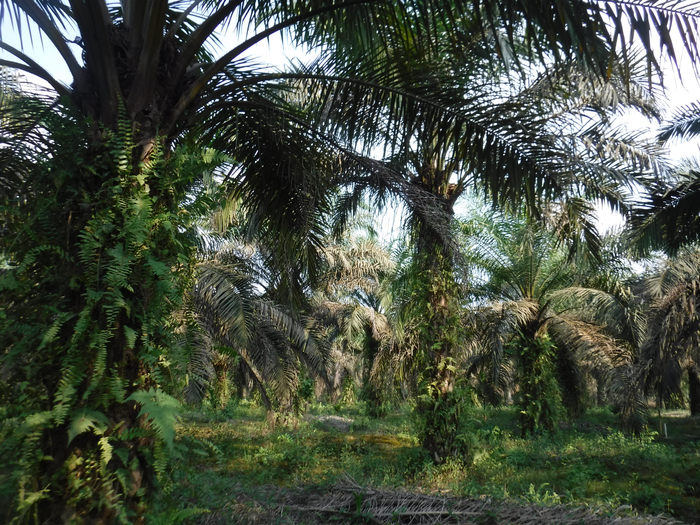
Credit: Dr. Eleanor Warren-Thomas
Restoring tropical peatlands supports bird diversity and does not affect livelihoods of oil palm farmers, study suggests
A new study has found that oil palm can be farmed more sustainably on peatlands by re-wetting the land – conserving both biodiversity and livelihoods.
The research looked at tropical peatland restoration efforts in Indonesia, and investigates whether managing water levels on drained peatlands affects the viability of oil palm grown by farmers, as well as bird species diversity.
Tropical peatlands in Southeast Asia contain large below-ground carbon stocks, while peat swamp forests contain unique and threatened biodiversity. However, when peat forests are cleared and peatlands are drained for cultivation, it results in carbon emissions, biodiversity losses, and land subsidence. Drained peatlands are also prone to fire, which in the past has led to toxic haze, deaths, and health and economic damage.
Indonesia is estimated to contain 47% of global tropical peatlands, chiefly on the islands of Borneo and Sumatra. Forests covered 76% of Sumatra’s peatland in 1990, but by 2015, 66% was covered by smallholder agriculture or industrial plantations, primarily of oil palm.
Drainage is considered necessary to maintain oil palm yields because prolonged flooding reduces fruit production. However, peatland drainage means Sumatra is now a hotspot for peat fires.
The study found that re-wetting should have net positive effects for smallholders by reducing the risk of fires that can damage property, plantations, and human health, without having a detectable effect on oil palm yields.
A farmer collaborating on the project, Mr Udin, said: “Even if the farm flooded for a few days, the yield is not decreased.”
The study, published in Journal of Applied Ecology, was led by the University of York and ZSL (Zoological Society of London), as well as colleagues from the Indonesian Center for Agricultural Land Resources Research and Development and Jambi University in Indonesia.
The study – which focussed on Jambi province in Sumatra, Indonesia – studied water table depths on oil palm farms managed by smallholder farmers, to assess impacts on oil palm yields and on bird species living on the farms.
Peat is a carbon-rich soil formed from partly decomposed vegetation in permanently wet conditions. Tropical peatlands are critically important for storing carbon in the ground, and also provide habitats for tropical wildlife, including tigers, gibbons, birds, and specially adapted plants, fish, and microbes.
Cultivating peatlands also supports people’s livelihoods, such as small-scale farmers growing oil palm.
Peatland needs to be drained using canals to make the land suitable for farming, which can impact habitats and cause the peat to emit carbon. The dry land can also become prone to fire – leading to increased carbon emissions, toxic haze, and a threat to the lives of both people and wildlife.
Restoring drained peatland involves a process of “rewetting” where canals draining water away are blocked or filled in, which makes it less likely that the peatlands will catch fire.
Ninety bird species were recorded in an area of peat swamp forest neighbouring the farms, but only 48 species were found in oil palm. The species living in the forest were also different, including 35 conservation-priority species, and tended to be larger-bodied species that play different ecological roles, meaning forest protection is critical for conserving biodiversity.
Reducing fire risk in the neighbouring oil palm farms by re-wetting should reduce the risk of forest burning and of further habitat loss for wildlife, while still supporting farmer production.
Dr. Eleanor Warren-Thomas, now at Bangor University and IIASA, and who led the study while a researcher at York, said: “Indonesia has been very successful in reducing deforestation and considerable effort has gone into peat restoration to avoid fires.
“But one of the big challenges is the trade-off between livelihoods of owners of small farms and ensuring biodiversity in these areas.
“What this new study shows is that retaining more water in oil palm farms to reduce fire risk seems to have no effect on yields, which is good news for farmers. In contrast to the concerns of some plantations, retaining water levels close to the surface (40cm or less) still enables oil palm cultivation.”
Eleanor said: “By also surveying bird species in one of the remaining peat swamp forest areas nearby, we also showed the huge importance of protecting the remaining forest for bird conservation – avoiding fires in the landscape is key to doing this.
“These unique birds can also act as seed dispersers – crucial if in the longer-term forest restoration becomes an option.
“One of the conclusions of the study is that larger-scale industrial farming organisations would be able to help further studies in this area, if they are able to publish their data and share their knowledge to inform sustainable oil palm production strategies.”
Journal
Journal of Applied Ecology
DOI
10.1111/1365-2664.14135
Subject of Research
Not applicable
Article Title
No evidence for trade-offs between bird diversity, yield and water table depth on oil palm smallholdings: implications for tropical peatland landscape restoration
Article Publication Date
15-Mar-2022