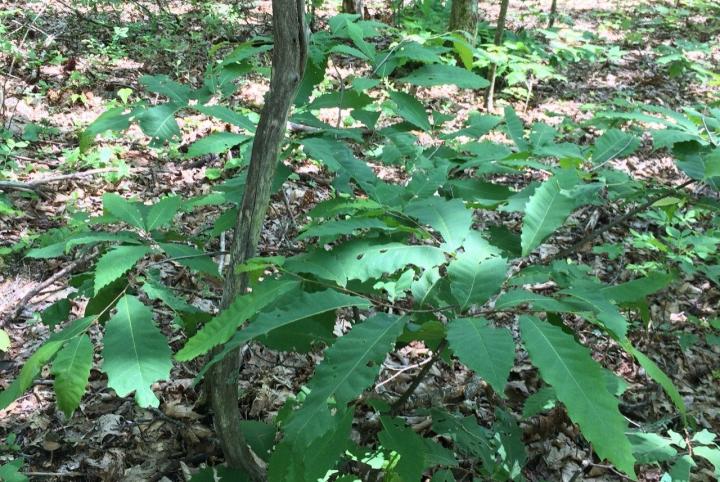
Credit: Roanoke College
At the turn of the 20th century, the American chestnut accounted for a quarter of the hardwood trees in some parts of Appalachia. The large tree was a crucial food source, producing nuts that were a staple in the diets of white-tailed deer, wild turkeys, and bears.
In 1904, a fungal blight was first discovered on trees in New York City, accidentally introduced via imported Asian chestnut trees. The invader spread quickly: by 1906 it was estimated that 98% of American chestnuts in New York City were impacted by the blight, which first forms a canker under the bark of a tree and then forms a ring that “girdles” the tree, killing everything above it.
The blight spread quickly. Just a half-century after it was discovered, the blight had all but eradicated mature American chestnut trees from the North American landscape, infecting an estimated 4 billion trees and irrevocably altering Appalachian forest ecosystems.
Now, a $500,000 grant from the National Institute of Food and Agriculture will help Associate Professor Jason Holliday of the College of Natural Resources and Environment research methods to utilize the genetic diversity of remaining trees as part of broader efforts to introduce disease-resistant American chestnuts to U.S. forests.
“The roots of the American chestnut still survive,” explained Holliday, a faculty member in the Department of Forest Resources and Environmental Conservation and an affiliate of the Fralin Life Sciences Institute. “While the chestnut is no longer fulfilling its historical role in the ecosystem, the genetic material persists. You can still find them in the forest, but they look more like a shrub now. The fungal blight lives above ground and doesn’t affect the roots, so many of the trees persist but rarely reach maturity.”
For decades, efforts have been underway to return a blight-resistant American chestnut to eastern forests. Two parallel methods in tree breeding — traditional methods of hybrid breeding and newer transgenic methods that utilize genetic engineering strategies — are inching closer towards successfully developing a blight-resistant cultivar. Once that is accomplished, the next challenge is incorporating the genetic diversity that the pre-blight trees had developed over centuries to ensure that American chestnut can reclaim its place as a nut-producing tree in North American forest ecosystems.
This is where Holliday’s research comes in. His team will gather and sequence the genomes of the surviving American chestnuts to understand how pre-blight genomic variation across the historical range of the species helped these trees adapt to and thrive in specific environments.
“Working with Dr. Jared Westbrook, director of science at the American Chestnut Foundation, we’re going out and collecting leaf samples from chestnut stump sprouts all across the tree’s historical range, from Maine to Alabama” Holliday said. “We’ll be sequencing the genomes of approximately 500 trees across that range to understand the extent to which genomic differences are related to environmental variation.”
The data from this effort will allow American Chestnut Foundation scientists to incorporate adaptive genetic variation that developed through centuries of natural selection operating on chestnut populations across diverse environments. This would ensure that blight-resistant lines of the American chestnut have the capacity to survive and reproduce.
“The goal is to propagate a bunch of the wild chestnuts and bring their genetics into an orchard context,” Holliday explained. “They will then be grown to maturity so that we could collect pollen from them and use those trees to diversify the blight-resistant lines that are being developed. The end goal is to have one population of trees that is good for restoration in Virginia, a different population that is good for restoration in New York or Pennsylvania, and so on.”
It has been a century since the American chestnut has been an overstory contributor in North American forests, but the recent revolution in genome sequencing has accelerated efforts to return this dormant species to its role in the forest ecosystems of Appalachia.
###
Media Contact
Krista Timney
[email protected]