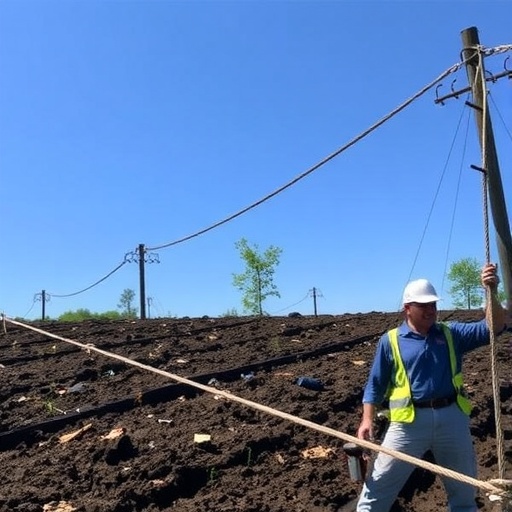
Restoring ecosystems disturbed by mining operations has long been a formidable challenge for environmental scientists and land managers alike. Among the myriad difficulties faced, one of the most persistent issues lies in the reconstruction of soils from waste rock—a substrate that is often sterile, devoid of organic content, and lacking in the microbial life that constitutes the biological engine of healthy soil. A groundbreaking study now reveals that the application of native plant litter, specifically from Eucalyptus woodlands, can catalyze the reassembly of a functional soil microbiome, effectively jump-starting the recovery of these degraded landscapes with remarkable efficiency and minimal cost.
The research, conducted near a former uranium mine in northern Australia, highlights how a simple intervention—spreading leaf litter harvested from adjacent undisturbed forests—can dramatically transform microbial communities in waste rock-based soils. This transformation leads to a soil ecosystem that mirrors the complexity and functionality of natural Eucalyptus woodland soils. Unlike traditional approaches that rely heavily on expensive amendments or imported topsoil, this strategy utilizes readily available biomass, making it a practical and scalable solution for mining rehabilitation worldwide.
Healthy soils are defined by their intricate, diverse communities of bacteria, fungi, and archaea, which orchestrate essential biochemical cycles such as the decomposition of organic matter and nutrient recycling. These processes underpin plant growth and ecosystem resilience. However, soils reconstructed from crushed rock often fail to establish these microbial networks effectively, resulting in stunted vegetation development and compromised ecosystem stability. The study’s approach, applying a thin layer of native litter, essentially acts as a biological inoculant, supplying both the organic substrate and native microbial consortia simultaneously.
Monitoring was focused during the wet season—a period when soil biological activity peaks—to maximize detection of microbial dynamics. After application of the litter, microbial diversity increased substantially, and the composition of community members shifted measurably toward taxa characteristic of undisturbed woodlands. This shift included a marked rise in the abundance of microbial groups instrumental in carbon and nitrogen cycling, crucial components for soil fertility. Conversely, microbes adapted to the extreme, nutrient-poor conditions of fresh waste rock declined, signaling a transition toward more stable and productive soil ecosystems.
Network analyses further elucidated the intricate interactions reshaped by litter inoculation. The formerly fragmented microbial communities began to exhibit more structured and cooperative networks, indicating improved resource sharing and ecological integration amongst microbial taxa. This reorganization is pivotal, as microbial cooperation enhances nutrient turnover rates and stabilizes soil organic matter, creating a feedback loop that sustains plant growth and promotes long-term soil health.
Biochemical assays complemented microbial community data by revealing heightened enzymatic activity associated with organic matter decomposition and nitrogen transformation. These functional responses underscore the immediate impact of native litter on soil biochemical processes—a key indicator that the biological functions necessary for ecosystem recovery are being re-established. The study’s lead author emphasized that the dual input of organic material and native microbial assemblages serves as a robust biological trigger accelerating soil system recovery toward natural conditions.
The elegance of this method lies not only in its efficacy but also in its simplicity and cost-effectiveness. During land clearing or vegetation management, native forest litter is often produced as a byproduct and typically discarded or burned. Repurposing this material as a restoration amendment exploits an untapped resource, provides ecological benefits, and reduces waste, aligning with sustainable land management goals. This approach contrasts sharply with more resource-intensive strategies that seek to physically replace soils or add synthetic amendments, both of which bear higher financial and environmental costs.
Moreover, the study challenges conventional restoration paradigms centered on exact species replacement, advocating instead for a functionally oriented approach. Restoring key ecological processes—such as nutrient cycling, microbial networking, and organic matter turnover—may prove more critical for successful rehabilitation than re-establishing precise taxonomic compositions. This insight aligns with emerging ecological theories emphasizing ecosystem resilience driven by functional biodiversity rather than taxonomic identity alone.
Despite these promising findings, the researchers caution that the benefits of litter inoculation may be most pronounced in the short term and that continued organic inputs will likely be necessary to maintain soil microbial functions over time. This requirement highlights the potential need for ongoing management interventions or carefully designed natural succession pathways to sustain soil and vegetation recovery, particularly in the hostile environments typical of mine-impacted sites.
Given the accelerating global demand for minerals and the consequent expansion of mining activities, finding scalable, economical, and ecologically sound restoration techniques is urgent. This study’s results suggest that mimicking natural processes—leveraging the inherent biological potential found in forest litter and native microbiomes—offers a viable route toward sustainable rehabilitation. Unlocking the latent power of fallen leaves and the microbial communities they harbor may redefine the practice of restoring devastated soil systems worldwide.
As scientists continue to delve into the complexities of soil ecology, the practical application of this research heralds a new era in ecological restoration. The ability to rebuild biologically active soils quickly and with minimal inputs is poised to reshape restoration ecology, bridging the gap between scientific understanding and field-level implementation. It is a vivid reminder that sometimes, nature’s simplest elements—like the humble leaf litter—hold the key to solving some of our most intractable environmental problems.
Subject of Research: Not applicable
Article Title: Biological triggering waste rock-based soil system with native plant litter establishes soil microbiome and biochemical functional potential typical of Eucalyptus woodland
News Publication Date: 27-Feb-2026
Web References:
https://doi.org/10.48130/een-0026-0003
References:
You F, Parry D, Hall M, Huang L. 2026. Biological triggering waste rock-based soil system with native plant litter establishes soil microbiome and biochemical functional potential typical of Eucalyptus woodland. Energy & Environment Nexus 2: e008.
Image Credits: Fang You, David Parry, Merinda Hall & Longbin Huang
Keywords: Soil microbiome, Waste rock reclamation, Native plant litter, Eucalyptus woodland, Microbial diversity, Soil restoration, Nutrient cycling, Mining rehabilitation, Ecological recovery, Microbial networks
Tags: enhancing soil biodiversity with native plantsenvironmental restoration using plant litterEucalyptus woodland litter benefitslow-cost soil restoration techniquesmicrobial communities in degraded soilsmicrobial recovery in waste rock soilsnative forest litter for soil restorationreassembling functional soil ecosystemsrestoring soil life in post-mining landscapesscalable post-mining ecosystem recoverysoil microbiome reconstruction after miningsustainable mining rehabilitation methods