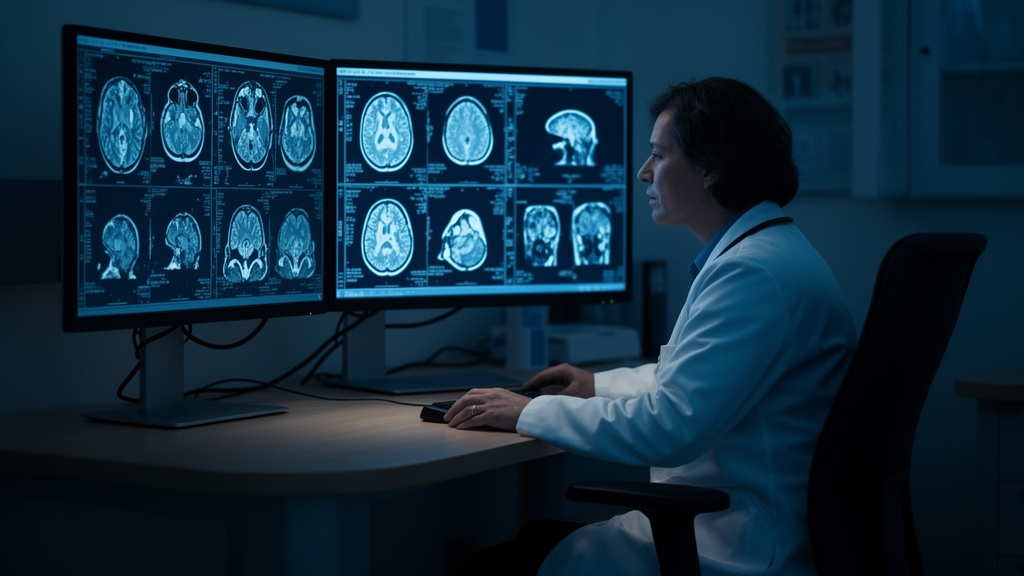
A deep learning framework integrating a ResNet backbone with attention mechanisms and Particle Swarm Optimization achieved over 98 percent accuracy in classifying brain stroke from computed tomography images across two public benchmark datasets. The automated image processing system demonstrated strong classification metrics in both binary detection and multi-category stroke differentiation tasks, highlighting the potential of automated computational models to assist in stroke identification.
Stroke is recognized as a life-threatening neurological disorder where prompt and precise diagnosis is essential for delivering timely clinical treatment and improving patient recovery outcomes. Automated analysis of computed tomography scans through deep learning architectures has shown considerable promise for supporting stroke detection; nevertheless, consistently attaining high diagnostic accuracy while effectively isolating clinically relevant radiographic features has continued to present a significant technical challenge.
To overcome these diagnostic hurdles, the researchers designed an automated pipeline incorporating a ResNet deep learning backbone, a Squeeze-and-Excitation attention mechanism, and Particle Swarm Optimization. Within this framework, the ResNet backbone performs hierarchical feature extraction from computed tomography slices. Working alongside the backbone, the Squeeze-and-Excitation attention mechanism emphasizes informative feature channels, while Particle Swarm Optimization tunes critical model hyperparameters to maximize classification efficacy.
The proposed computational framework underwent evaluation on two publicly available brain stroke computed tomography datasets to assess its diagnostic capabilities. On the Kaggle Binary Brain Stroke CT Dataset, the optimized architecture reached an overall classification accuracy of 98.72 percent. Performance evaluation on this binary benchmark further revealed an area under the receiver operating characteristic curve of 0.93 and an area under the precision-recall curve of 0.94.
The investigators additionally evaluated the framework on the multiclass TEKNOFEST-2021 Brain Stroke CT Dataset, where it recorded an accuracy of 98.19 percent. Across the three evaluated diagnostic categories—comprising no stroke, ischemia, and bleeding—the model demonstrated a macro-average area under the receiver operating characteristic curve of 0.986 along with a macro-average area under the precision-recall curve of 0.973.
In addition to standalone evaluations, comparative experiments were conducted to determine the individual contributions of the architectural enhancements against standard configurations. These comparative assessments demonstrated measurable performance gains when integrating the Squeeze-and-Excitation attention mechanism and Particle Swarm Optimization compared against the unoptimized baseline ResNet architecture, confirming the value of channel attention and hyperparameter search.
Although the experimental outcomes demonstrated promising classification capability across both public datasets, the authors highlighted critical limitations surrounding clinical translation. The current investigation did not include independent multi-center clinical validation or prospective real-time testing in healthcare environments. Consequently, the researchers noted that further prospective evaluation across diverse hospital settings remains necessary before drawing conclusions about the model’s broader clinical generalizability and real-world diagnostic reliability.
Subject of Research: Automated deep learning classification of brain stroke from computed tomography scans
Article Title: ResNet-based deep learning architecture with attention mechanisms and Particle Swarm Optimization for brain stroke prediction using CT images
Article References: Ramalakshmi, K., Shukla, V. K., Kumari, L. K., Santhoshkumar, S. P., Pandiselvi, T., & Krishnan, R. S. (2026). ResNet-based deep learning architecture with attention mechanisms and Particle Swarm Optimization for brain stroke prediction using CT images. Neural Computing and Applications, 38(22), Article 899. https://doi.org/10.1007/s00521-026-12632-9
Image Credits: AI Generated
DOI: 10.1007/s00521-026-12632-9
Keywords: Brain stroke, Computed tomography, CT scan, Deep learning, ResNet, Squeeze-and-Excitation, Attention mechanisms, Particle Swarm Optimization, Stroke classification, Ischemia, Brain bleeding, Kaggle CT dataset, TEKNOFEST-2021, ROC-AUC, PR-AUC, Hyperparameter optimization, Medical image analysis, Feature extraction
News Source: Cassandra Pierce. (November 21, 2026). ResNet Deep Learning Model Accurately Classifies Brain Stroke on CT Scans. Scienmag.