

• HOME
  • NEWS
  • EXPLORE
    • CAREER
      • Companies
      • Jobs
    • EVENTS
    • iGEM
      • News
      • Team
    • PHOTOS
    • VIDEO
    • WIKI
  • BLOG
  • COMMUNITY
    • FACEBOOK
    • INSTAGRAM
    • TWITTER
Tuesday, December 30, 2025
BIOENGINEER.ORG
No Result
View All Result
  • Login
  • HOME
  • NEWS
  • EXPLORE
    • CAREER
      • Companies
      • Jobs
        • Lecturer
        • PhD Studentship
        • Postdoc
        • Research Assistant
    • EVENTS
    • iGEM
      • News
      • Team
    • PHOTOS
    • VIDEO
    • WIKI
  • BLOG
  • COMMUNITY
    • FACEBOOK
    • INSTAGRAM
    • TWITTER
  • HOME
  • NEWS
  • EXPLORE
    • CAREER
      • Companies
      • Jobs
        • Lecturer
        • PhD Studentship
        • Postdoc
        • Research Assistant
    • EVENTS
    • iGEM
      • News
      • Team
    • PHOTOS
    • VIDEO
    • WIKI
  • BLOG
  • COMMUNITY
    • FACEBOOK
    • INSTAGRAM
    • TWITTER
No Result
View All Result
Bioengineer.org
No Result
View All Result
Home NEWS Science News Biology

Researchers set record for fastest light pulse

Bioengineer by Bioengineer
August 7, 2017
in Biology
Reading Time: 2 mins read
0
Share on FacebookShare on TwitterShare on LinkedinShare on RedditShare on Telegram
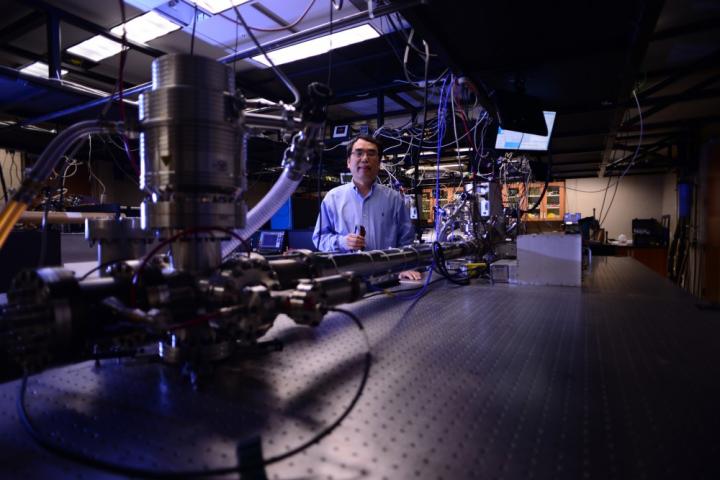
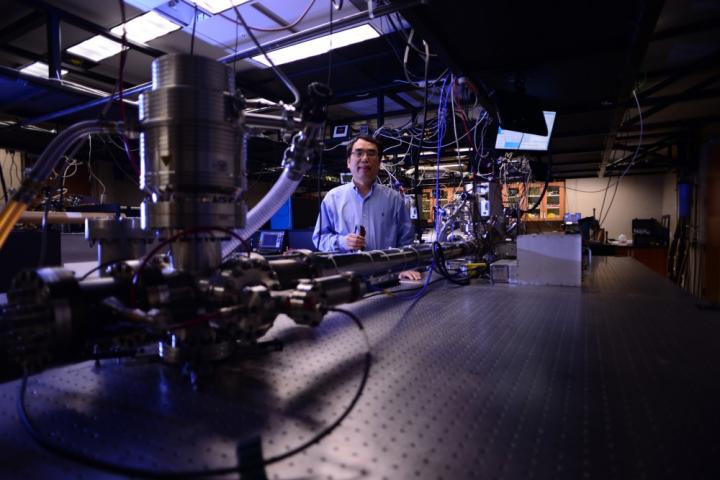
IMAGE

Credit: University of Central Florida

A research team at the University of Central Florida has demonstrated the fastest light pulse ever developed, a 53-attosecond X-ray flash.

The group led by Professor Zenghu Chang beat its own record set in 2012: a 67-attosecond extreme ultraviolet light pulse that was the fastest at the time.

At one-quintillionth of a second, an attosecond is unimaginably fast. In 53 attoseconds, light travels less than one-thousandth of the diameter of a human hair.

In the same way high-speed cameras can record slow-motion video of flying bullets, attosecond light pulses allow scientists to capture images of fast-moving electrons in atoms and molecules with unprecedented sharpness.

As reported Aug. 4 in Nature Communications, the pulses Chang has now demonstrated are not just shorter in duration, but also in wavelength. The new light reaches an important spectral region, the so called "water window," where carbon atoms absorb strongly but water does not.

"Such attosecond soft X-rays could be used to shoot slow-motion video of electrons and atoms of biological molecules in living cells to, for instance, improve the efficiency of solar panels by better understanding how photosynthesis works," said Chang, a UCF Trustee Chair Professor in CREOL, The College of Optics & Photonics, and the Department of Physics. Chang is the director of the Institute for the Frontiers of Attosecond Science and Technology (iFAST), located in the Physics Department, where the experiments were carried out.

X-rays interact with the tightly bound electrons in matter and may reveal which electrons move in which atoms, providing another way to study fast processes in materials with chemical element specificity. That capability is invaluable for the development of next-generation logic and memory chips for mobile phones and computers that are a thousand times faster than those in use today.

Producing attosecond X-rays requires a new type of high power driver: femtosecond lasers with a long wavelength. It's an approach that Chang and his team have pioneered.

###

Chang's team includes Jie Li, Xiaoming Ren, Yanchun Yin, Andrew Chew, Yan Cheng, Eric Cunningham, Yang Wang, Shuyuan Hu and Yi Wu, who are all affiliated with iFAST; Kun Zhao, who is also affiliated with the Chinese Academy of Sciences; and Michael Chini with the UCF Department of Physics.

The research was supported by grants through the DARPA PULSE program, the Army Research Office, and the Air Force Office of Scientific Research, and is based on work supported by the National Science Foundation.

Media Contact

Mark Schlueb
[email protected]
407-823-0221
@UCF

http://www.ucf.edu

Original Source

https://today.ucf.edu/ucf-researchers-set-record-fastest-light-pulse/ http://dx.doi.org/10.1038/s41467-017-00321-0


Share16Tweet8Share2ShareShareShare2

Related Posts

Unraveling Safflower Spininess: EMS and QTL-Seq Insights

Unraveling Safflower Spininess: EMS and QTL-Seq Insights

December 30, 2025
blank

Gender Identity: Breaking Down Stereotypes and Cognition

December 30, 2025

Unlocking Embryonic Secrets: Nematode Chromatin Accessibility Revealed

December 30, 2025

Impact of Wildlife on Livestock Production in Zimbabwe

December 30, 2025
Please login to join discussion

POPULAR NEWS

  • blank

    PTSD, Depression, Anxiety in Childhood Cancer Survivors, Parents

    82 shares
    Share 33 Tweet 21
  • NSF funds machine-learning research at UNO and UNL to study energy requirements of walking in older adults

    71 shares
    Share 28 Tweet 18
  • Exploring Audiology Accessibility in Johannesburg, South Africa

    52 shares
    Share 21 Tweet 13
  • Nurses’ Views on Online Learning: Effects on Performance

    71 shares
    Share 28 Tweet 18

About

We bring you the latest biotechnology news from best research centers and universities around the world. Check our website.

Follow us

Recent News

Dementia Care: Adapting Serious Illness Conversations in Singapore

Global Perspectives on AI Chatbots in Healthcare

Ca2+ Role in Pyroptosis and Kidney Stones

Subscribe to Blog via Email

Enter your email address to subscribe to this blog and receive notifications of new posts by email.

Join 71 other subscribers
  • Contact Us

Bioengineer.org © Copyright 2023 All Rights Reserved.

Welcome Back!

Login to your account below

Forgotten Password?

Retrieve your password

Please enter your username or email address to reset your password.

Log In
No Result
View All Result
  • Homepages
    • Home Page 1
    • Home Page 2
  • News
  • National
  • Business
  • Health
  • Lifestyle
  • Science

Bioengineer.org © Copyright 2023 All Rights Reserved.
