• HOME
  • NEWS
  • EXPLORE
    • CAREER
      • Companies
      • Jobs
    • EVENTS
    • iGEM
      • News
      • Team
    • PHOTOS
    • VIDEO
    • WIKI
  • BLOG
  • COMMUNITY
    • FACEBOOK
    • INSTAGRAM
    • TWITTER
Saturday, February 7, 2026
BIOENGINEER.ORG
No Result
View All Result
  • Login
  • HOME
  • NEWS
  • EXPLORE
    • CAREER
      • Companies
      • Jobs
        • Lecturer
        • PhD Studentship
        • Postdoc
        • Research Assistant
    • EVENTS
    • iGEM
      • News
      • Team
    • PHOTOS
    • VIDEO
    • WIKI
  • BLOG
  • COMMUNITY
    • FACEBOOK
    • INSTAGRAM
    • TWITTER
  • HOME
  • NEWS
  • EXPLORE
    • CAREER
      • Companies
      • Jobs
        • Lecturer
        • PhD Studentship
        • Postdoc
        • Research Assistant
    • EVENTS
    • iGEM
      • News
      • Team
    • PHOTOS
    • VIDEO
    • WIKI
  • BLOG
  • COMMUNITY
    • FACEBOOK
    • INSTAGRAM
    • TWITTER
No Result
View All Result
Bioengineer.org
No Result
View All Result
Home NEWS Science News Biology

Researchers reveal Knl1 gene function in plants

Bioengineer by Bioengineer
May 11, 2021
in Biology
Reading Time: 2 mins read
0
IMAGE
Share on FacebookShare on TwitterShare on LinkedinShare on RedditShare on Telegram

IMAGE

Credit: Dr. HAN Fangpu’s group

Dr. HAN Fangpu’s group from the Institute of Genetics and Developmental Biology of the Chinese Academy of Sciences reports the identification and functional study of the maize Knl1 gene in an article published online in PNAS. The gene is a major component of the KMN network that links centromeric DNA and the plus-ends of spindle microtubules. It also plays an important role in kinetochore protein recruitment.

The kinetochore complex that assembles on the centromeres mediates the proper partitioning of chromosomes to daughter cells during the cell cycle. However, kinetochore proteins undergo frequent mutations and coevolve with their interaction partners, leading to great diversity in kinetochore composition in eukaryotes.

Functional studies of kinetochore composition in plant model organisms are necessary to shed light on the evolutionary role of this intriguing component, and thus improve our collective understanding of the fundamentals of genetics.

The Knl1 is the constitutive component of the central kinetochore protein in plants. The researchers showed it was subcellularly localized and colocalized with other kinetochore components during interphase, mitosis, and meiosis. The functional importance of Knl1 in plants was demonstrated via characterization of the knl1 mutant.

The researchers revealed that Knl1 plays an essential role in chromosomal congregation and segregation during mitosis in maize, and deficiencies in Knl1 are linked to defective kernel development.

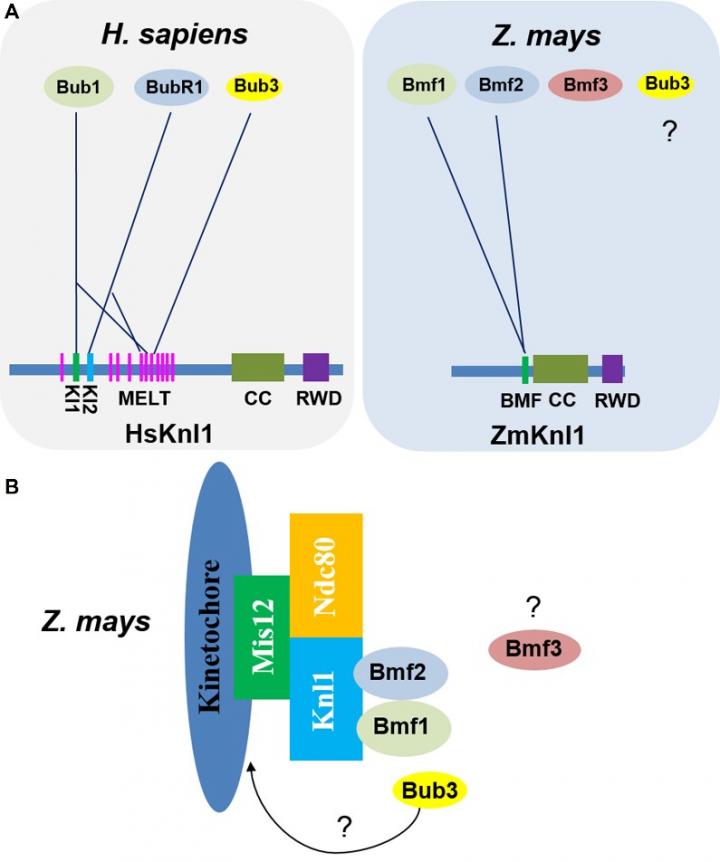
In addition, the researchers shed light on how spindle assembly checkpoint (SAC) proteins interact with kinetochores in plants.

In the present study, the scientists discovered that maize Knl1 interacts with BMF1/2 via a 145-aa region that does not contain well-known MELT repeats described in yeast and mammalian cells. This region displayed high divergence between monocots and eudicots, implying a rapid evolution of kinetochore proteins.

In fact, despite being evolutionarily conserved in function, KNL1 displayed low overall sequence similarity between species. The intricate species-dependent presence/absence of conserved sequence regions led the authors to propose an interaction network model of plant Knl1 with spindle assembly checkpoint signaling.

Understanding the evolutionary and functional importance of these fundamental individual components of the kinetochore complex may in turn improve the efficacy of downstream manipulations, such as the generation of haploid inducer lines for medical applications.

###

Media Contact
HAN Fangpu
[email protected]

Related Journal Article

http://dx.doi.org/10.1073/pnas.2022357118

Tags: BiologyGenesGeneticsPlant Sciences
Share12Tweet8Share2ShareShareShare2

Related Posts

Florida Cane Toad: Complex Spread and Selective Evolution

Florida Cane Toad: Complex Spread and Selective Evolution

February 7, 2026
New Study Uncovers Mechanism Behind Burn Pit Particulate Matter–Induced Lung Inflammation

New Study Uncovers Mechanism Behind Burn Pit Particulate Matter–Induced Lung Inflammation

February 6, 2026

DeepBlastoid: Advancing Automated and Efficient Evaluation of Human Blastoids with Deep Learning

February 6, 2026

Navigating the Gut: The Role of Formic Acid in the Microbiome

February 6, 2026
Please login to join discussion

POPULAR NEWS

  • Robotic Ureteral Reconstruction: A Novel Approach

    Robotic Ureteral Reconstruction: A Novel Approach

    82 shares
    Share 33 Tweet 21
  • Digital Privacy: Health Data Control in Incarceration

    63 shares
    Share 25 Tweet 16
  • Study Reveals Lipid Accumulation in ME/CFS Cells

    57 shares
    Share 23 Tweet 14
  • Breakthrough in RNA Research Accelerates Medical Innovations Timeline

    53 shares
    Share 21 Tweet 13

About

We bring you the latest biotechnology news from best research centers and universities around the world. Check our website.

Follow us

Recent News

Digital Health Perspectives from Baltic Sea Experts

Florida Cane Toad: Complex Spread and Selective Evolution

Exploring Decision-Making in Dementia Caregivers’ Mobility

Subscribe to Blog via Email

Enter your email address to subscribe to this blog and receive notifications of new posts by email.

Join 73 other subscribers
  • Contact Us

Bioengineer.org © Copyright 2023 All Rights Reserved.

Welcome Back!

Login to your account below

Forgotten Password?

Retrieve your password

Please enter your username or email address to reset your password.

Log In
No Result
View All Result
  • Homepages
    • Home Page 1
    • Home Page 2
  • News
  • National
  • Business
  • Health
  • Lifestyle
  • Science

Bioengineer.org © Copyright 2023 All Rights Reserved.