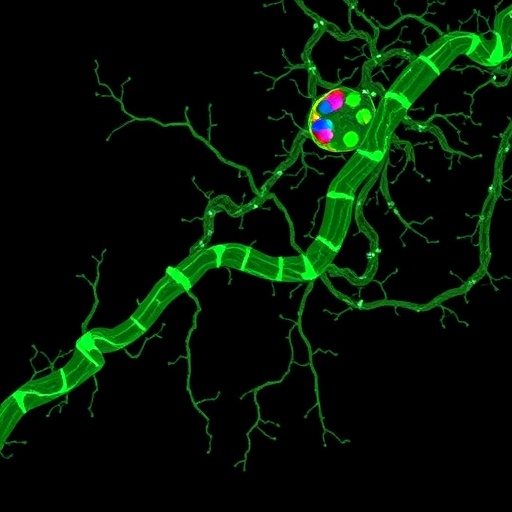
Columbus, Ohio – A new study shows that attaching antibody-like RNA nanoparticles to microvesicles can deliver effective RNA therapeutics such as small interfering RNA (siRNA) specifically to cancer cells. Researchers used RNA nanotechnology to apply the RNA nanoparticles and control their orientation to produce microscopic, therapy-loaded extracellular vesicles that successfully targeted three types of cancer in animal models.
The findings, reported in the journal Nature Nanotechnology, could lead to a new generation of anticancer drugs that use siRNA, microRNA and other RNA-interference technologies.
The study was led by researchers at Ohio State's College of Pharmacy and at the Ohio State University Comprehensive Cancer Center – James Cancer Hospital and Solove Research Institute (OSUCCC – James).
"Therapies that use siRNA and RNA interference technologies are poised to transform cancer therapy," says the principal investigator Peixuan Guo, PhD, Sylvan G. Frank Endowed Chair professor of the College of Pharmacy and a member of the OSUCCC – James Translational Therapeutics Program. "But clinical trials evaluating these agents have failed one after another due to the inability to deliver the agents directly to cancer cells in the human body."
Guo noted that even when agents did reach and enter cancer cells, they were trapped in internal vesicles called endosomes and rendered ineffective.
"Our findings solve two major problems that impede these promising anticancer treatments: targeted delivery of the vesicles to tumor cells and freeing the therapeutic from the endosome traps after it is taken up by cancer cells. In this study, cancers stopped growing after systemic injection of these particles into animal models with tumors derived from human patients." Guo says. "We're working now to translate this technology into clinical applications."
Guo and his colleagues produced extracellular microvesicles (exosomes) that display antibody-like RNA molecules called aptamers that bind with a surface marker that is overexpressed by each of three tumor types:
- To inhibit prostate cancer, vesicles were designed to bind to prostate-specific membrane antigen (PSMA);
- To inhibit breast cancer, vesicles were designed to bind to epidermal growth factor receptor (EGFR);
- To inhibit a colorectal-cancer graft of human origin, vesicles were designed to bind to folate receptors.
All vesicles were loaded with a small interfering RNA for down regulating the survivin gene as a test therapy. The survivin gene inhibits apoptosis and is overexpressed in many cancer types.
Key findings include:
- Vesicles targeting the prostate-specific membrane antigen completely inhibited prostate-cancer growth in an animal model with no observed toxicity.
- Vesicles targeting EGFR inhibited breast-cancer growth in an animal model.
- Vesicles targeting folate receptors significantly suppressed tumor growth of human patient-derived colorectal cancer in an animal model.
"Overall, our study suggests that RNA nanotechnology can be used to program natural extracellular vesicles for delivery of interfering RNAs specifically to cancer cells," Guo says.
###
Funding from the National Institutes of Health/National Cancer Institute (grants TR000875 and CA207946, CA186100, CA197706, CA177558 and CA195573) supported this research.
Other researchers involved in this study were Fengmei Pi, Daniel W. Binzel, Zhefeng Li, Hui Li, Farzin Haque, Shaoying Wang and Carlo M. Croce, The Ohio State University Wexner Medical Center; Meiyan Sun and Bin Guo, University of Houston; Piotr Rychahou and B. Mark Evers, University of Kentucky; and Tae Jin Lee, now at University of Texas.
Media Contact
Amanda Harper
[email protected]
614-685-5420
http://medicalcenter.osu.edu/Pages/index.aspx
https://cancer.osu.edu/news-and-media/news/researchers-invent-novel-rna-nanotech-to-decorate-exosomes-for-effective-cancer-therapy
Related Journal Article
http://dx.doi.org/10.1038/s41565-017-0012-z