• HOME
  • NEWS
  • EXPLORE
    • CAREER
      • Companies
      • Jobs
    • EVENTS
    • iGEM
      • News
      • Team
    • PHOTOS
    • VIDEO
    • WIKI
  • BLOG
  • COMMUNITY
    • FACEBOOK
    • INSTAGRAM
    • TWITTER
Saturday, August 8, 2026
BIOENGINEER.ORG
No Result
View All Result
  • Login
  • HOME
  • NEWS
  • EXPLORE
    • CAREER
      • Companies
      • Jobs
        • Lecturer
        • PhD Studentship
        • Postdoc
        • Research Assistant
    • EVENTS
    • iGEM
      • News
      • Team
    • PHOTOS
    • VIDEO
    • WIKI
  • BLOG
  • COMMUNITY
    • FACEBOOK
    • INSTAGRAM
    • TWITTER
  • HOME
  • NEWS
  • EXPLORE
    • CAREER
      • Companies
      • Jobs
        • Lecturer
        • PhD Studentship
        • Postdoc
        • Research Assistant
    • EVENTS
    • iGEM
      • News
      • Team
    • PHOTOS
    • VIDEO
    • WIKI
  • BLOG
  • COMMUNITY
    • FACEBOOK
    • INSTAGRAM
    • TWITTER
No Result
View All Result
Bioengineer.org
No Result
View All Result
Home NEWS Science News Chemistry

Researchers in Sweden develop light emitters for quantum circuits

Bioengineer by Bioengineer
May 10, 2021
in Chemistry
Reading Time: 2 mins read
0
IMAGE
Share on FacebookShare on TwitterShare on LinkedinShare on RedditShare on Telegram

IMAGE

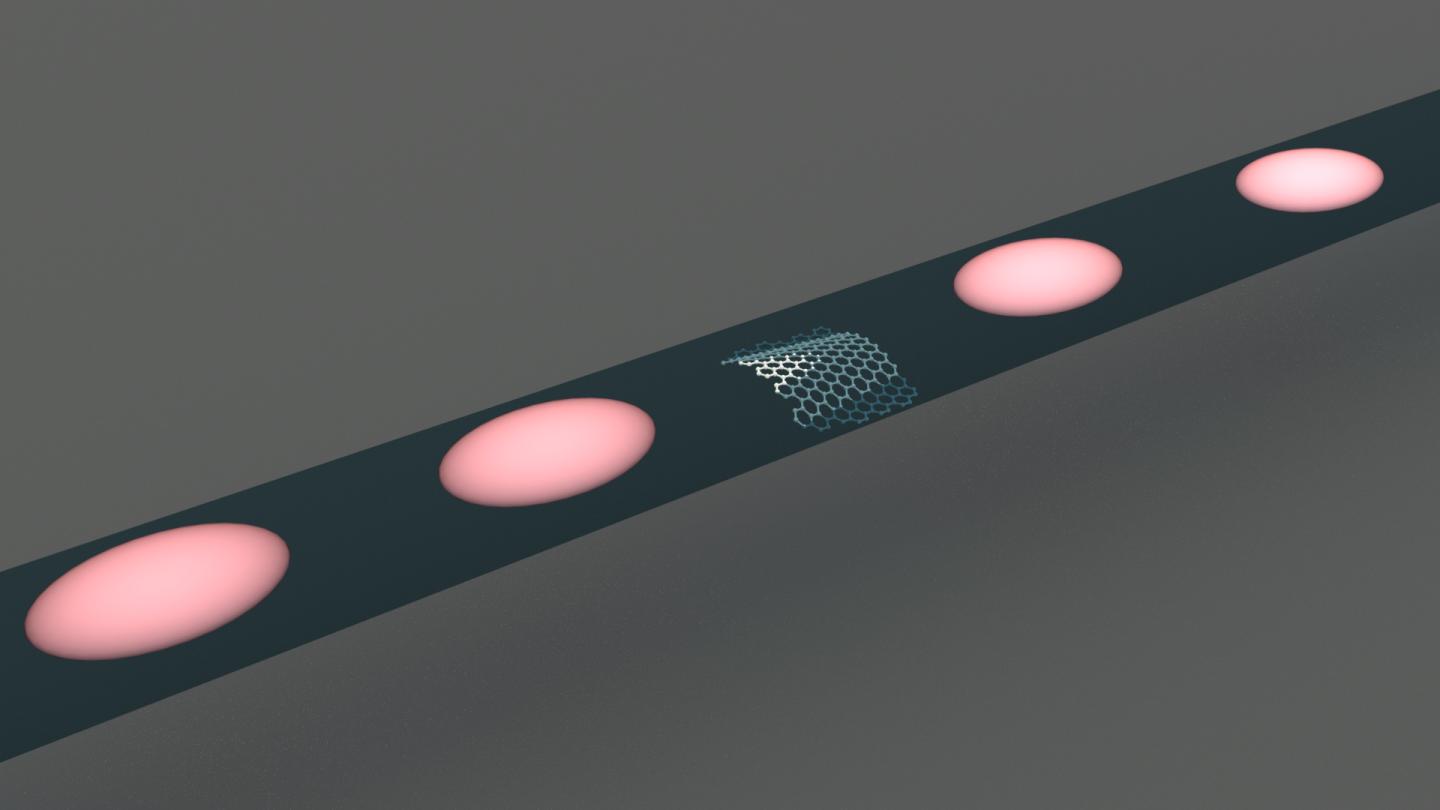
Credit: Ali Elshaair

The promise of a quantum internet depends on the complexities of harnessing light to transmit quantum information over fiber optic networks. A potential step forward was reported today by researchers in Sweden who developed integrated chips that can generate light particles on demand and without the need for extreme refrigeration.

Quantum computing today relies on states of matter, that is, electrons which carry qubits of information to perform multiple calculations simultaneously, in a fraction of the time it takes with classical computing.

The co-author of the research, Val Zwiller, Professor at KTH Royal Institute of Technology, says that in order to integrate quantum computing seamlessly with fiber-optic networks–which are used by the internet today–a more promising approach would be to harness optical photons.

“The photonic approach offers a natural link between communication and computation,” he says. “That’s important, since the end goal is to transmit the processed quantum information using light.”

But in order for photons to deliver qubits on-demand in quantum systems, they need to be emitted in a deterministic, rather than probabilistic, fashion. This can be accomplished at extremely low temperatures in artificial atoms, but today the research group at KTH reported a way to make it work in optical integrated circuits–at room temperature.

The new method enables photon emitters to be precisely positioned in integrated optical circuits that resemble copper wires for electricity, except that they carry light instead, says co-author of the research, Ali Elshaari, Associate Professor at KTH Royal Institute of Technology.

The researchers harnessed the single-photon-emitting properties of hexagonal boron nitride (hBN), a layered material. hBN is a compound commonly used is used ceramics, alloys, resins, plastics and rubbers to give them self-lubricating properties. They integrated the material with silicon nitride waveguides to direct the emitted photons.

Quantum circuits with light are either operated at cryogenic temperatures–plus 4 Kelvin above absolute zero–using atom-like single photon sources, or at room temperature using random single photon sources, Elshaari says. By contrast, the technique developed at KTH enables optical circuits with on-demand emission of light particles at room temperature.

“In existing optical circuits operating at room temperature, you never know when the single photon is generated unless you do a heralding measurement,” Elshaari says. “We realized a deterministic process that precisely positions light-particles emitters operating at room temperature in an integrated photonic circuit.”

The researchers reported coupling of hBN single photon emitter to silicon nitride waveguides, and they developed a method to image the quantum emitters. Then in a hybrid approach, the team built the photonic circuits with respect to the quantum sources locations using a series of steps involving electron beam lithography and etching, while still preserving the high quality nature of the quantum light.

The achievement opens a path to hybrid integration, that is, incorporating atom-like single-photon emitters into photonic platforms that cannot emit light efficiently on demand.

###

Media Contact
David Callahan
[email protected]

Related Journal Article

http://dx.doi.org/10.1002/qute.202100032

Tags: Computer ScienceElectrical Engineering/ElectronicsHardwareInternetOpticsParticle PhysicsResearch/DevelopmentTechnology/Engineering/Computer ScienceTelecommunications
Share12Tweet8Share2ShareShareShare2

Related Posts

Hebrew University Congratulates Haim Sompolinsky on Receiving 2026 Dirac Medal

Hebrew University Congratulates Haim Sompolinsky on Receiving 2026 Dirac Medal

August 8, 2026
New brain model reveals how regional chemistry shapes large-scale neural activity

New brain model reveals how regional chemistry shapes large-scale neural activity

August 8, 2026

Topological coupler breaks bandwidth tradeoff in broadband coupled resonator waveguides

August 8, 2026

Radical Chemistry Selectively Cleaves Strong Bonds While Preserving Weaker Ones

August 7, 2026
Please login to join discussion

POPULAR NEWS

  • Pulmonary Hypertension and Acute Hypoxic Respiratory Failure in Premature Infants

    29 shares
    Share 12 Tweet 7
  • Stochastic Thermodynamics Reveals Social Imitation Beyond Energy Costs

    29 shares
    Share 12 Tweet 7
  • Breastfed Infants’ Bacterial and Metabolic Profiles Shift During Transition to Solid Foods

    29 shares
    Share 12 Tweet 7
  • Multi-population GWAS maps bladder cancer loci and smoking-related genetic risk

    29 shares
    Share 12 Tweet 7

About

We bring you the latest biotechnology news from best research centers and universities around the world. Check our website.

Follow us

Recent News

Pulmonary Hypertension and Acute Hypoxic Respiratory Failure in Premature Infants

Stochastic Thermodynamics Reveals Social Imitation Beyond Energy Costs

Breastfed Infants’ Bacterial and Metabolic Profiles Shift During Transition to Solid Foods

Subscribe to Blog via Email

Enter your email address to subscribe to this blog and receive notifications of new posts by email.

Join 86 other subscribers
  • Contact Us

Bioengineer.org © Copyright 2023 All Rights Reserved.

Welcome Back!

Login to your account below

Forgotten Password?

Retrieve your password

Please enter your username or email address to reset your password.

Log In
No Result
View All Result
  • Homepages
    • Home Page 1
    • Home Page 2
  • News
  • National
  • Business
  • Health
  • Lifestyle
  • Science

Bioengineer.org © Copyright 2023 All Rights Reserved.