Credit: Osaka University
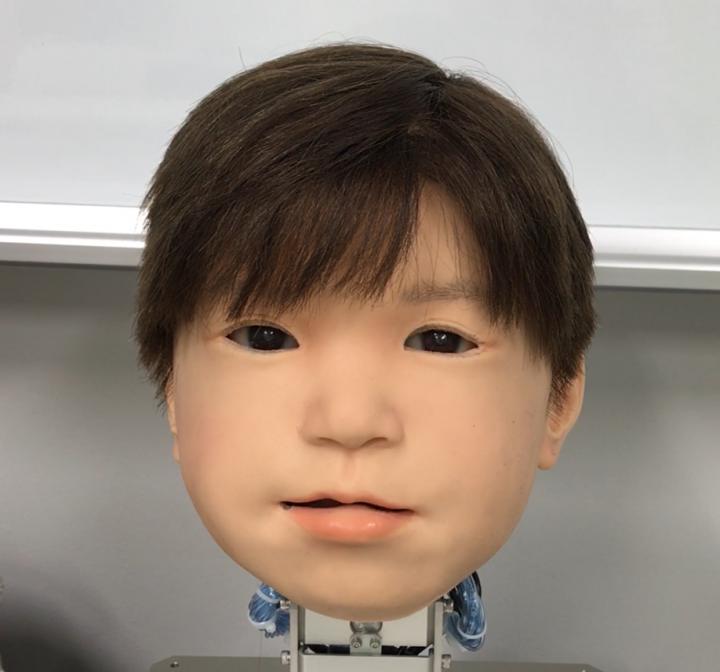
Osaka – Japan's affection for robots is no secret. But is the feeling mutual in the country's amazing androids? We may now be a step closer to giving androids greater facial expressions to communicate with.
While robots have featured in advances in healthcare, industrial, and other settings in Japan, capturing humanistic expression in a robotic face remains an elusive challenge. Although their system properties have been generally addressed, androids' facial expressions have not been examined in detail. This is owing to factors such as the huge range and asymmetry of natural human facial movements, the restrictions of materials used in android skin, and of course the intricate engineering and mathematics driving robots' movements.
A trio of researchers at Osaka University has now found a method for identifying and quantitatively evaluating facial movements on their android robot child head. Named Affetto, the android's first-generation model was reported in a 2011 publication. The researchers have now found a system to make the second-generation Affetto more expressive. Their findings offer a path for androids to express greater ranges of emotion, and ultimately have deeper interaction with humans.
The researchers reported their findings in the journal Frontiers in Robotics and AI.
"Surface deformations are a key issue in controlling android faces," study co-author Minoru Asada explains. "Movements of their soft facial skin create instability, and this is a big hardware problem we grapple with. We sought a better way to measure and control it."
The researchers investigated 116 different facial points on Affetto to measure its three-dimensional movement. Facial points were underpinned by so-called deformation units. Each unit comprises a set of mechanisms that create a distinctive facial contortion, such as lowering or raising of part of a lip or eyelid. Measurements from these were then subjected to a mathematical model to quantify their surface motion patterns.
While the researchers encountered challenges in balancing the applied force and in adjusting the synthetic skin, they were able to employ their system to adjust the deformation units for precise control of Affetto's facial surface motions.
"Android robot faces have persisted in being a black box problem: they have been implemented but have only been judged in vague and general terms," study first author Hisashi Ishihara says. "Our precise findings will let us effectively control android facial movements to introduce more nuanced expressions, such as smiling and frowning."
###
The article, "Identification and Evaluation of the Face System of a Child Android Robot Affetto for Surface Motion Design" was published in Frontiers in Robotics and AI at doi: https://doi.org/10.3389/frobt.2018.00119.
A related movie can be shown at the following links:
Various expressions of a child android Affetto
https://www.youtube.com/watch?time_continue=36&v=EKFc1DEoO6U
Child Android Affetto Head Version 2018
https://www.youtube.com/watch?time_continue=1&v=IxuluHiwGSk
Affetto Eyeblink&Neck motion
https://www.youtube.com/watch?time_continue=20&v=KbEIv9ONajs
About Osaka University
Osaka University was founded in 1931 as one of the seven imperial universities of Japan and now has expanded to one of Japan's leading comprehensive universities.?The University has now embarked on open research revolution from a position as Japan's most innovative university and among the most innovative institutions in the world according to Reuters 2015 Top 100 Innovative Universities and the Nature Index Innovation 2017. The university's ability to innovate from the stage of fundamental research through the creation of useful technology with economic impact stems from its broad disciplinary spectrum.
Website: http://resou.osaka-u.ac.jp/en/top
Media Contact
Saori Obayashi
[email protected]
81-661-055-886
@osaka_univ_e
http://www.osaka-u.ac.jp/en
Original Source
https://resou.osaka-u.ac.jp/en/research/2018/20181114_1 http://dx.doi.org/10.3389/frobt.2018.00119