• HOME
  • NEWS
  • EXPLORE
    • CAREER
      • Companies
      • Jobs
    • EVENTS
    • iGEM
      • News
      • Team
    • PHOTOS
    • VIDEO
    • WIKI
  • BLOG
  • COMMUNITY
    • FACEBOOK
    • INSTAGRAM
    • TWITTER
Wednesday, April 1, 2026
BIOENGINEER.ORG
No Result
View All Result
  • Login
  • HOME
  • NEWS
  • EXPLORE
    • CAREER
      • Companies
      • Jobs
        • Lecturer
        • PhD Studentship
        • Postdoc
        • Research Assistant
    • EVENTS
    • iGEM
      • News
      • Team
    • PHOTOS
    • VIDEO
    • WIKI
  • BLOG
  • COMMUNITY
    • FACEBOOK
    • INSTAGRAM
    • TWITTER
  • HOME
  • NEWS
  • EXPLORE
    • CAREER
      • Companies
      • Jobs
        • Lecturer
        • PhD Studentship
        • Postdoc
        • Research Assistant
    • EVENTS
    • iGEM
      • News
      • Team
    • PHOTOS
    • VIDEO
    • WIKI
  • BLOG
  • COMMUNITY
    • FACEBOOK
    • INSTAGRAM
    • TWITTER
No Result
View All Result
Bioengineer.org
No Result
View All Result
Home NEWS Science News Biology

Researchers gain insight into protein critical to Zika virus…

Bioengineer by Bioengineer
February 8, 2018
in Biology
Reading Time: 3 mins read
0
Share on FacebookShare on TwitterShare on LinkedinShare on RedditShare on Telegram
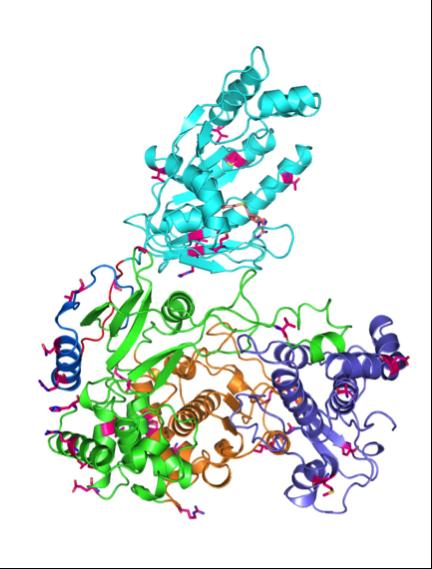
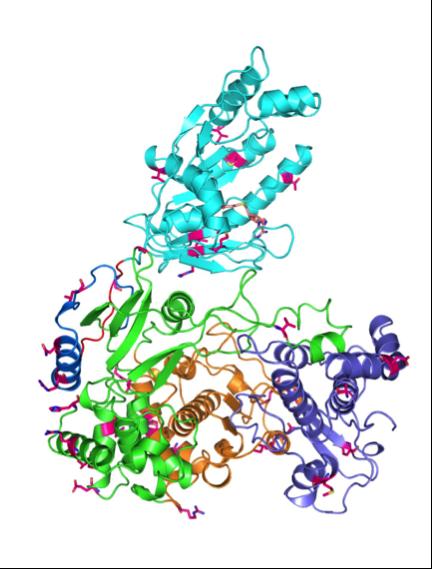
IMAGE

Credit: Cheng Kao, Indiana University

Zika virus is a mosquito-borne infectious disease linked to certain birth defects in infants in South and Central America and the United States. A Lawrence Berkeley National Laboratory (Berkeley Lab) researcher, Banumathi Sankaran, worked as part of a multi-institutional team to map a key viral protein called NS5. Necessary to virus reproduction, NS5 contains two enzyme activities: one reduces the body's ability to mount an immune response against infection and the other helps start the genetic replication process. The work was led by Indiana University's Cheng Kao and Pingwei Li at Texas A&M University (TAMU).

In a study published March 27 in Nature Communications, the team described the structure and function of these two enzyme active sites. They also showed comparisons between this protein and those from other related viruses that cause dengue fever, West Nile virus, Japanese encephalitis virus, and hepatitis C. These comparisons will help researchers as they search for possible compounds to halt the ability of the virus to reproduce.

Working with researchers from TAMU, Sankaran, a research scientist in the Molecular Biophysics and Integrated Bioimaging Division at Berkeley Lab, used X-ray crystallography to solve the atomic structure of NS5 in the Berkeley Center for Structural Biology at the Advanced Light Source (ALS). "The ALS was critical to the success of this project," said Li. "The powerful beam and the sensitive detector on beamline 5.0.2 made it possible for us to obtain data on our poor quality crystals."

Sankaran is in charge of the Collaborative Crystallography (CC) program at the ALS. Funded by the NIH, this program is a fast, reliable and transparent mail-in crystallographic service for the structural biology community. Since the mosquitos carrying the vector have been spreading into the Southern U.S., interest in studying the virus has increased and TAMU's Li indicated that several groups currently are working on similar structural determination efforts. "Having access to state-of-the-art facilities provided by our Collaborative Crystallography program resulted in a rapid turnaround of this project," according to Sankaran.

While the researchers have gathered a lot of information about how to target this protein, there are still puzzles remaining. "One of the most important unresolved questions about Zika NS5 is how it catalyzes the synthesis of RNA," said Li. "We look forward to further studies and future collaborations, which will be invaluable for therapeutics discovery."

###

Funding for this work was provided by the National Institutes of Health and the Howard Hughes Medical Institute. The ALS is a DOE Office of Science User Facility.

Lawrence Berkeley National Laboratory addresses the world's most urgent scientific challenges by advancing sustainable energy, protecting human health, creating new materials, and revealing the origin and fate of the universe. Founded in 1931, Berkeley Lab's scientific expertise has been recognized with 13 Nobel Prizes. The University of California manages Berkeley Lab for the U.S. Department of Energy's Office of Science. For more, visit http://www.lbl.gov.

DOE's Office of Science is the single largest supporter of basic research in the physical sciences in the United States, and is working to address some of the most pressing challenges of our time. For more information, please visit science.energy.gov.

Media Contact

Jon Weiner
[email protected]
510-486-4014
@BerkeleyLab

Home Video
Share12Tweet7Share2ShareShareShare1

Related Posts

New Study Reveals Respiratory Evolution as Key Driver of Body Size Variation in Early Terrestrial Vertebrates

New Study Reveals Respiratory Evolution as Key Driver of Body Size Variation in Early Terrestrial Vertebrates

April 1, 2026
Survey Reveals Many Dog Owners Overlook Subtle Pain Signs Like Nighttime Restlessness and Clinginess

Survey Reveals Many Dog Owners Overlook Subtle Pain Signs Like Nighttime Restlessness and Clinginess

April 1, 2026

Ancient 500-Million-Year-Old Clawed Predator Redefines the Evolution of Spiders and Horseshoe Crabs

April 1, 2026

Chikungunya Virus Lingers in Joint Macrophages, Causes Chronic Disease

April 1, 2026
Please login to join discussion

POPULAR NEWS

  • blank

    Revolutionary AI Model Enhances Precision in Detecting Food Contamination

    96 shares
    Share 38 Tweet 24
  • Imagine a Social Media Feed That Challenges Your Views Instead of Reinforcing Them

    1006 shares
    Share 398 Tweet 249
  • Promising Outcomes from First Clinical Trials of Gene Regulation in Epilepsy

    51 shares
    Share 20 Tweet 13
  • Popular Anti-Aging Compound Linked to Damage in Corpus Callosum, Study Finds

    43 shares
    Share 17 Tweet 11

About

We bring you the latest biotechnology news from best research centers and universities around the world. Check our website.

Follow us

Recent News

Protein Language Model Accuracy Test Sheds Light on AI’s ‘Black Box’

Lehigh University College of Health Launches HEAL Service Center: A Cutting-Edge Shared High-Resolution Mass Spectrometry Facility

Scientists Unveil Innovative Method to Identify Breakthroughs in Science

Subscribe to Blog via Email

Enter your email address to subscribe to this blog and receive notifications of new posts by email.

Join 78 other subscribers
  • Contact Us

Bioengineer.org © Copyright 2023 All Rights Reserved.

Welcome Back!

Login to your account below

Forgotten Password?

Retrieve your password

Please enter your username or email address to reset your password.

Log In
No Result
View All Result
  • Homepages
    • Home Page 1
    • Home Page 2
  • News
  • National
  • Business
  • Health
  • Lifestyle
  • Science

Bioengineer.org © Copyright 2023 All Rights Reserved.