• HOME
  • NEWS
  • EXPLORE
    • CAREER
      • Companies
      • Jobs
    • EVENTS
    • iGEM
      • News
      • Team
    • PHOTOS
    • VIDEO
    • WIKI
  • BLOG
  • COMMUNITY
    • FACEBOOK
    • INSTAGRAM
    • TWITTER
Saturday, February 7, 2026
BIOENGINEER.ORG
No Result
View All Result
  • Login
  • HOME
  • NEWS
  • EXPLORE
    • CAREER
      • Companies
      • Jobs
        • Lecturer
        • PhD Studentship
        • Postdoc
        • Research Assistant
    • EVENTS
    • iGEM
      • News
      • Team
    • PHOTOS
    • VIDEO
    • WIKI
  • BLOG
  • COMMUNITY
    • FACEBOOK
    • INSTAGRAM
    • TWITTER
  • HOME
  • NEWS
  • EXPLORE
    • CAREER
      • Companies
      • Jobs
        • Lecturer
        • PhD Studentship
        • Postdoc
        • Research Assistant
    • EVENTS
    • iGEM
      • News
      • Team
    • PHOTOS
    • VIDEO
    • WIKI
  • BLOG
  • COMMUNITY
    • FACEBOOK
    • INSTAGRAM
    • TWITTER
No Result
View All Result
Bioengineer.org
No Result
View All Result
Home NEWS Science News Biology

Researchers from TU Dresden and CiQUS obtain decacene, the largest acene synthesized ever

Bioengineer by Bioengineer
August 14, 2017
in Biology
Reading Time: 2 mins read
0
Share on FacebookShare on TwitterShare on LinkedinShare on RedditShare on Telegram
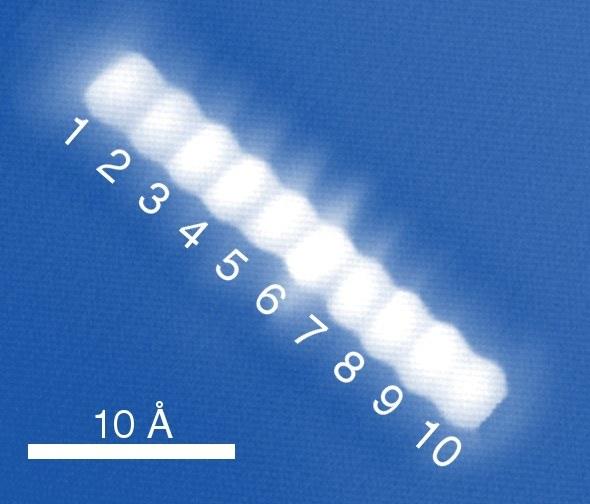
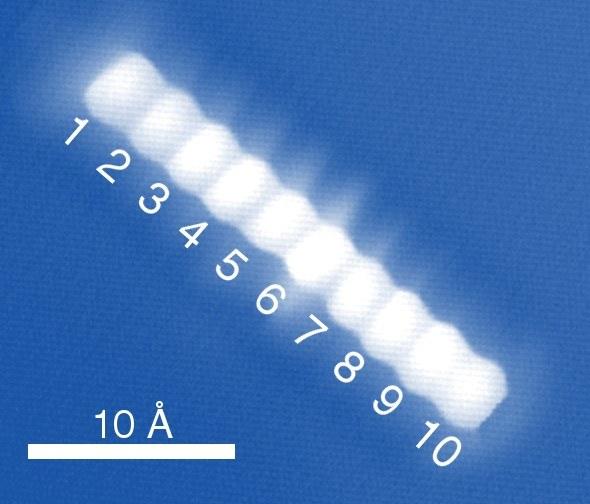
IMAGE

Credit: TU Dresden

Acenes are molecules formed by the linear fusion of special carbon-based hexagons, widely known as 'benzene rings'. In spite of its structural simplicity, these molecules have attracted huge attention due to their unique electronic properties; pentacene, for example, a member of this family with five linear rings, is considered as one of the most relevant organic semiconductor to build photoelectronic devices, while larger acenes present intriguing properties that have fascinated scientists for decades. However, long acenes are unstable molecules, which cannot be found in natural sources. The obvious alternative is to access these molecules by chemical synthesis, but this approach becomes more challenging as the length of the molecule increases. In fact, nonacene (nine rings linearly fused) was the largest acene detected to date in 2010.

In a new paper that has just been published online in the International Edition of Angewandte Chemie, scientists from the Institute for Materials Science and Center for Advancing Electronics at Technische Universität of Dresden – TUD (Chair of Prof. Gianaurelio Cuniberti) and the research center CiQUS (University of Santiago de Compostela) have been able to generate elusive decacene, a molecule formed by the linear fusion of ten benzene rings, the longest acene prepared ever. Throughout this research collaboration, led by professors Francesca Moresco (TUD) and Diego Peña (CiQUS), chemists from CiQUS prepared stable decacene precursors by solution chemistry, while physicists from TUD used these precursors to prepare decacene on a gold surface under ultra-high vacuum, in order to stabilise this extremely reactive compound. As a result, individual decacene molecules were visualised by high-resolution Scanning Tunneling Microscopy (STM).

A feat of collaborative European research

The outcome of this work demonstrates that collaborations between synthetic chemists and surface scientists can lead to the achievement of long-standing chemical challenges, as evidenced by this research. The study has been developed in the framework of the EU Project PAMS, oriented to the fabrication of nanosized electronic devices (Planar Atomic and Molecular Scale devices), and scientists involved have dedicated it to the memory of Prof Erich Clar, who is widely-considered a pioneer in the field of acene chemistry.

###

Media Contact

Francesca Moresco
[email protected]
49-035-146-339-405
@tudresden_de

http://tu-dresden.de/en

Share12Tweet7Share2ShareShareShare1

Related Posts

New Study Uncovers Mechanism Behind Burn Pit Particulate Matter–Induced Lung Inflammation

New Study Uncovers Mechanism Behind Burn Pit Particulate Matter–Induced Lung Inflammation

February 6, 2026

DeepBlastoid: Advancing Automated and Efficient Evaluation of Human Blastoids with Deep Learning

February 6, 2026

Navigating the Gut: The Role of Formic Acid in the Microbiome

February 6, 2026

AI-Enhanced Optical Coherence Photoacoustic Microscopy Revolutionizes 3D Cancer Model Imaging

February 6, 2026
Please login to join discussion

POPULAR NEWS

  • Robotic Ureteral Reconstruction: A Novel Approach

    Robotic Ureteral Reconstruction: A Novel Approach

    82 shares
    Share 33 Tweet 21
  • Digital Privacy: Health Data Control in Incarceration

    63 shares
    Share 25 Tweet 16
  • Study Reveals Lipid Accumulation in ME/CFS Cells

    57 shares
    Share 23 Tweet 14
  • Breakthrough in RNA Research Accelerates Medical Innovations Timeline

    53 shares
    Share 21 Tweet 13

About

We bring you the latest biotechnology news from best research centers and universities around the world. Check our website.

Follow us

Recent News

Oxygen-Enhanced Dual-Section Microneedle Patch Improves Drug Delivery and Boosts Photodynamic and Anti-Inflammatory Treatment for Psoriasis

Scientists Identify SARS-CoV-2 PLpro and RIPK1 Inhibitors Showing Potent Synergistic Antiviral Effects in Mouse COVID-19 Model

Neg-Entropy: The Key Therapeutic Target for Chronic Diseases

Subscribe to Blog via Email

Enter your email address to subscribe to this blog and receive notifications of new posts by email.

Join 73 other subscribers
  • Contact Us

Bioengineer.org © Copyright 2023 All Rights Reserved.

Welcome Back!

Login to your account below

Forgotten Password?

Retrieve your password

Please enter your username or email address to reset your password.

Log In
No Result
View All Result
  • Homepages
    • Home Page 1
    • Home Page 2
  • News
  • National
  • Business
  • Health
  • Lifestyle
  • Science

Bioengineer.org © Copyright 2023 All Rights Reserved.