• HOME
  • NEWS
  • EXPLORE
    • CAREER
      • Companies
      • Jobs
    • EVENTS
    • iGEM
      • News
      • Team
    • PHOTOS
    • VIDEO
    • WIKI
  • BLOG
  • COMMUNITY
    • FACEBOOK
    • INSTAGRAM
    • TWITTER
Saturday, July 11, 2026
BIOENGINEER.ORG
No Result
View All Result
  • Login
  • HOME
  • NEWS
  • EXPLORE
    • CAREER
      • Companies
      • Jobs
        • Lecturer
        • PhD Studentship
        • Postdoc
        • Research Assistant
    • EVENTS
    • iGEM
      • News
      • Team
    • PHOTOS
    • VIDEO
    • WIKI
  • BLOG
  • COMMUNITY
    • FACEBOOK
    • INSTAGRAM
    • TWITTER
  • HOME
  • NEWS
  • EXPLORE
    • CAREER
      • Companies
      • Jobs
        • Lecturer
        • PhD Studentship
        • Postdoc
        • Research Assistant
    • EVENTS
    • iGEM
      • News
      • Team
    • PHOTOS
    • VIDEO
    • WIKI
  • BLOG
  • COMMUNITY
    • FACEBOOK
    • INSTAGRAM
    • TWITTER
No Result
View All Result
Bioengineer.org
No Result
View All Result
Home NEWS Science News Chemistry

Researchers explore the potential of δ-FAPbI3 for X-ray detection and imaging

Bioengineer by Bioengineer
July 25, 2023
in Chemistry
Reading Time: 2 mins read
0
Researchers Explore the Potential of δ-FAPbI3 for X-ray Detection and Imaging
Share on FacebookShare on TwitterShare on LinkedinShare on RedditShare on Telegram

Prof. PAN Xu’s team at the Institute of Solid State Physics, Hefei Institutes of Physical Science (HFIPS), Chinese Academy of Science (CAS), in collaboration with Zheng Xiaojia at the Chinese Academy of Engineering Physics (CAEP), and other researchers, discovered the remarkable potential of one-dimensional (1D) δ-phase formamidinium lead iodide (δ-FAPbI3) as an advanced material for X-ray detection.
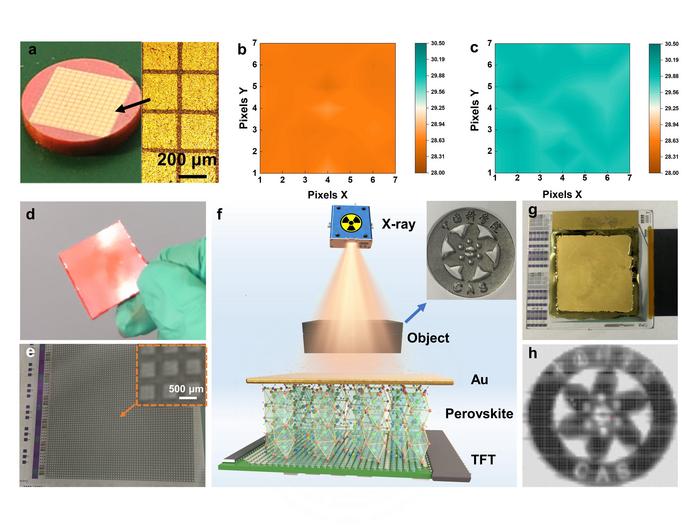
Researchers Explore the Potential of δ-FAPbI3 for X-ray Detection and Imaging

Credit: YE Jiajiu

Prof. PAN Xu’s team at the Institute of Solid State Physics, Hefei Institutes of Physical Science (HFIPS), Chinese Academy of Science (CAS), in collaboration with Zheng Xiaojia at the Chinese Academy of Engineering Physics (CAEP), and other researchers, discovered the remarkable potential of one-dimensional (1D) δ-phase formamidinium lead iodide (δ-FAPbI3) as an advanced material for X-ray detection.

The related results were published in ACS Nano recently.

Perovskite materials with excellent optoelectronic properties have great potential for direct X-ray detection, with multiple orders of magnitude higher sensitivity and lower detection limits than current commercial detector materials, and are expected to dramatically reduce the radiation dose rate in radiographic imaging. However, the preparation of polycrystalline wafers generates a large number of grain boundaries and pores, which leads to severe ion migration and further causes device instability and current drift, severely limiting the imaging resolution of the detectors and future commercial applications.

In this research, researchers focus their attention on the unique characteristics of 1D δ-FAPbI3. This yellow phase compound possessed high ion mobility barriers, low Young’s modulus, and exceptional long-term stability.

“We consider it an ideal candidate for high-performance X-ray detection,” said YE Jiajiu, a postdoctoral researcher, “Especially the dense wafer devices prepared by a cold isostatic pressing process can detect X-rays with high sensitivity and low detection limits.”

In addition, researchers fabricated an X-ray imager with large-size δ-FAPbI3 wafers integrated on a thin-film transistor (TFT) backplane, realizing two-dimensional multi-pixel X-ray imaging and demonstrating the feasibility of the δ-FAPbI3 wafer detector for ultra-stable imaging applications.

Prof. PAN expressed optimism about the future prospects of this technology. “This study provides a new design idea and material selection system for perovskite application in X-ray imaging,” he said.


Journal

ACS Nano

Article Title

Supple Formamidinium-Based Low-Dimension Perovskite Derivative for Sensitive and Ultrastable X-ray Detection

Article Publication Date

5-Jul-2023

Share12Tweet8Share2ShareShareShare2

Related Posts

Blue Light and Chemistry Simplify Complex Drug Production Steps

Blue Light and Chemistry Simplify Complex Drug Production Steps

July 10, 2026
New Discovery Promises Brighter, More Energy-Efficient Digital Displays

New Discovery Promises Brighter, More Energy-Efficient Digital Displays

July 10, 2026

New Crystalline 3D Frameworks Linked by Spiroborates Developed

July 10, 2026

IBEC Joins Major European Grant on Living Matter Physics

July 10, 2026

POPULAR NEWS

  • Detection of EDCs in Breast Milk and Infant Urine Up to Six Months Highlights Early Exposure Risks

    77 shares
    Share 31 Tweet 19
  • New Drug Candidate Developed at McMaster Shows Potential for Treating Brain Cancer

    58 shares
    Share 23 Tweet 15
  • KTU Researchers Explore Ultrasound’s Role in Enhancing Blood Flow Beyond Diagnostics

    53 shares
    Share 21 Tweet 13
  • 高齢者の骨粗鬆症治療の持続性比較

    51 shares
    Share 20 Tweet 13

About

We bring you the latest biotechnology news from best research centers and universities around the world. Check our website.

Follow us

Recent News

Plasma pTau217 and pTau231 Forecast Dementia Progression in Parkinson’s Disease

Urban Navigation Services Increase Traffic Congestion in Cities

Nursing Students Explore Caring for Older Adults in Home Care Settings

Subscribe to Blog via Email

Enter your email address to subscribe to this blog and receive notifications of new posts by email.

Join 85 other subscribers
  • Contact Us

Bioengineer.org © Copyright 2023 All Rights Reserved.

Welcome Back!

Login to your account below

Forgotten Password?

Retrieve your password

Please enter your username or email address to reset your password.

Log In
No Result
View All Result
  • Homepages
    • Home Page 1
    • Home Page 2
  • News
  • National
  • Business
  • Health
  • Lifestyle
  • Science

Bioengineer.org © Copyright 2023 All Rights Reserved.