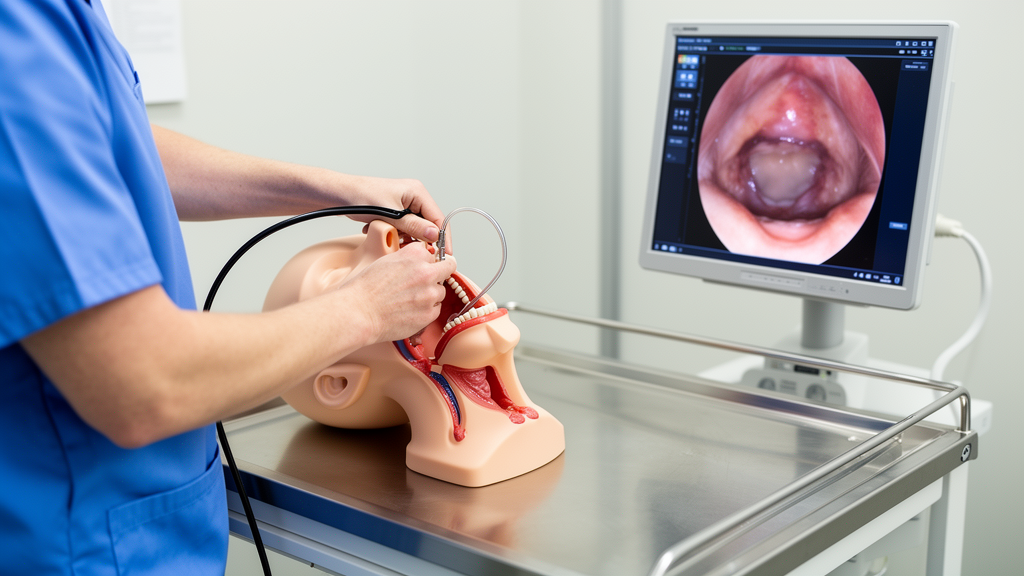
Created as a locally reproducible training solution, the simulator was designed and fabricated with an intended-use-driven engineering strategy to provide a practical alternative to expensive commercial trainers.
Fiberoptic intubation represents a fundamental airway management technique that requires clinicians to master coordinated hand-eye control, precise bronchoscope tip manipulation, and reliable visuospatial orientation. While deliberate practice within simulation environments is widely acknowledged as an effective means of preparing practitioners before performing procedures on patients in clinical settings, accessible training tools remain scarce.
To overcome these barriers, the development team structured the design process using an intended-use-driven approach informed by the classical V-model of simulator engineering. This methodological framework established an explicit and traceable relationship connecting foundational user requirements directly to detailed design specifications, followed systematically by physical component verification, integrated bench testing, and structured pilot user acceptance evaluations.
A central design principle of Intu-box is its deliberate prioritization of functional task alignment over high-fidelity anatomical realism. The device is engineered to train operators in steering the flexible scope tip, maintaining spatial orientation through varying pathways, executing controlled insertion advancement and withdrawal, and refining manual dexterity and visual coordination during fine instrument guidance.
The physical structure of the completed prototype comprises a rectangular training box constructed with transparent acrylic outer walls and fitted with interchangeable interior acrylic navigation plates. These internal plates feature progressively challenging hole configurations that require trainees to steer the flexible bronchoscope through tailored trajectories. Refinements to the internal plate spacing, the geometry of navigation apertures, the overarching fabrication methods, and overall device usability were systematically guided by iterative prototype testing, digital modeling, and formal multidisciplinary expert reviews.
The usability and perceived training value of the prototype were evaluated during a pilot educational workshop conducted with six anesthesia residents. Analysis of the workshop responses revealed favorable participant ratings regarding the perceived procedural resemblance of the simulator to clinical endoscopy, its effectiveness in strengthening hand-eye coordination during instrument handling, and the overall educational utility of the training sessions.
However, the researchers emphasized that the present findings represent early feasibility evidence, noting that the long-term impact of Intu-box practice on clinical skill acquisition and real-world procedural performance remains to be established in future comparative trials.
Subject of Research: Development and pilot evaluation of a low-cost fiberoptic intubation task trainer
Article Title: Development of a low-cost fiberoptic intubation task trainer using an intended-use-driven V-model framework
Article References: Shamim, F., Ahmed, S. S., Khan, A. S., Ali, G., Mehraj, G., Pirani, S. S., Shahid, S., Hasan, S., & Ismail, F. W. (2026). Development of a low-cost fiberoptic intubation task trainer using an intended-use-driven V-model framework. Advances in Simulation. https://doi.org/10.1186/s41077-026-00508-w
Image Credits: AI Generated
DOI: 10.1186/s41077-026-00508-w
Keywords: fiberoptic intubation, task trainer, airway management, simulation training, Intu-box, V-model framework, bronchoscope manipulation, hand-eye coordination, visuospatial orientation, procedural simulation, medical education, low-cost simulator, acrylic navigation plates, anesthesia resident training, user acceptance testing, functional task alignment
News Source: Courtney Benton. (November 12, 2026). Researchers Develop Low-Cost Fiberoptic Intubation Task Trainer for Airway Simulation. Scienmag.