Laser powder bed fusion, a 3D-printing technique, offers potential in the manufacturing industry, particularly when fabricating nickel-titanium shape memory alloys with complex geometries. Although this manufacturing technique is attractive for applications in the biomedical and aerospace fields, it has rarely showcased the superelasticity required for specific applications using nickel-titanium shape memory alloys. Defects generated and changes imposed onto the material during the 3D-printing process prevented the superelasticity from appearing in 3D-printed nickel-titanium.
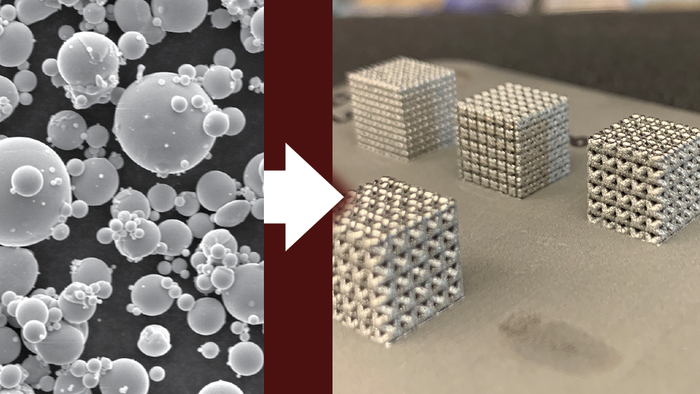
Credit: Texas A&M Engineering
Laser powder bed fusion, a 3D-printing technique, offers potential in the manufacturing industry, particularly when fabricating nickel-titanium shape memory alloys with complex geometries. Although this manufacturing technique is attractive for applications in the biomedical and aerospace fields, it has rarely showcased the superelasticity required for specific applications using nickel-titanium shape memory alloys. Defects generated and changes imposed onto the material during the 3D-printing process prevented the superelasticity from appearing in 3D-printed nickel-titanium.
Researchers from Texas A&M University recently showcased superior tensile superelasticity by fabricating a shape memory alloy through laser powder bed fusion, nearly doubling the maximum superelasticity reported in literature for 3D printing.
This study was recently published in vol. 229 of the Acta Materialia journal.
Nickel-titanium shape memory alloys have various applications due to their ability to return to their original shape upon heating or upon removal of the applied stress. Therefore, they can be used in biomedical and aerospace fields for stents, implants, surgical devices and aircraft wings. However, developing and properly fabricating these materials requires extensive research to characterize functional properties and examine the microstructure.
“Shape memory alloys are smart materials that can remember their high-temperature shapes,” said Dr. Lei Xue, a former doctoral student in the Department of Materials Science and Engineering and the first author of the publication. “Although they can be utilized in many ways, fabricating shape memory alloys into complex shapes requires fine-tuning to ensure the material exhibits the desired properties.”
Laser powder bed fusion is an additive manufacturing technique that presents a way to produce nickel-titanium shape memory alloys effectively and efficiently, offering a pathway to quick manufacturing or prototyping. This technique, similar to polymer 3D printing, uses a laser to fuse metal or alloy powders layer by layer. The layer-by-layer process is beneficial because it can create parts with complex geometries that would be impossible in traditional manufacturing.
“Using a 3D printer, we spread the alloy powder over a substrate and then use the laser to melt the powder, forming one full layer,” said Xue. “We repeat this layering, scanning the same or different patterns until the desired structure is formed.”
Unfortunately, most nickel-titanium materials cannot withstand the current laser powder bed fusion process, often resulting in printing defects such as porosity, warping or delamination caused by large thermal gradient and brittleness from oxidation. In addition, the laser can change the composition of the material due to evaporation during printing.
To combat this issue, the researchers used an optimization framework they created in a previous study, which can determine optimal process parameters to achieve defect-free structure and specific material properties.
With this framework, as well as the change in composition and refined process parameters, the researchers fabricated nickel-titanium parts that consistently exhibited a room temperature tensile superelasticity of 6% in the as-printed condition (without post-fabrication heat treatment). This level of superelasticity is nearly double the amount previously seen in literature for 3D printing.
The ability to produce shape memory alloys through 3D printing with increased superelasticity means the materials are more capable of handling applied deformation. Using 3D printing to develop these superior materials will reduce the cost and time of the manufacturing process.
In the future, the researchers hope their discoveries will lead to increased use of printed nickel-titanium shape memory alloys in biomedical and aerospace applications.
“This study can serve as a guide on how to print nickel-titanium shape memory alloys with desired mechanical and functional characteristics,” said Xue. “If we can tailor the crystallographic texture and microstructure, there are far more applications these shape memory alloys can be used in.”
This research was funded by the U.S. Army Research Laboratory, the National Priorities Research Program grant, the Qatar National Research Fund and the U.S. National Science Foundation grant.
Other contributors to the publication include materials science and engineering department head Dr. Ibrahim Karaman; materials science and engineering professors Dr. Kadri Can Atli and Dr. Raymundo Arroyave; former materials science and engineering student Dr. Abhinav Srivastava and current student Nathan Hite; Wm Michael Barnes ’64 Department of Industrial Systems and Engineering professor Dr. Alaa Elwany; industrial systems and engineering student Chen Zhang; and U.S. Army Research Laboratory researchers Dr. Asher C. Leff, Dr. Adam A. Wilson and Dr. Darin J. Sharar.
Journal
Acta Materialia
DOI
10.1016/j.actamat.2022.117781
Method of Research
News article
Subject of Research
Not applicable
Article Title
Laser powder bed fusion of defect-free NiTi shape memory alloy parts with superior tensile superelasticity
Article Publication Date
1-May-2022