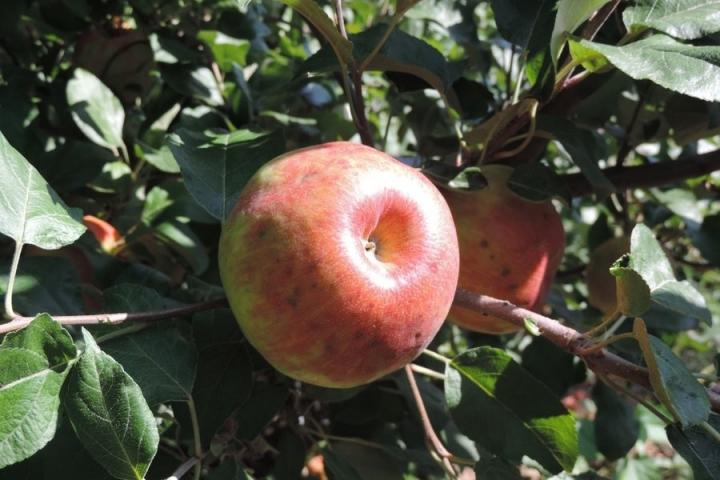
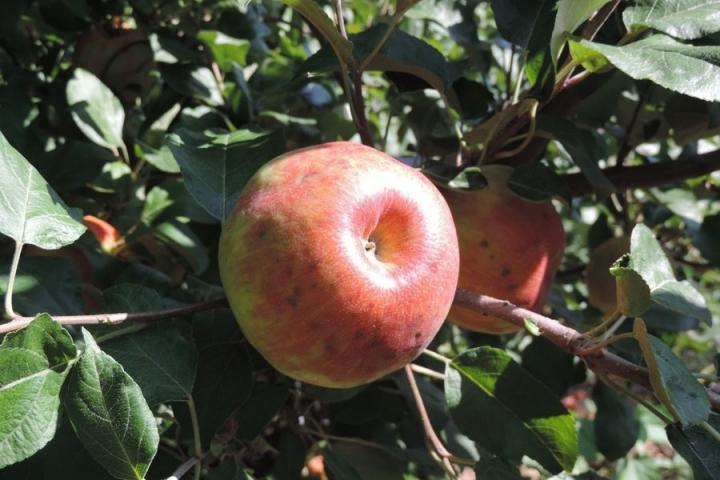
Credit: Penn State Extension
A test to determine whether bitter pit — a disorder that blindsides apple growers by showing up weeks or months after picking — will develop in stored Honeycrisp apples was developed by a team of Penn State researchers, promising to potentially save millions of dollars annually in wasted fruit.
While Honeycrisp is not yet the most popular apple in the U. S., trailing Gala and Fuji in sales, more Honeycrisp trees have been planted in recent years than other varieties, according to researcher Rich Marini, professor of horticulture, College of Agricultural Sciences. That is because consumers prefer Honeycrisps and they typically wholesale for 30 to 40 cents more a pound than other varieties, he said.
Developed in the 1960s and introduced to the market in the 1990s by the University of Minnesota, the flesh of Honeycrisp is crunchier than other apples — and the snap from a bite releases a burst of flavor, Marini pointed out. However, that quality comes at a price because the variety is extremely susceptible to bitter pit, which is induced in the fruit by a calcium deficiency.
The "corky" brown spots under the skin caused by the disorder usually do not develop until long after healthy-appearing fruit is put into storage by growers. In most cases, if they had known their apples would develop bitter pit, the growers would sell them immediately, before the disorder showed up.
"The apple looks good," said Marini. "You put it in cold storage for three or four months and take it out and it still looks good. You put it in room temperature for a few days and bitter pit develops. Only then do you see it."
The team conducted the study over three years in six high-density Honeycrisp blocks. They looked in orchards with varying histories of bitter pit incidence in Adams County, Pennsylvania. The researchers determined that the disorder is associated with low calcium levels in fruit peels.
Researchers also frequently saw the disorder when peels contained high ratios of nitrogen, potassium and/or magnesium to calcium, indicating an imbalance of minerals. The disorder was most frequently seen in fast-growing trees with excessive terminal shoot length.
The findings, published in the current issue of HortScience, described a procedure to assess whether apples will develop bitter pit. Researchers air-dried peels and ground them into a fine powder, which was analyzed for the calcium level. If the calcium level is low, it is a strong indicator bitter pit will develop in storage.
It is important for growers to know which apples can be stored, Marini explained, because the market can only handle so much fruit at harvest time. The growers like to be able to store some and spread out the sales during the year.
"The growers would like to know — what's the probability that their fruit is going to develop bitter pit in storage?" he said. "Depending on the probability of developing bitter pit, they can sell their fruit immediately and avoid the problem. So we are hoping that they can use the information generated by this research to decide which fruit they should sell immediately and which fruit they should put into storage."
In 2016, the final year of the study, researchers noted that nearly three out of four — 74 percent — Honeycrisp apples in the orchards developed bitter pit and were down-graded. In average years in Pennsylvania, about 23 percent of Honeycrisp apples end up with bitter pit. The severity of bitter pit's impact on Honeycrisp production is what convinced research team member Tara Baugher, Penn State Extension tree fruit specialist in Adams County, to initiate the study.
Hot, dry conditions promote the disorder, she explained. In years when the disorder is most common, such as 2016, symptoms of the disorder are apparent even on some apples on trees. Bitter pit management in the orchard is central to prevention of the disorder but is not always effective, according to Baugher. Growers spray trees with calcium nutrient sprays six to eight times during a growing season.
"Sampling fruit three weeks before harvest gives the analytical laboratory time to send fruit analysis reports to growers and packers before harvest, and research showed no differences in nutrient levels between fruit peels sampled at harvest versus three weeks before harvest," she said.
Marini believes the study has huge implications throughout the Northeast. New York and Pennsylvania are among the leading apple-growing states in the country. "We don't know if it's relevant to the West Coast, because their growing conditions are so different," he said. "The study's findings could lead to millions of dollars a year for apple growers in fruit that is not wasted."
###
Also involved in the research were James Schupp, professor of pomology at Penn State's Fruit Research and Extension Center at Biglerville, and Christopher Watkins, professor of horticulture in the School of Integrated Plant Science at Cornell University.
The Pennsylvania Department of Agriculture and the State Horticultural Association of Pennsylvania supported this work.
Media Contact
A'ndrea Elyse Messer
[email protected]
814-865-9481
@penn_state
http://live.psu.edu