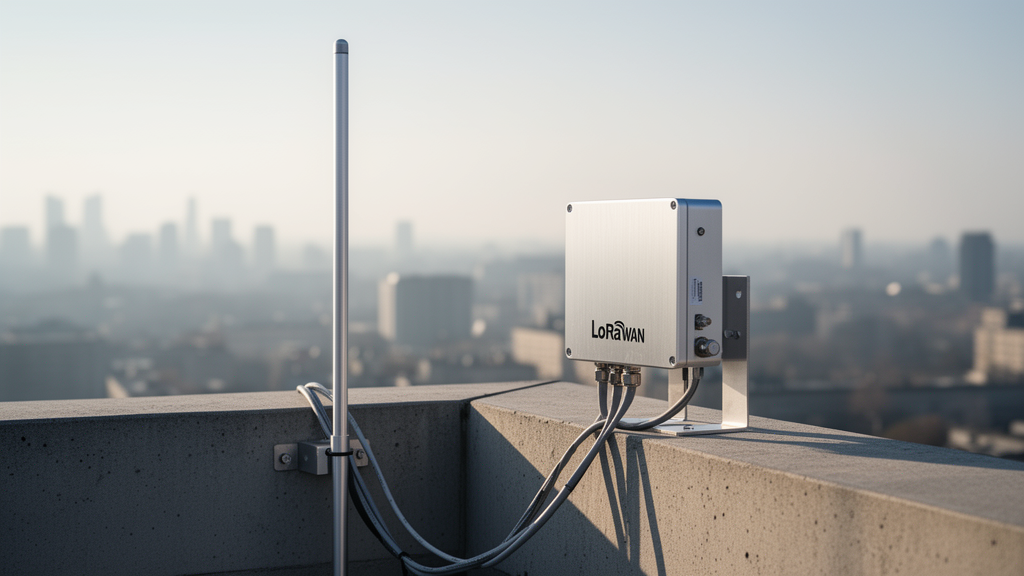
In an experimental trial evaluating low-power wide-area networking hardware under laboratory conditions, researchers deployed a reinforcement learning framework that dynamically tuned both cryptographic key creation and wireless radio transmission settings, demonstrating simultaneous improvements in communications reliability, energy efficiency, and security against unauthorized packet replay. Engineering researchers G. Abinaya, P. Sundaravadivel, S. Vasudevan, and K. Muthulakshmi validated the architecture across twenty consecutive real-time transmission cycles over a controlled fifteen-metre indoor line-of-sight path using a single physical sensor node. According to findings published in Discover Internet of Things, the integrated setup achieved a mean data-recovery rate between 93.7 percent and 96.5 percent across the transmission runs, representing the proportion of transmitted environmental sensor readings that were accurately decrypted and verified at the receiver. Relative to conventional static LoRaWAN baselines, the adaptive system demonstrated a 27.8 percent enhancement in packet delivery ratio while reducing energy consumption by 32.5 percent, all while recording a zero percent replay acceptance rate across all tested adversarial replay scenarios.
Conventional implementations of the Long Range protocol stack, widely known as LoRaWAN, have expanded significantly across industrial automation, municipal infrastructure, and environmental monitoring due to their capability to transmit over extensive distances with sub-milliwatt power draw. However, standard deployments operating under the LoRaWAN 1.0.x specification rely on statically provisioned network session keys and application session keys derived from fixed pre-shared root credentials. These static cryptographic keys remain vulnerable to extraction through physical device theft, brute-force key search over extended lifespans, and packet replay attacks facilitated by poorly synchronized or captured frame counters. At the same time, conventional nodes typically maintain fixed radio physical-layer parameters, including spreading factors ranging from seven to twelve, transmission power levels, and forward error correction coding rates. Because physical wireless channels experience dynamic variations such as multipath fading, environmental attenuation, and background radio-frequency interference, fixed parameters frequently yield inefficient power consumption, elevated packet loss, and degraded service quality that existing heuristic adaptive mechanisms fail to resolve quickly.
To address the historical separation between security enhancements and physical-layer transmission tuning, the researchers formulated an integrated framework driven by deep reinforcement learning. Prior attempts in the literature had frequently focused either on communication throughput alone while ignoring cryptographic burdens, or on cryptographic security while disregarding the severe computational and battery limitations inherent to edge devices. The architecture introduced by the authors deploys a Dueling Deep Q-Network agent tasked with governing both domains simultaneously. Rather than isolating cryptographic defense as an invariant operational layer, the system models the multi-parameter problem as a unified Markov Decision Process. This formulation enables an automated control agent to observe physical wireless channel behavior alongside cryptographic metrics in real time, executing decisions that adjust both key randomness parameters and physical transmission variables before dispatching radio packets over unlicensed industrial, scientific, and medical frequency bands.
A foundational element of the proposed architecture is an entropy-harvesting pipeline that establishes dynamic symmetric keys without relying on static pre-shared key registries. Standard LoRaWAN deployments often face severe security compromises if root keys leak from centralized servers or physical hardware storage. To counter this vulnerability, the experimental platform extracts true physical entropy directly from the node microcontroller hardware across three distinct physical mechanisms during execution. The system captures analog-to-digital converter thermal noise generated during quiescent sampling intervals, collects timing fluctuations resulting from oscillator clock-cycle jitter, and integrates pseudorandom bit sequences produced by an embedded hardware random number generator. These raw entropy inputs are normalized, merged with a monotonically advancing device timestamp, and shaped by reinforcement-learning-guided entropy scaling coefficients into a structured two-by-three parameter matrix. Empirical measurements confirmed that this dynamic key derivation process yielded an entropy level exceeding 7.95 bits per byte of key material, compared to an average of 3.42 bits per byte observed under conventional static generation.
Before sensor data undergoes authenticated cryptographic encapsulation, the pipeline applies an eigenvector-based diffusion transformation directly to the structured measurement payload. Environmental monitoring readings acquired from edge instruments—including operational flags, temperature figures, and relative humidity percentages—are formatted into a compact two-by-two numerical data matrix designed for efficient linear algebraic manipulation on embedded hardware. The system calculates the eigenvalues and corresponding eigenvectors of the dynamically established session key matrix, creating a transformation matrix that multiplies the original measurement array. This diffusion step maximizes mathematical dependency among data elements and disperses statistical correlations before the data reaches the cryptographic core. Following this diffusion stage, the randomized payload is processed using Advanced Encryption Standard in Galois/Counter Mode with associated data, providing verifiable mathematical guarantees of confidentiality, data integrity, and origin authenticity while appending an explicit nonce derived from timestamp and counter metadata.
The reinforcement learning decision model operates within a discrete action space of cardinality eighty-one, allowing the learning algorithm to calibrate multiple operational parameters simultaneously during continuous network operation. At each execution step, the Dueling Deep Q-Network agent evaluates state vectors comprising the current spreading factor, transmission power, coding rate, received signal strength indicators, signal-to-noise ratios, past latency, past energy consumption, and instantaneous key entropy. The agent can apply incremental adjustments to the spreading factor, alter transmission power in steps of two decibels relative to one milliwatt, adjust coding rates, and scale entropy coefficients. Policy optimization is driven by a multi-objective reward function that balances packet delivery ratio, transmission latency, energy expenditure, and key entropy using empirically tuned weighting coefficients of 0.40, 0.25, 0.20, and 0.15, respectively, alongside explicit penalties levied whenever packet drops, authentication errors, or sub-threshold entropy events occur.
Physical evaluation of the system was carried out using a specialized laboratory hardware testbed integrating commodity embedded computing components. At the sensing edge, the assembly utilized an MQ-series semiconductor gas sensor node operating across an analog measurement range of 200 to 10,000 parts per million, coupled to an STM32L4 Discovery Kit development board equipped with an onboard ten-bit analog-to-digital converter. The microprocessing unit conducted initial sensor digitization, matrix restructuring, and diffusion transformations before transferring payloads over a Serial Peripheral Interface to an SX1276-based LoRa transceiver. Transmission occurred at an operating carrier frequency of 868 megahertz through a 2.15 dBi half-wave dipole directional antenna. Computational management, neural network training, inference execution, and AES-GCM encryption were hosted on a proximal Raspberry Pi 4 edge computing unit featuring eight gigabytes of random-access memory, running Python 3.10 and TensorFlow 2.15.
During experimental training over five hundred episodes, the Dueling Deep Q-Network architecture demonstrated rapid learning between episodes one and one hundred fifty before stabilizing near episode 350, showing an 18 percent faster convergence rate and a 12 percent higher asymptotic value than conventional Q-learning implementations. On the physical Raspberry Pi 4 edge host, the lightweight decision table maintained modest computational requirements, registering a mean central processing unit utilization of 22 percent and consuming less than 120 megabytes of memory. Furthermore, dynamic transmission power adjustments compensated for path loss, leading directly to the observed 32.5 percent drop in overall energy demand.
To evaluate defensive capabilities against hostile wireless interception, the researchers analyzed the architecture under the formal Dolev-Yao threat model, assuming a computationally bounded adversary capable of eavesdropping, injecting crafted packets, altering metadata, and replaying recorded traffic over the wireless medium. Security analysis established proof sketches demonstrating indistinguishability under adaptive chosen-plaintext attack, ciphertext integrity, and deterministic replay resistance conditioned on core operational assumptions regarding entropy diversity and invertible matrix diffusion. The study emphasized that brute-force resistance is fundamentally established by the standard 128-bit key space of AES-GCM—requiring an estimated 5.4 times ten to the eighteenth years under exhaustive offline testing at one trillion guesses per second—whereas the observed 7.95 bits per byte entropy metric specifically validates session unpredictability and the elimination of key reuse across transmission cycles.
The study authors documented several technical boundaries governing their findings, noting that hardware validation was restricted to a single prototype node evaluated over twenty transmission cycles across a fifteen-metre indoor line-of-sight baseline. Communication behaviors depicted beyond this experimental boundary, such as multi-kilometer coverage modeling up to ten kilometers, represent analytical projections derived from free-space path-loss equations rather than empirical field measurements. Consequently, the authors highlighted that the restricted sample size precluded formal statistical hypothesis testing across diverse environmental configurations. Future research initiatives outlined by the authors include performing multi-node outdoor campaigns across complex urban and industrial environments up to five kilometers, implementing cooperative multi-agent reinforcement learning, evaluating post-quantum key encapsulation mechanisms such as CRYSTALS-Kyber, subjecting physical entropy sources to standardized randomness test suites, and constructing full reduction-based cryptographic proofs.
Subject of Research: Deep reinforcement learning for adaptive authenticated encryption and dynamic LoRaWAN transmission control
Article Title: Deep reinforcement learning-optimized adaptive authenticated encryption and dynamic transmission control for secure LoRaWAN IoT communication
Article References: Abinaya, G., Sundaravadivel, P., Vasudevan, S., & Muthulakshmi, K. (2026). Deep reinforcement learning-optimized adaptive authenticated encryption and dynamic transmission control for secure LoRaWAN IoT communication. Discover Internet of Things, 6(1), Article 170. https://doi.org/10.1007/s43926-026-00515-3
Image Credits: AI Generated
DOI: 10.1007/s43926-026-00515-3
Keywords: LoRaWAN, Deep Reinforcement Learning, Dueling Deep Q-Network, Authenticated Encryption, AES-GCM, Hardware Entropy, Internet of Things, Eigenvector Diffusion, Transmission Power Control, Spreading Factor, SX1276 Transceiver, Raspberry Pi 4, Packet Delivery Ratio, Energy Optimization, Replay Attack Resistance, Markov Decision Process
News Source: Denise Maddox. (November 13, 2026). Reinforcement Learning Prototype Bolsters LoRaWAN Data Delivery and Transmission Efficiency. Scienmag.